From Pilot Projects to Institutional Systems Toward Strategic Readiness for Artificial Intelligence in Evaluation within Developing and Conflict-Affected Contexts
Mesa redonda | En línea
-
Organizado por:
National School of Public Administration -ENAP Québec, Canada
Sobre el evento
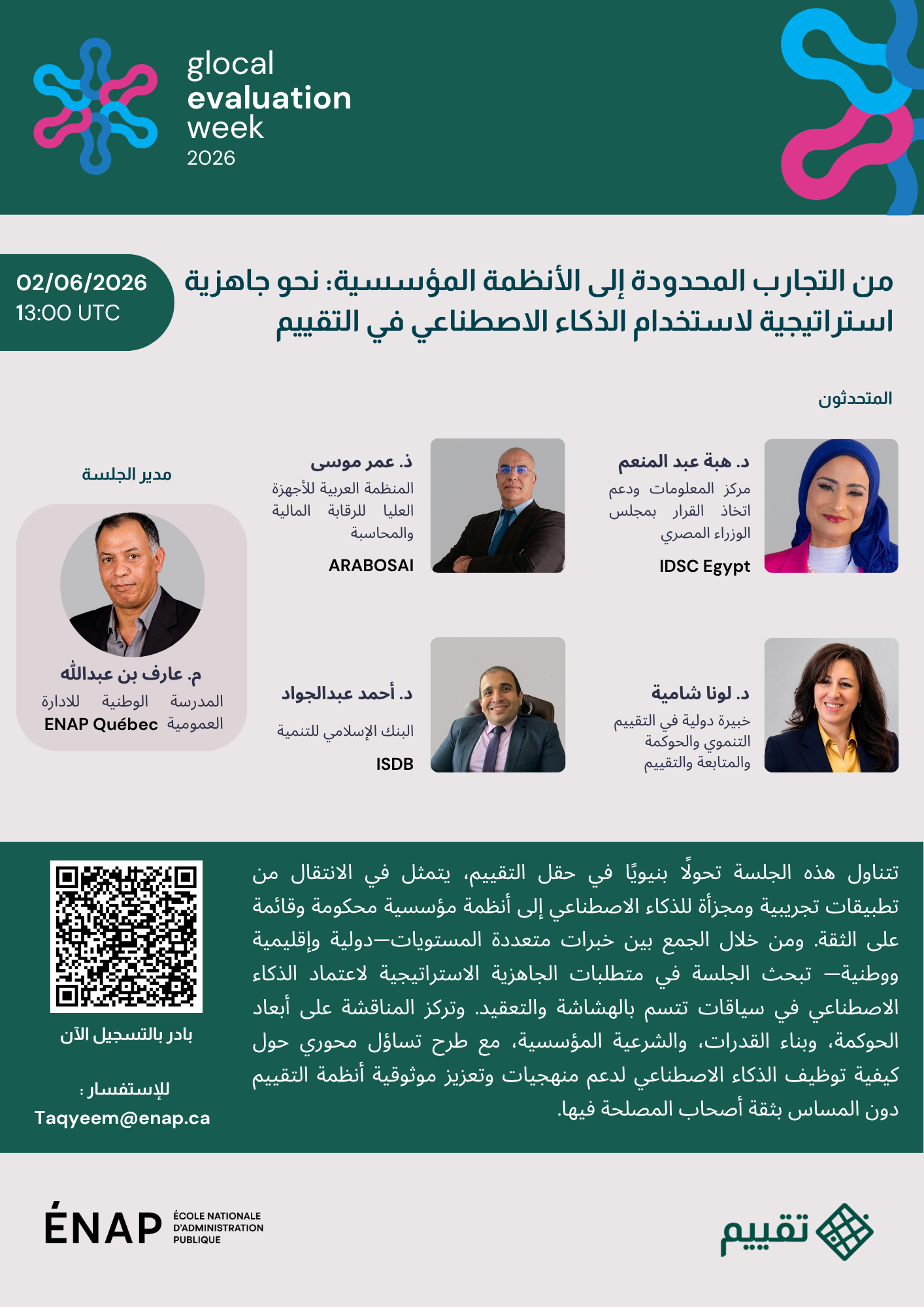
"This panel will be held in Arabic, with interpretation available in English, French, and Spanish."
"من التجارب المحدودة إلى الأنظمة المؤسسية: نحو جاهزية استراتيجية لاستخدام الذكاء الاصطناعي في التقييم"
As Artificial Intelligence (AI) expands in evaluation practice, the main challenge has shifted from technical feasibility to institutional and strategic governance. In developing and conflict-affected contexts—where evaluation intersects with public accountability, resource allocation, and political dynamics—introducing AI without clear governance frameworks may distort knowledge production, weaken trust, and reshape evidence systems in unequal ways.
This session approaches AI in evaluation as an issue of knowledge and institutional governance rather than a purely technical challenge. It brings together perspectives from government institutions, international donors, and regional and national audit bodies, alongside comparative international experience, to explore responsible pathways for AI integration in evaluation systems.
The discussion is structured around four dimensions:
(1) positioning AI within multilateral development evaluation frameworks,
(2) implications for oversight, standards, and accountability,
(3) integration into national policy and decision-support systems,
(4) lessons from international experiences in AI governance for evaluation.
The session addresses two central questions: what are the benefits and risks of AI in this field, and what institutional and regulatory conditions ensure that AI strengthens rather than undermines the credibility of evaluation systems? It emphasizes governance frameworks, capacity building, ethical safeguards, and the transition from pilot initiatives to institutional integration, aiming to develop practical principles for transparent, accountable, and context-sensitive AI-enabled evaluation systems.
Trust is placed at the center of analysis as an outcome of institutional design rather than a technological by-product, with particular attention to how AI reshapes credibility and legitimacy in fragile and conflict-affected contexts.
-------------
مع التوسع المتسارع في إدماج الذكاء الاصطناعي ضمن ممارسات التقييم، لم يعد التحدي الرئيسي تقنياً بقدر ما أصبح مؤسسياً واستراتيجياً. ففي السياقات النامية أو المتأثرة بالنزاعات، حيث تتداخل أنظمة التقييم مع اعتبارات المساءلة العامة وتخصيص الموارد والتوازنات السياسية، فإن إدخال الذكاء الاصطناعي دون أطر حوكمة واضحة قد يؤدي إلى إعادة تشكيل غير متكافئة لمصادر المعرفة، وتقويض الثقة، وتشويه مسارات إنتاج الأدلة.
تنطلق هذه الجلسة من افتراض أن الذكاء الاصطناعي في التقييم يمثل قضية حوكمة معرفية ومؤسسية وليس مجرد تحدٍ تقني. وتجمع بين وجهات نظر من مؤسسات حكومية وداعمين دوليين وهيئات رقابية إقليمية ووطنية، إلى جانب تحليل مقارن للخبرات الدولية، لاستكشاف سبل الإدماج المسؤول للذكاء الاصطناعي في أنظمة التقييم.
وتتمحور المناقشة حول أربعة أبعاد:
(1) تموضع الذكاء الاصطناعي ضمن أطر تقييم التنمية متعددة الأطراف،
(2) انعكاساته على الرقابة والمعايير والمساءلة،
(3) إدماجه في السياسات الوطنية ونظم دعم القرار،
(4) الدروس المستفادة من التجارب الدولية في حوكمة الذكاء الاصطناعي في التقييم.
وتسعى الجلسة إلى الإجابة عن سؤالين رئيسيين: ما هي مزايا الذكاء الاصطناعي ومخاطره؟ وما الشروط المؤسسية والتنظيمية التي تضمن تعزيز مصداقية أنظمة التقييم بدلًا من إضعافها؟ كما تركز على الحوكمة وبناء القدرات والضمانات الأخلاقية والانتقال من المبادرات التجريبية إلى التكامل المؤسسي، بهدف بلورة مبادئ عملية لتقييم قائم على الذكاء الاصطناعي يتسم بالشفافية والمساءلة والحساسية للسياق.
وتضع الجلسة الثقة في صميم النقاش باعتبارها نتاجاً للتصميم المؤسسي، وليس مجرد أثر للتكنولوجيا، مع تحليل دور الذكاء الاصطناعي في إعادة تشكيل المصداقية والشرعية في أنظمة التقييم.
"من التجارب المحدودة إلى الأنظمة المؤسسية: نحو جاهزية استراتيجية لاستخدام الذكاء الاصطناعي في التقييم"
As Artificial Intelligence (AI) expands in evaluation practice, the main challenge has shifted from technical feasibility to institutional and strategic governance. In developing and conflict-affected contexts—where evaluation intersects with public accountability, resource allocation, and political dynamics—introducing AI without clear governance frameworks may distort knowledge production, weaken trust, and reshape evidence systems in unequal ways.
This session approaches AI in evaluation as an issue of knowledge and institutional governance rather than a purely technical challenge. It brings together perspectives from government institutions, international donors, and regional and national audit bodies, alongside comparative international experience, to explore responsible pathways for AI integration in evaluation systems.
The discussion is structured around four dimensions:
(1) positioning AI within multilateral development evaluation frameworks,
(2) implications for oversight, standards, and accountability,
(3) integration into national policy and decision-support systems,
(4) lessons from international experiences in AI governance for evaluation.
The session addresses two central questions: what are the benefits and risks of AI in this field, and what institutional and regulatory conditions ensure that AI strengthens rather than undermines the credibility of evaluation systems? It emphasizes governance frameworks, capacity building, ethical safeguards, and the transition from pilot initiatives to institutional integration, aiming to develop practical principles for transparent, accountable, and context-sensitive AI-enabled evaluation systems.
Trust is placed at the center of analysis as an outcome of institutional design rather than a technological by-product, with particular attention to how AI reshapes credibility and legitimacy in fragile and conflict-affected contexts.
-------------
مع التوسع المتسارع في إدماج الذكاء الاصطناعي ضمن ممارسات التقييم، لم يعد التحدي الرئيسي تقنياً بقدر ما أصبح مؤسسياً واستراتيجياً. ففي السياقات النامية أو المتأثرة بالنزاعات، حيث تتداخل أنظمة التقييم مع اعتبارات المساءلة العامة وتخصيص الموارد والتوازنات السياسية، فإن إدخال الذكاء الاصطناعي دون أطر حوكمة واضحة قد يؤدي إلى إعادة تشكيل غير متكافئة لمصادر المعرفة، وتقويض الثقة، وتشويه مسارات إنتاج الأدلة.
تنطلق هذه الجلسة من افتراض أن الذكاء الاصطناعي في التقييم يمثل قضية حوكمة معرفية ومؤسسية وليس مجرد تحدٍ تقني. وتجمع بين وجهات نظر من مؤسسات حكومية وداعمين دوليين وهيئات رقابية إقليمية ووطنية، إلى جانب تحليل مقارن للخبرات الدولية، لاستكشاف سبل الإدماج المسؤول للذكاء الاصطناعي في أنظمة التقييم.
وتتمحور المناقشة حول أربعة أبعاد:
(1) تموضع الذكاء الاصطناعي ضمن أطر تقييم التنمية متعددة الأطراف،
(2) انعكاساته على الرقابة والمعايير والمساءلة،
(3) إدماجه في السياسات الوطنية ونظم دعم القرار،
(4) الدروس المستفادة من التجارب الدولية في حوكمة الذكاء الاصطناعي في التقييم.
وتسعى الجلسة إلى الإجابة عن سؤالين رئيسيين: ما هي مزايا الذكاء الاصطناعي ومخاطره؟ وما الشروط المؤسسية والتنظيمية التي تضمن تعزيز مصداقية أنظمة التقييم بدلًا من إضعافها؟ كما تركز على الحوكمة وبناء القدرات والضمانات الأخلاقية والانتقال من المبادرات التجريبية إلى التكامل المؤسسي، بهدف بلورة مبادئ عملية لتقييم قائم على الذكاء الاصطناعي يتسم بالشفافية والمساءلة والحساسية للسياق.
وتضع الجلسة الثقة في صميم النقاش باعتبارها نتاجاً للتصميم المؤسسي، وليس مجرد أثر للتكنولوجيا، مع تحليل دور الذكاء الاصطناعي في إعادة تشكيل المصداقية والشرعية في أنظمة التقييم.
Presentador/a
| Nombre | Título | Biografía |
|---|---|---|
| Aref Ben Abdallah | Senior International Expert International Affairs Advisor at ENAP | TAQYEEM Program Coordinator | Co-Chair of EvalSDGs | Board Member of SQEP | An international expert and consultant in development and international cooperation, with extensive experience in monitoring and evaluation gained through work with prominent international and national organizations. He has contributed to the design of monitoring and evaluation systems for public and sectoral policies and development programs in areas such as agriculture, finance, infrastructure, poverty reduction, and sustainable development across Africa, Asia, and Latin America. He has also led numerous capacity development and institutional strengthening programs in the fields of strategic planning, results-based management and budgeting, and the management of public development projects. In addition, he has trained more than 1,500 professionals and contributed to enhancing the effectiveness and performance of institutions, including Supreme Audit Institutions and central government bodies. He currently serves as International Affairs Advisor at ENAP, where he oversees several projects and directs the International Program for Development Evaluation Training “Taqyeem”, delivered in Arabic for professionals across the Arab region. |
| Luna Shamieh | International expert in development evaluation, governance, and monitoring and evaluation | She has over 22 years of experience across the Middle East and North Africa region. She works as a consultant with the OECD on the governance of monitoring and evaluation systems for development programs and projects. She has advanced expertise in designing evaluation methodologies, developing theories of change, establishing impact measurement frameworks, and assessing the social impact of investments. She has contributed to the evaluation of numerous national programs in Saudi Arabia and across the MENA region. She has worked as a consultant and evaluation expert with international organizations and governments, leading the development of governance systems, sectoral planning, and capacity-building initiatives in Egypt, Yemen, and Saudi Arabia. She also has extensive experience in executive training, institutional evaluation, and impact measurement. In addition, she has expertise in Early Childhood Development (ECD), child protection, and social cohesion and peacebuilding programs in fragile and conflict-affected contexts. |
| Heba Abdel Monem | Head of the Central Department of Monitoring and Evaluation of the National Strategies | Head of the Scientific Advisory Committee - Information and Decision Support Center- The Egyptian Cabinet of Ministers | Dr. Heba is an economist with more than 31 years of experience in economic research, macroeconomic and sectoral policymaking, and the digital economy. She previously served as Head of the Studies and Statistics Division at the Arab Monetary Fund for 11 years and held several positions within the Egyptian Cabinet before joining the Fund. She holds a PhD in Macroeconomics and a Master’s degree in International Economics. Dr. Heba has published more than 85 research papers, and several of her studies have ranked among the most downloaded worldwide in the fields of economic forecasting and financial stability. She is currently ranked among the top 3.6% of researchers on the Social Science Research Network (SSRN). She has represented Arab countries at several international summits and meetings, including the G20 meetings (2020), the Basel Committee on Banking Supervision, and the High-Level Regional Dialogue on the Accession of Arab Countries to the World Trade Organization. She has also contributed to the development of several national policies and strategies and led a large-scale research initiative to develop scenarios for addressing global economic risks affecting the Egyptian economy. The initiative involved hundreds of national and international experts and resulted in hundreds of policy recommendations supporting decision-making in Egypt. |
| Ahmed Abdelgawad | Senior Evaluation Specialist | Project & Program Evaluation | Independent Evaluations - Islamic Development Bank (IsDB) | Dr. Abdelgawad is a seasoned international development expert with more than 17 years of experience in monitoring and evaluation, strategic management, and development effectiveness. He holds a Bachelor’s degree in Medicine, as well as two Master’s degrees: one in Public Policy and another in Immunology and Medical Statistics. He also earned a Leadership Development Certificate from Harvard University and an International Evaluation Diploma from Carleton University. Dr. Abdelgawad currently serves in the Evaluation Department at the Islamic Development Bank (IsDB), where he has spent the past six years leading results-based evaluation efforts and promoting development effectiveness. Prior to joining IsDB, he held influential roles with organizations such as UNICEF, USAID, and Save the Children. Throughout his career, he has led and contributed to evaluation and development initiatives in more than thirty countries, combining technical rigor with strategic vision to address complex global development challenges. |
| Omar Moussa | Assigned Officer to the Secretary General of the Arab Organization of Supreme Audit Institutions (ARABOSAI), and Judge Counsellor and Head of Department at the Tunisian Court of Accounts | Mr. Omar currently serves as Rapporteur of the ARABOSAI Working Group on Information Technology Audit. He has more than 22 years of professional experience in the legal and judicial fields, including over 18 years of specialized expertise in audit, oversight, and information technology. Throughout his career, he has contributed to the development of audit methodologies, the strengthening of information systems governance, and risk assessment frameworks. He has also participated in several regional initiatives aimed at promoting knowledge exchange and the adoption of international best practices in auditing and oversight. |
Resumen
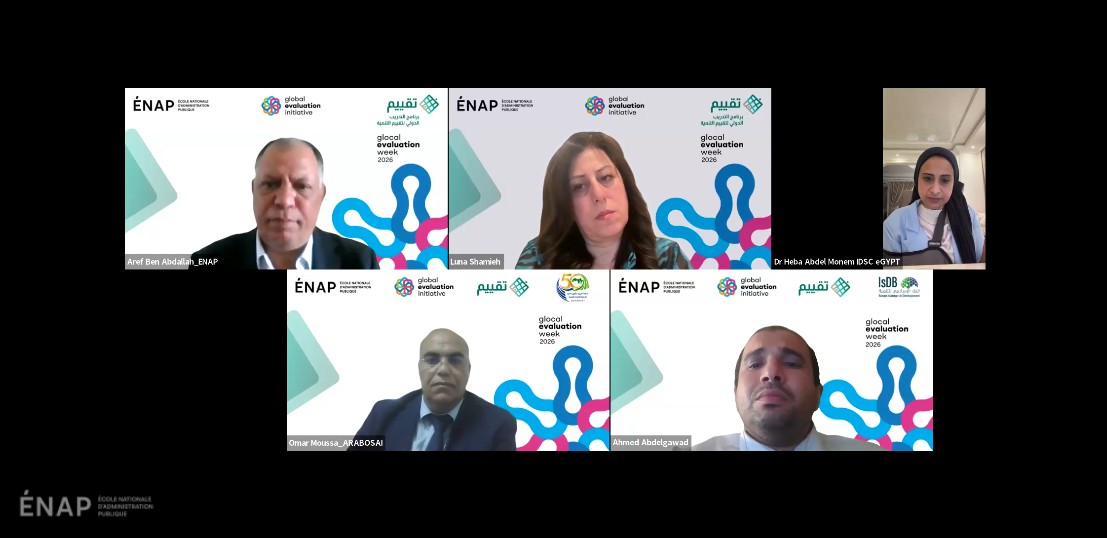
This E-Panel aimed to examine the evolving role of artificial intelligence in evaluation and decision-making, moving from experimental applications toward more institutionalized approaches rooted in trust, governance, and accountability. The panel brought together complementary perspectives from academia, development partners, policymakers, and supreme audit institutions, creating a space for reflection on how AI can strengthen evaluation systems while remaining aligned with public sector values and institutional responsibilities.
The discussions showed that AI is no longer limited to isolated pilot initiatives or technical curiosity. Across the presentations, it was presented as a growing set of tools and approaches that can support data analysis, knowledge management, decision support, and learning processes, while also helping institutions improve efficiency and responsiveness. At the same time, the speakers made clear that the value of AI depends not only on its technical performance, but also on the quality of the data, the clarity of the institutional framework, and the presence of human judgment to interpret and validate results.
A central message of the panel was that trust must remain at the heart of any effort to integrate AI into evaluation systems. Participants stressed that institutional users must be able to understand how AI tools operate, what assumptions they rely on, and how their outputs are used in practice. This is especially important in evaluation, where credibility, transparency, and methodological rigor are essential to ensure that evidence informs policy decisions in a responsible way. The panel therefore highlighted the need for governance mechanisms that can guide adoption, define safeguards, and ensure that AI strengthens rather than weakens institutional accountability.
The contributions from ARABOSAI, IsDB, IDSC, and ENAP illustrated different but complementary pathways toward this transition. Supreme audit institutions brought a governance and oversight perspective, development partners highlighted innovation and operational relevance, while research and training institutions emphasized the importance of building skills, methods, and critical thinking. Together, these perspectives showed that institutionalizing AI in evaluation is not only a technological challenge, but also an organizational and cultural one that requires collaboration across sectors and disciplines.
The panel also underscored the importance of capacity building. Several of the presentations suggested that AI should be understood as a tool that augments human expertise rather than replacing it, particularly in fields such as monitoring, evaluation, and learning. This means investing in training, strengthening digital literacy, and supporting practitioners so they can use AI critically and effectively. It also means encouraging institutions to develop internal standards and practices that make AI use consistent with ethical principles and public interest objectives.
Another important lesson from the discussion was the need to situate AI within broader institutional priorities, including inclusivity, relevance, and evidence use. The panel showed that AI can contribute to more timely, adaptive, and informed decision-making, but only if it is embedded in systems that are designed to serve people and public outcomes. In that sense, the transition described during the session was not simply about adopting new technologies, but about rethinking how institutions generate, validate, and use evidence in a rapidly changing environment.
Overall, the E-Panel demonstrated strong interest in the future of AI for evaluation and governance, as reflected by the participation of an average of around 80 participants (166 inscriptions) throughout the event. The level of engagement confirmed the relevance of the topic and the value of continued dialogue among practitioners, researchers, and institutional actors. More importantly, it showed that the conversation is moving beyond experimentation toward a more mature reflection on how AI can be responsibly integrated into evaluation systems that are trusted, useful, and sustainable
As a follow-up to this E-Panel, a series of webinars will be proposed with the panelists to allow sufficient time for each of them to further present their experience, insights, and expertise on the subject. These webinars will be organized by ENAP as part of its collaboration with GEI under the TAQYEEM program.
galería de imágenes