Feminist Evaluation in the age of AI
Webinar | Online
-
Organized by:
European University Institute
About the Event
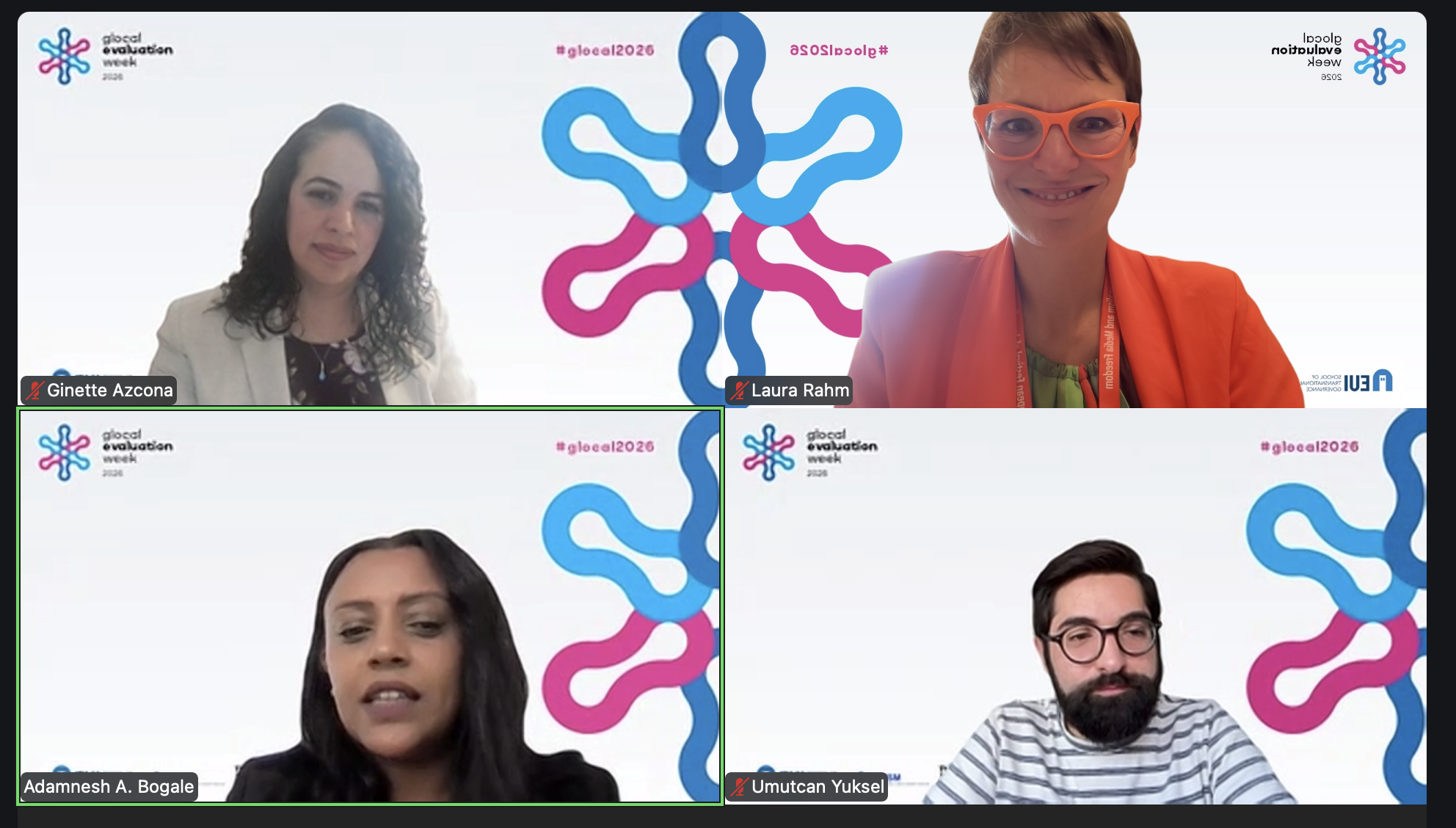
What does feminist evaluation in the age of AI look like? To what extent can AI advance feminist evaluation rather than reinforce existing gender biases? How can evaluators navigate a rapidly evolving technological landscape that presents both opportunities and risks for gender equality? Under what conditions can AI support feminist goals - or are feminist evaluation, which challenges power imbalances, and AI, often seen as reinforcing them, fundamentally incompatible? This gLOCAL panel brings together scholars and practitioners in gender, development, and evaluation to explore these critical questions.
Speakers
| Nome | Título | Biography |
|---|---|---|
| Ginette Azcona | Research Fellow, The New School | Founder, KAIA Network | Former UN Women | Ginette Azcona is a Research Fellow at The New School, and former UN Women’s leading focal point on gender, data and the SDGs. At UN Women she managed the data and statistics for UN Women’s flagship reports, including the annual Progress on the Sustainable Development Goals: The Gender Snapshot. |
| Umutcan Yüksel | Policy Leader Fellow, European University Institute | Humanitarian Specialist | Umutcan Yüksel is the creator of the humanitarian data platform (PRISM – www.prismonitor.eu) that provides evidence-based insights into humanitarian needs, protection risks, funding gaps, climate-related disasters, migration externalization, and aid effectiveness, including for a gender lens. |
| Laura Rahm | Policy Leader Fellow, European University Institute | Specialist in Gender and Policy Evaluation | Laura Rahm is a Policy Leader Fellow at the European University Institute. Her research focuses on global governance, gender, monitoring, and evaluation. Laura has worked with UNFPA, UN Women, the World Bank, and the German International Development Cooperation, among others. |
Moderators
| Nome | Título | Biography |
|---|---|---|
| Adamnesh A. Bogale | Head of Gender, African Center for Economic Transformation | Adamnesh A. Bogale is Head of Gender at ACET where she oversees and leads the expansion of the gender and economic transformation portfolio. With over 15 years of experience as a senior researcher and Assistant Professor at Addis Ababa University, Adamnesh is an expert in the history and philosophy of sex and gender, feminist epistemology, and justice essentially through the lens of human mobility/immobility. Her research explores the intersection of gender, social inequality, economics, politics and leadership, and migration with specific emphasis on global policy discourse in Sub-Saharan Africa and the Middle East corridor. |
Resumo
The webinar highlighted that feminist evaluation remains essential in an AI-driven world because it centers power, inclusion, participation, and accountability. Participants explored possible avenues for how AI can strengthen evaluation, while also recognizing risks related to algorithmic bias, exclusion, surveillance, and unequal power relations. The discussion emphasized that technology is not neutral and that feminist evaluation provides critical tools to identify and challenge embedded inequalities. Ultimately, human judgment, local knowledge, lived experience, and participatory approaches are fundamental to equitable and transformative evaluation - and these cannot be replaced by AI.
Evaluators are encouraged to critically examine how participation, voice, and power are affected by the growing use of AI in evaluation. Key actions include strengthening AI literacy within the evaluation profession, embedding gender-responsive and intersectional approaches in AI-assisted evaluations, and ensuring transparency regarding data sources, algorithms, and decision-making processes. Evaluators should ask: Who is represented in the data? Who is excluded? Whose knowledge counts? AI must be assessed for its impact on equity, inclusion, and trust. The evaluation community has a responsibility to ensure that technological innovation advances, rather than undermines, feminist principles and social justice.
Image Gallery