


Empowering Communities: Unveiling the Impact of Participatory Monitoring and Evaluation on Project Achievements
Conference | Online
-
Organized by:
iDE (International Development Enterprises)
About the Event
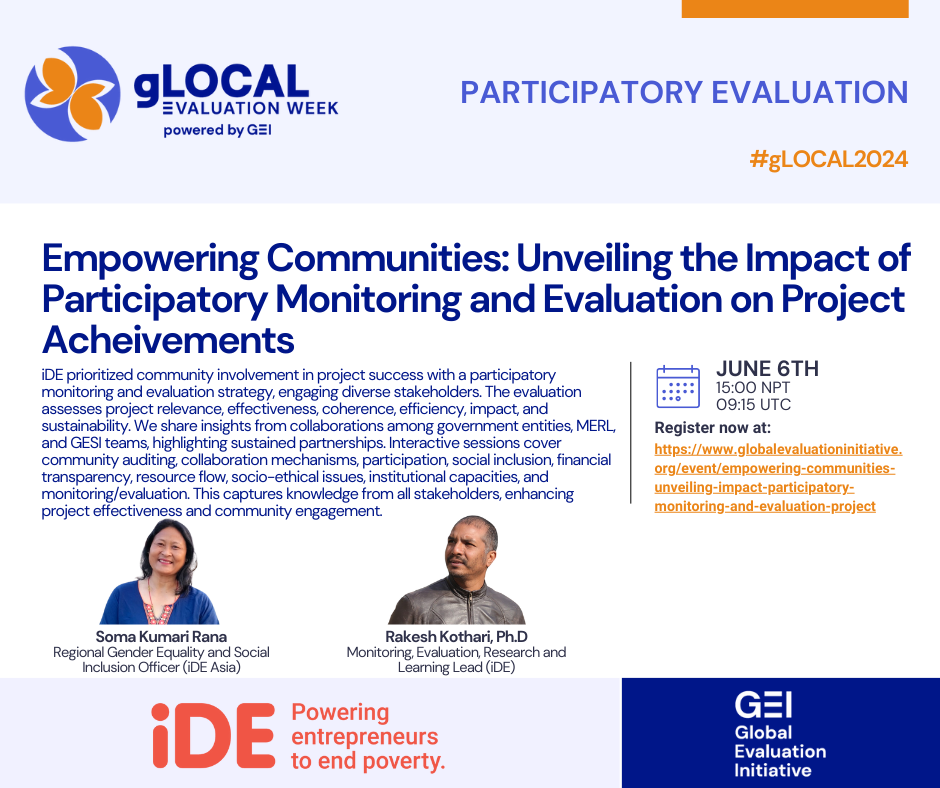
iDE prioritized community involvement in achieving project success by implementing a participatory monitoring and evaluation strategy, engaging diverse stakeholders across all projects. The evaluation focuses on assessing the relevance, effectiveness, coherence, efficiency, impact, and sustainability of project interventions within designated project sites and timeframes. Our aim is to disseminate the methodology, strategies, and insights derived from robust collaboration among government entities, MERL, and GESI teams, emphasizing key elements that fostered and sustained our partnerships. Interactive sessions will facilitate learning about various aspects including community auditing practices, collaboration mechanisms, levels and impacts of community participation, social inclusion, income and expenditure patterns, accounting transparency, resource flow modalities, socio-ethical issues, institutional capacities, planning implementation, and monitoring/evaluation modalities. This approach ensures the capture of knowledge and experiences from all stakeholders, enhancing project effectiveness and community engagement.
Speakers
| Name | Title | Biography |
|---|---|---|
| Soma Rana | Ms. | Ms. Soma Kumari Rana from Nepal, has been with iDE as a regional capacity for GESI Officer in Asia. With over 20 years she gained immense experience in GESI, policy advocacy, agriculture-based rural livelihoods, and nutrition as a frontline extension worker and in different capacities in the I/NGOs in Nepal. |
| Rakesh Kothari | Dr. | Dr. Rakesh Kothari has over 20 years of experience and has made notable contributions to research in climate change, poverty alleviation, market system resilience, economic growth, inclusion, agricultural development, and nutrition. With the completion of a Ph.D. in sociology, he brings a profound understanding of societal dynamics to his work. |
Summary
This event aimed to share PME approaches, best practices and experiences of the project. The theme was ‘evaluation and transformational change: balancing ambition and realism, collaborative evaluation’ focusing on the demand for evidence and translating results into action and impact.
This session attended by evaluators, policymakers, academia, NGOs, individual consultants and firms. The presentation introduced PME, its process, approaches and methods, highlighting key findings, challenges, lessons, best practices and recommendations.
The evaluation covered strategic, implementation and organizational levels, analyzing the context, planning, partnerships, resource mobilization, reporting, M&E, and management effectiveness.
Share the recording of the presentation and final evaluation report with all participants, and stakeholders via email and online platforms.
Review recommendations and adjust project planning, documentation, partnership and networking strategies. Establish robust and continue monitoring system to track the progress of implemented recommendations. Plan for periodic impact assessment and engage local communities in PME process to ensure their input and ownership of the project outcomes.
Advocate for the supportive policies. Explore new partnerships to expand the reach and impact. Ensuring the lesson learned and best practices are effectively utilized to benefits the local communities.