Data for Inclusive Development: Confronting Blind Spots in Evidence-Based Policy
Master Class | Online
-
Organized by:
CERP
About the Event
Despite the growing emphasis on evidence-based policy design, development strategies often continue to overlook the lived realities of marginalized communities. Pakistan remains one of the most surveyed populations in the Global South, yet critical data blind spots persist—particularly in relation to women, persons with disabilities, and other vulnerable groups. This session explores how data collection methods and institutional biases can unintentionally exclude key voices, leading to skewed priorities and exclusionary policies.
Building on the principles of evidence-informed policymaking, the session will critically unpack the limitations of current data ecosystems and reflect on who gets counted, whose experiences are overlooked, and why this matters for inclusive development. The discussion will conclude with practical strategies for designing more equitable and representative data systems—ones that can truly support development that leaves no one behind.to be filled soon
Building on the principles of evidence-informed policymaking, the session will critically unpack the limitations of current data ecosystems and reflect on who gets counted, whose experiences are overlooked, and why this matters for inclusive development. The discussion will conclude with practical strategies for designing more equitable and representative data systems—ones that can truly support development that leaves no one behind.to be filled soon
Speakers
| 名称 | 标题 | Biography |
|---|---|---|
| Hadia Majid | Chairperson, Economics Department, LUMS | Dr. Hadia Majid is Associate Professor and Chair of the Department of Economics at LUMS. Her research agenda considers the impact of monetary and public resource constraints on individuals in Pakistan with a special focus on women’s access to decent, empowering work. |
摘要
Despite being one of the most surveyed populations in the Global South, Pakistan still faces critical data blind spots—especially around women, persons with disabilities, and other marginalized communities.
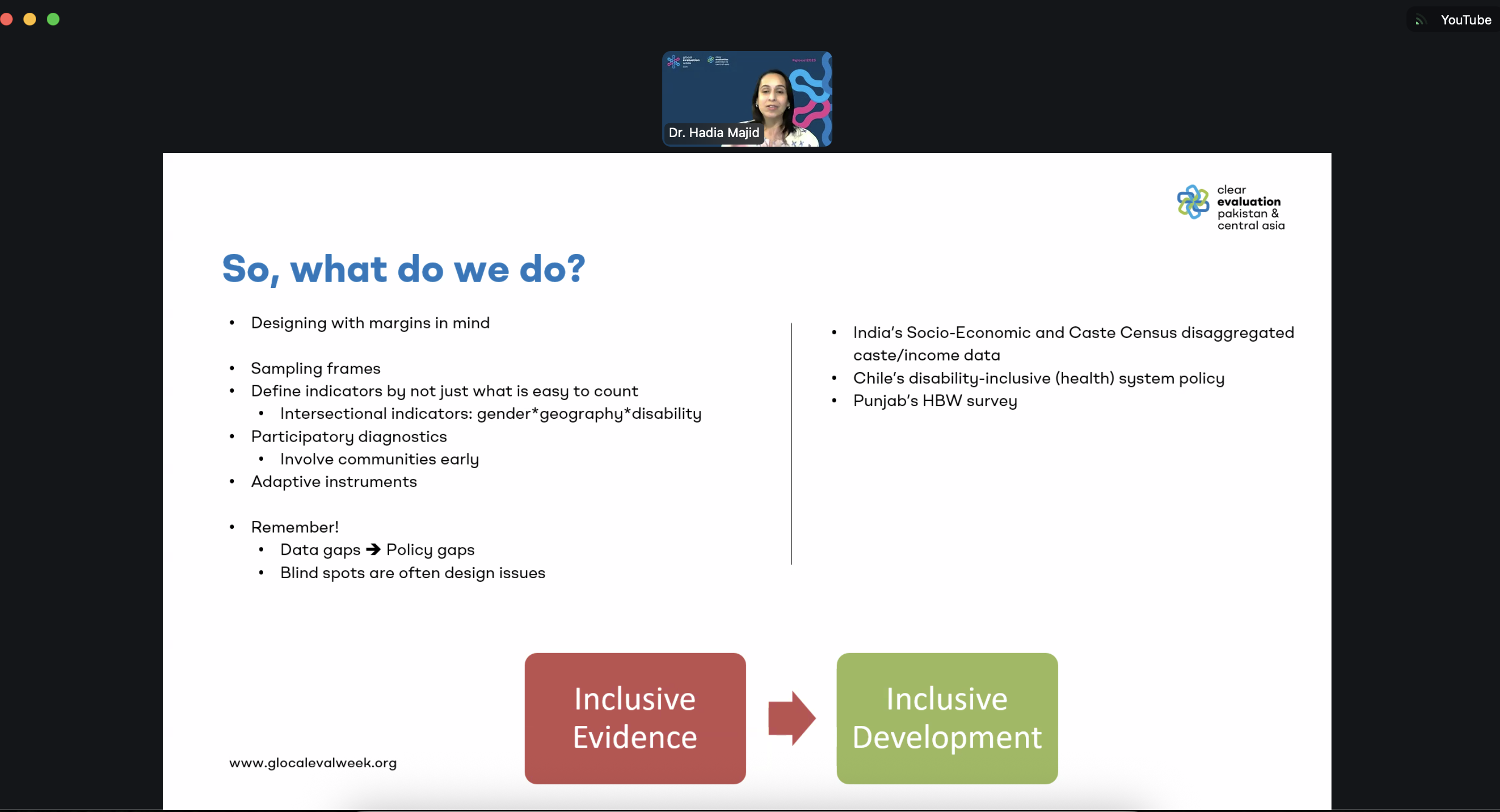
In this powerful GLOCAL 2025 session, Dr. Hadia Majid unpacked the institutional, definitional, and cultural barriers that skew how we collect and interpret data—and why it matters. From enumerator and respondent bias to the invisibility of unpaid care work and intersectional exclusion in M&E, the session offered timely reflections and practical steps toward designing more equitable data ecosystems
The session sparked a discussion on confronting blind spots in evidence-based policy. It talked about how data is misinterpreted or missed. The follow-up actions called for building narrow and context-specific definitions that include unseen populations.
Image Gallery