


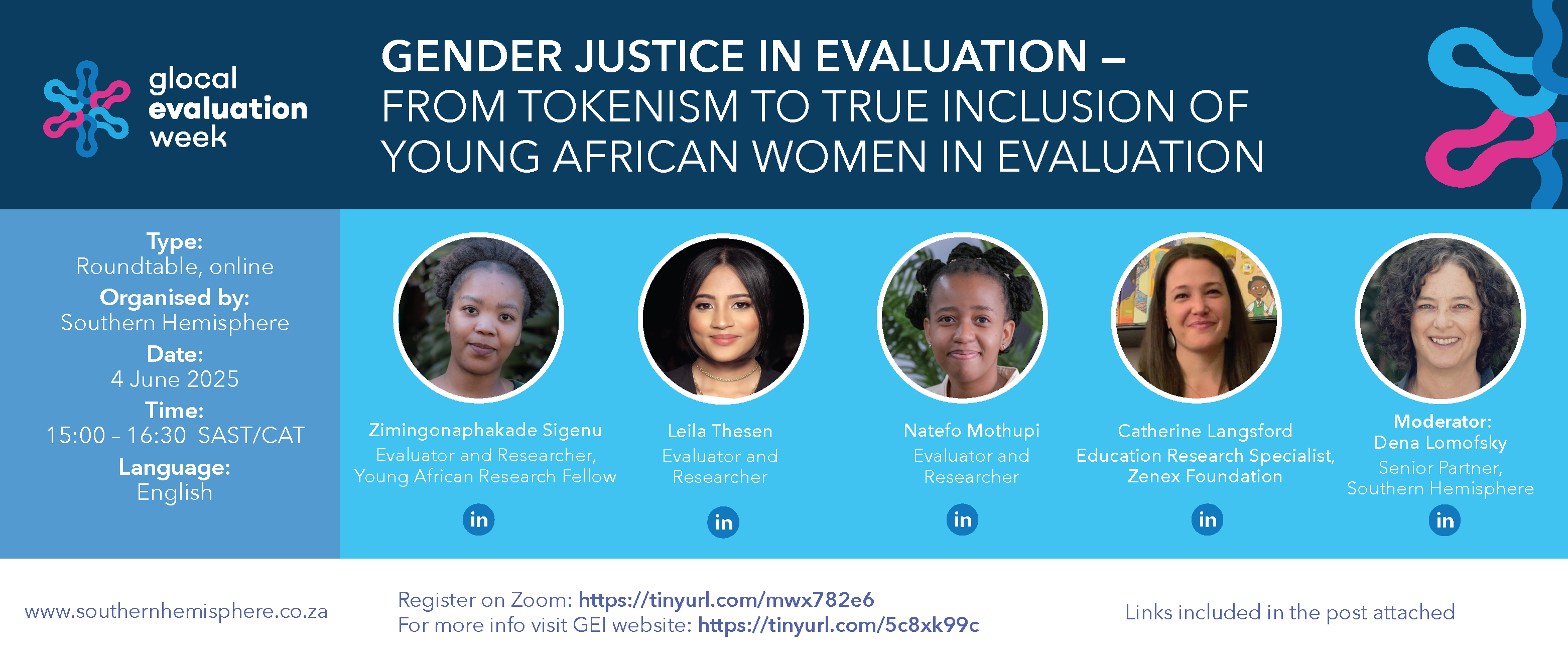
Gender Justice in Evaluation — From Tokenism to True Inclusion of Young African Women in Evaluation
圆桌会议 | Online
-
Organized by:
Southern Hemisphere
About the Event
As Southern Hemisphere celebrates 25 years of advancing evaluation practice, we reflect on our commitment to nurturing local talent — especially young African women — through structured support and opportunity. This roundtable aims to share insights and lessons from our journey, focusing on our emerging evaluators programme, including participating in the South African Monitoring and Evaluation Association Emerging Evaluators initiative and its role in building a pipeline of competent, confident evaluators. We will offer dual perspectives: that of an employer championing inclusive evaluation capacity and that of emerging evaluators who have benefited directly from long-term, intentional support.
Our presentation will reflect on the journey from internship to professional practice, demonstrating how a locally rooted, equity-driven approach to evaluator development can promote the decolonisation of evaluation practices, sustainability, gender equality, and social justice in the sector. In alignment with the gLOCAL 2025 sub-themes, this session will explore how evaluation can evolve to meet future needs and address inequalities through innovation in mentorship, hiring, and leadership inclusion.
Session Format:
The session will take the form of a roundtable that will be introduced through two key perspectives:
1. The stories of emerging evaluators: Zimingonaphakade Sigenu, Natefo Mothupi and Leila Thesen will reflect on their trajectory — from receiving internships and or scholarships to now professional opportunities. Their stories exemplify the power of inclusive and sustained mentorship in shaping junior to mid-career evaluators.
2. An Employer’s Commitment to Local Talent: Southern Hemisphere will present how our hiring practices, mentorship structures, and partnerships (like those with SAMEA and ZENEX) reflect a deliberate commitment to social justice, local capacity, and evaluation sustainability. This reflection will be led by Nana Davies, partner of Southern Hemisphere and the SAMEA EE programme lead.
Thereafter, individuals will be invited to participate in a facilitated discussion titled Gender Justice in Evaluation: From Tokenism to True Inclusion . This topic will open space for collective dialogue on what it truly means to support and elevate African women in evaluation — not just as beneficiaries, but as leaders. We’ll explore practical strategies for moving beyond surface-level representation, and toward systems where young women are empowered to lead, influence, and shape evaluation work from within.
Participants will contribute to identifying actionable steps and recommendations to support meaningful inclusion — both within evaluation teams and across the broader system of commissioning, funding, and practice. These discussions will help address critical questions posed by gLOCAL Evaluation Week, such as :
• How can evaluation address inequalities and promote social justice
• How can organisations create sustainable pathways for emerging evaluators, particularly those from underrepresented groups?
• What practical strategies can help move from tokenistic inclusion to meaningful leadership opportunities for African women in evaluation?
• How does decolonising evaluation practice connect to the development of local evaluation talent?
As such, the session’s overall objectives would be to a) highlight the importance of long-term, intentional support structures in developing emerging evaluators, b) demonstrate how employers can build inclusive and empowering pathways for young, local talent, especially African women and c) explore the systemic and organisational changes needed to ensure evaluator development aligns with social justice, sustainability, and growth.
Why This Matters:
Too often, emerging evaluators — particularly young African women — are excluded from meaningful participation and leadership in the evaluation sector. By sharing both the organisational and personal journey, this session will provide tangible examples of how to shift that narrative. Southern Hemisphere’s experience offers a model for how sustained, intentional support can transform the field — ensuring it reflects the communities it serves and delivers more relevant, just, and effective evaluation practices.
Target Audience:
Evaluation practitioners, funders, employers, and capacity developers interested in building inclusive, sustainable, and socially just evaluation ecosystems.
Our presentation will reflect on the journey from internship to professional practice, demonstrating how a locally rooted, equity-driven approach to evaluator development can promote the decolonisation of evaluation practices, sustainability, gender equality, and social justice in the sector. In alignment with the gLOCAL 2025 sub-themes, this session will explore how evaluation can evolve to meet future needs and address inequalities through innovation in mentorship, hiring, and leadership inclusion.
Session Format:
The session will take the form of a roundtable that will be introduced through two key perspectives:
1. The stories of emerging evaluators: Zimingonaphakade Sigenu, Natefo Mothupi and Leila Thesen will reflect on their trajectory — from receiving internships and or scholarships to now professional opportunities. Their stories exemplify the power of inclusive and sustained mentorship in shaping junior to mid-career evaluators.
2. An Employer’s Commitment to Local Talent: Southern Hemisphere will present how our hiring practices, mentorship structures, and partnerships (like those with SAMEA and ZENEX) reflect a deliberate commitment to social justice, local capacity, and evaluation sustainability. This reflection will be led by Nana Davies, partner of Southern Hemisphere and the SAMEA EE programme lead.
Thereafter, individuals will be invited to participate in a facilitated discussion titled Gender Justice in Evaluation: From Tokenism to True Inclusion . This topic will open space for collective dialogue on what it truly means to support and elevate African women in evaluation — not just as beneficiaries, but as leaders. We’ll explore practical strategies for moving beyond surface-level representation, and toward systems where young women are empowered to lead, influence, and shape evaluation work from within.
Participants will contribute to identifying actionable steps and recommendations to support meaningful inclusion — both within evaluation teams and across the broader system of commissioning, funding, and practice. These discussions will help address critical questions posed by gLOCAL Evaluation Week, such as :
• How can evaluation address inequalities and promote social justice
• How can organisations create sustainable pathways for emerging evaluators, particularly those from underrepresented groups?
• What practical strategies can help move from tokenistic inclusion to meaningful leadership opportunities for African women in evaluation?
• How does decolonising evaluation practice connect to the development of local evaluation talent?
As such, the session’s overall objectives would be to a) highlight the importance of long-term, intentional support structures in developing emerging evaluators, b) demonstrate how employers can build inclusive and empowering pathways for young, local talent, especially African women and c) explore the systemic and organisational changes needed to ensure evaluator development aligns with social justice, sustainability, and growth.
Why This Matters:
Too often, emerging evaluators — particularly young African women — are excluded from meaningful participation and leadership in the evaluation sector. By sharing both the organisational and personal journey, this session will provide tangible examples of how to shift that narrative. Southern Hemisphere’s experience offers a model for how sustained, intentional support can transform the field — ensuring it reflects the communities it serves and delivers more relevant, just, and effective evaluation practices.
Target Audience:
Evaluation practitioners, funders, employers, and capacity developers interested in building inclusive, sustainable, and socially just evaluation ecosystems.
Speakers
| 名称 | 标题 | Biography |
|---|---|---|
| Zimingonaphakade Sigenu | Ms | Zimingonaphakade Sigenu holds a Master of Philosophy (MPhil) in Development Studies from the University of Cape Town (UCT), Cape Town, South Africa. Zimingonaphakade has BSocSc in Politics and Sociology and a Bachelor of Social Sciences (BSocSc) (Hons) in Sociology, both awarded by UCT. Her expertise lies in research, monitoring, and evaluation (M&E) and project coordination. She has experience in conducting research and evaluations for projects that address critical issues such as education, youth livelihoods, socioeconomic redress initiatives, rural development and sexual reproductive health and rights. Through the work she does she seeks to contribute to social justice and favours context sensitive and participatory methodologies. Zimingonaphakade is a proponent for decolonial thought and scholarship, institutionally and in society at large. In 2023, she contributed a chapter to the book Azibuye Emasisweni: Reclaiming Our Space And Centring Our Knowledge which focuses on Africanisation and decolonisation of knowledges as praxis. She also recently had an article, Beyond Survival: Unveiling The Factors Shaping Livelihood Choices In Agriculture, published in a special issue in Youth Voice journal. The article explores how young South Africans navigate pathways into farming enterprises. She is affiliated with the Advancing Critical University Studies Across Africa (ACUSAfrica) network and is a member of the Africa Evidence Network (AEN) and the AEN Youth League. In her work, she aims to centre African perspectives and amplify the marginalised voices. |
| Natefo Mothupi | Ms | Natefo Mothupi is a Monitoring, Evaluation, Research and Learning Practitioner at Southern Hemisphere, with a background in both the life and social sciences. She holds an MPhil in Monitoring and Evaluation from Stellenbosch University and a BSc in Biochemistry and Cell Biology from Wits. Natefo brings sharp analytical skills and a passion for gender equity and youth development. Her journey, shaped by mentorship and the SAMEA EE internship, exemplifies how inclusive support structures enable emerging African women evaluators to thrive. At gLOCAL, Natefo will share her personal and professional evolution, shedding light on how access and opportunity reshape the sector from within. |
| Leila Thesen | Ms | Leila Thesen is an emerging evaluator at Southern Hemisphere with academic roots in social policy and management. She holds a Master of Social Science with distinction from the University of Cape Town, where her research focused on the functionality and impact of M&E systems in non-profit organisations. Her early exposure to evaluation as a tool for social accountability and transformation has since blossomed into a professional passion. Leila’s practical experience includes coordinating complex, multi-country evaluations — such as the Deafkidz Defenders Realist Evaluation and UNICEF’s Teenage Pregnancy Study in Uganda — where she has supported both research and facilitation. Her strength lies in navigating diverse stakeholder contexts, youth-focused research, and gender-sensitive evaluation. Leila brings a relational, justice-oriented lens to her work, grounded in her background in community development and engagement. At gLOCAL, Leila will speak to her personal trajectory from student to professional evaluator, reflecting on how sustained mentorship and feminist leadership at Southern Hemisphere have opened doors to learning, confidence, and contribution. Her story embodies the systemic changes needed to elevate young African women into meaningful roles in evaluation |
| Catherine Langsford | Ms | Catherine Langsford is a Research Specialist at the Zenex Foundation where she manages its research grants and contributes to the organisation’s positioning as a thought leader. Catherine started her career as a high school teacher of English and computer studies. She then worked as a Materials Developer and Research Coordinator at READ Educational Trust, after which she was a lecturer in the Department of Linguistics and Modern Languages at UNISA. Catherine has carried out consulting work in technical and research capacities for many organisations in the field of literacy in South Africa. She is a Past Chairperson of the Literacy Association of South Africa and a current steering committee member of the National Reading Barometer. Catherine continues to teach on Saturdays and implement digital learning initiatives at the Alexandra Education Committee. Catherine holds an Honours degree in English and Linguistics, a Postgraduate Certificate in Education (Senior and FET Phase), a Masters degree in English Studies, a Masters degree in Development Studies and a Postgraduate Diploma in Educational Technology. She is currently a PhD candidate in the School of Education at UCT. For the webinar, she will be offering the perspective of an employer highlighting hiring practices, mentorship structures, and partnerships that promote the nurturing of local talent in evaluations. |
Moderators
| 名称 | 标题 | Biography |
|---|---|---|
| Dena Lomofsky | Ms | Dena Lomofsky is a founding partner of Southern Hemisphere and a seasoned development sociologist with 24 years of experience in the field of monitoring, evaluation, and learning (MEL). Over the course of her career, she has worked across the African continent with governments, donors, NGOs, and think tanks, leading evaluations and learning partnerships that centre equity, participation, and locally grounded approaches. Dena is recognised for her expertise in participatory and gender-responsive evaluation, with a strong commitment to transformative practice. Her work reflects a deep belief in the power of evidence to contribute to social justice and sustainable development, and she has played a critical role in supporting MEL systems that are not only technically sound but also inclusive and empowering. She is also a highly experienced facilitator and trainer, having delivered professional development courses in Theory of Change, MEL system design, and dynamic facilitation for emerging and established practitioners alike. Dena’s ability to guide reflective processes and foster meaningful dialogue has made her a trusted advisor and mentor in the evaluation community. Within Southern Hemisphere, Dena has mentored and worked closely with young professionals as they build their skills and voices in the sector. Her mentorship has contributed to shaping a new generation of African evaluators—particularly young women—who are equipped to lead with confidence, competence, and a commitment to social change. At gLOCAL Evaluation Week 2025, Dena will serve as the moderator of the session. In this role, she will facilitate a dynamic, inclusive conversation that bridges perspectives across generations and roles—supporting dialogue on how the evaluation field can move from tokenism to true inclusion, and from technical practice to transformative impact. |