Is the Cure Worse Than The Disease? Evidence from Public Procurement
Online
About the Event
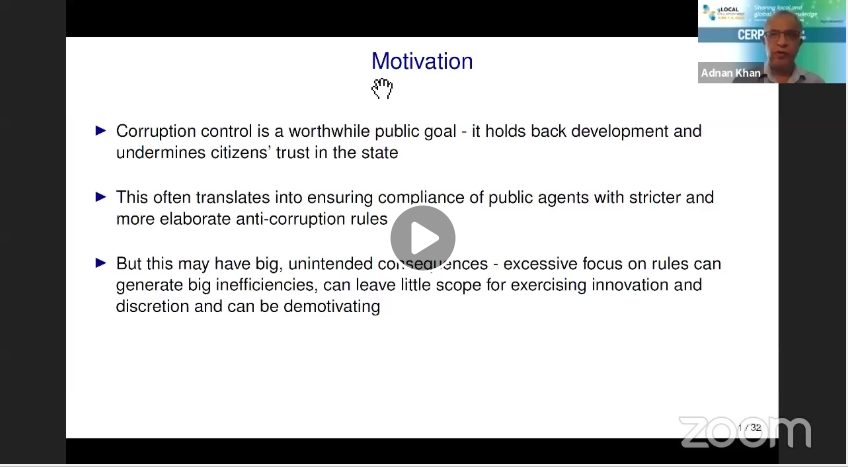
Policy reforms often do not work and sometimes backfire in generating perverse unintended consequences. This talk will share lessons on how to unpack an important policy question using theory and data, as well as discuss the mechanism required to design and run an impact evaluation jointly with governments that ultimately generates new knowledge, which in turn can be taken into policy. It will focus on how to improve efficiency of public procurement which is a large item in the government budget. Reducing waste in procurement can free funds that can provide more public services and maintain the citizen's trust. Yet, the systems created to improve procurement often themselves prove to be a burden for the public purse.
Speakers
| Nome | Título | Biography |
|---|---|---|
| Dr. Adnan Q. Khan | Professor in Practice with School of Public Policy at the London School of Economics and Political Science and a founding Board Member of Centre for Economic Research in Pakistan (CERP). | He is also an Associate with the Building State Capability Program with CID at Harvard & was the Research and Policy Director of the IGC,a member of the IGC’s Steering Group,& a visiting lecturer in Public Policy HKS & was a Co-chair of the LSE-Oxford Commission on State Fragility,Growth&Development |
Resumo
Within the two treatments, greater autonomy to agents results in reduced procurement prices, with performance based incentives being ineffective when monitor's inefficiency drives prices.
Aspects of this study have been scaled up such as the online procurement portal. A follow up discussion focused on the trade-off between rigorous evaluations and quick result delivery for public knowledge. It also discussed how external validity of such programs can help policy makers replicate some aspects of this program across different departments. Logistical and field issues in implementation, such as cooperation by procurement officers, whether they can game the system/experiment etc were also discussed. Participants were given access to the academic paper and blog of this project.
Image Gallery