


Evaluation to Impact: Building Resilience across borders in fragile and conflict-affected settings
Webinar | Online
-
Organized by:
UNICEF WCARO
- In partnership with: Hiroaki Yagami, Spécialiste en évaluation (multi-pays), UNICEF WCARO, Souraya Hassan, Conseillère Régionale en Évaluation, UNICEF WCARO
About the Event
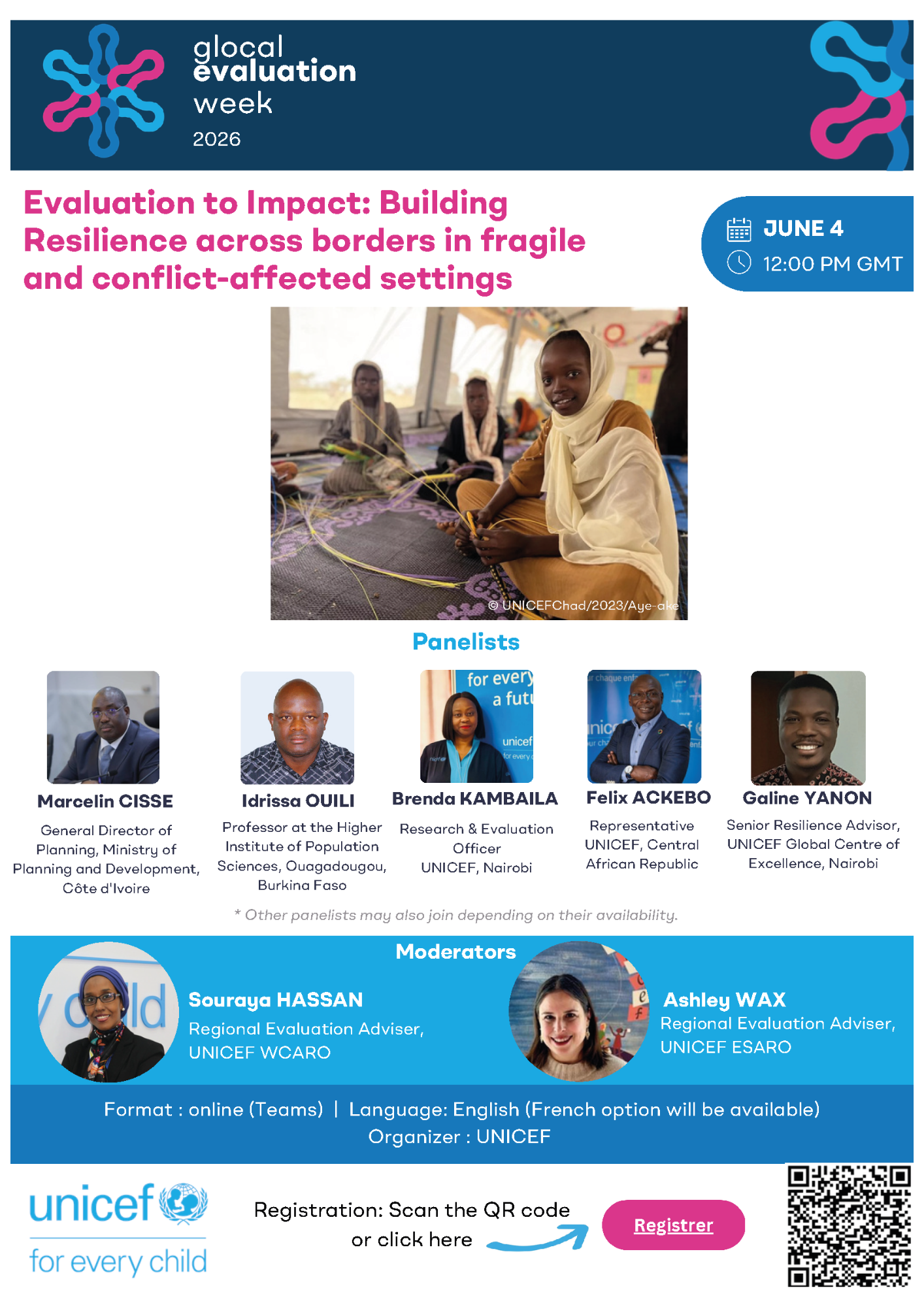
Fragility does not respect borders. Across Africa, crises—from the Sahel and the Lake Chad Basin to the Great Lakes and the Horn of Africa—spill across national boundaries, driving displacement at scale, disrupting systems, and stretching the limits of development investments. In this context, building resilience is not a sectoral priority: it is the foundation on which all sustainable development rests.
Yet, for all the policy commitment to resilience and to the Humanitarian-Development-Peace (HDP) Nexus, a persistent gap remains between what we commit to on paper and what we deliver on the ground.
Evidence from country evaluations conducted by UNICEF across Africa between 2018 and 2025 tells a consistent story: strong strategic intent, uneven operational translation. The evaluations document what works, what does not, and critically why.
At a time of increasing fragility, constrained financing, and growing demand for demonstrable development impact, there is an urgent need to move beyond commitments toward actionable, evidence-based solutions that deliver results at scale.
The GEI’s Glocal Evaluation Week 2026, convened under the theme "Evaluation, Evidence, and Trust in the Age of AI" offers a timely and powerful platform to bring this evidence into a cross-institutional conversation and learning. UNICEF is deeply invested in building resilience in fragile settings, through social protection, systems strengthening, and multi-year programming. With insights from multiple countries in Africa, we can move the conversation from fragmented lessons to shared learning, and from shared learning to coordinated action.
This session will bring forward evaluative evidence rarely discussed in a single forum, offering participants concrete lessons and operational insights to strengthen cross-border resilience programming and evaluation practice.
Yet, for all the policy commitment to resilience and to the Humanitarian-Development-Peace (HDP) Nexus, a persistent gap remains between what we commit to on paper and what we deliver on the ground.
Evidence from country evaluations conducted by UNICEF across Africa between 2018 and 2025 tells a consistent story: strong strategic intent, uneven operational translation. The evaluations document what works, what does not, and critically why.
At a time of increasing fragility, constrained financing, and growing demand for demonstrable development impact, there is an urgent need to move beyond commitments toward actionable, evidence-based solutions that deliver results at scale.
The GEI’s Glocal Evaluation Week 2026, convened under the theme "Evaluation, Evidence, and Trust in the Age of AI" offers a timely and powerful platform to bring this evidence into a cross-institutional conversation and learning. UNICEF is deeply invested in building resilience in fragile settings, through social protection, systems strengthening, and multi-year programming. With insights from multiple countries in Africa, we can move the conversation from fragmented lessons to shared learning, and from shared learning to coordinated action.
This session will bring forward evaluative evidence rarely discussed in a single forum, offering participants concrete lessons and operational insights to strengthen cross-border resilience programming and evaluation practice.
Speakers
| Nome | Título | Biography |
|---|---|---|
| Galine YANON | Conseiller principal en résilience, Centre mondial d'excellence de l'UNICEF | Conseiller principal en résilience, Centre mondial d'excellence de l'UNICEF |
| Marcelin CISSE | General Director of Planning, Ministry of Planning and Development, Côte d'Ivoire | |
| Idrissa OUILI | Professor at the Higher Institute of Population Sciences, Ouagadougou, Burkina Faso. | |
| Brenda KAMBAILA | Research & Evaluation Officer, UNICEF Nairobi | |
| Felix ACKEBO | Representative UNICEF Central African Republic |
Moderators
| Nome | Título | Biography |
|---|---|---|
| Souraya HASSAN | Conseillère Régionale en Evaluation | Conseillère Régionale en Evaluation |
| Ashley WAX | Regional Evaluation Adviser, UNICEF ESARO |