


Rapid Gender Analysis – Gaza Brief: Evidence‑Driven Gender Insights for Crisis Response
Workshop de Capacitação | Online
-
Organized by:
Mohammad Abu Audeh
About the Event
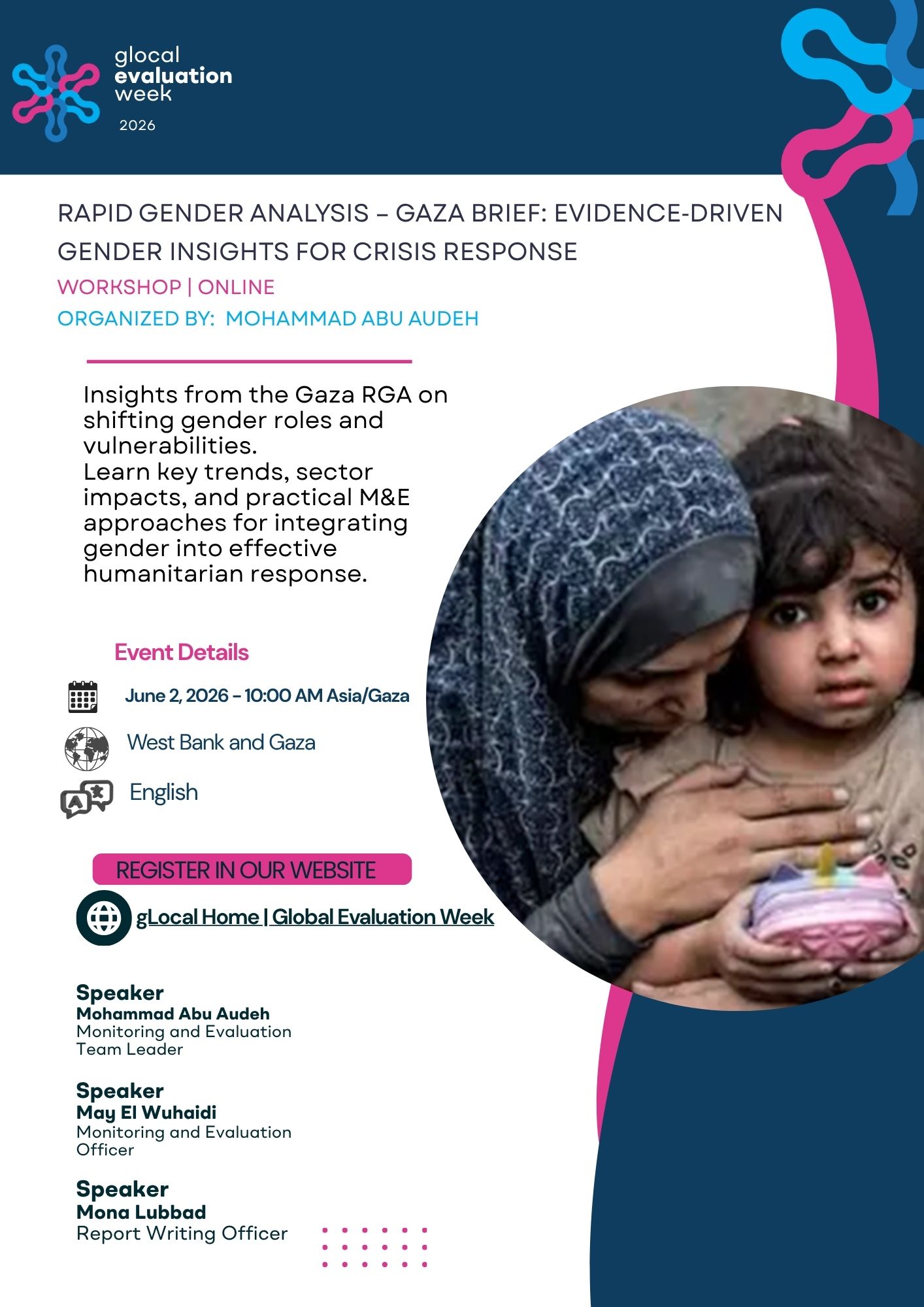
This session presents key findings and methodological lessons from the Rapid Gender Analysis (RGA) – Gaza Brief, offering a focused look at how the ongoing crisis has reshaped gender roles, vulnerabilities, and capacities across the Gaza Strip. Drawing on field based monitoring, sectoral data, and gender sensitive analytical tools, the event demonstrates how rapid, crisis responsive gender analysis can guide more equitable and conflict sensitive humanitarian programming.
Participants will gain insights into how gendered vulnerabilities differ across humanitarian sectors—including WASH, health, food security, shelter, education, cash assistance, and protection—and how these differences can be captured and addressed through effective monitoring and evaluation (M&E) systems. The session will also highlight demographic shifts such as the rising number of female headed households, escalating protection risks, and widening access barriers for women and girls.
Through practical examples from Gaza, the event will showcase M&E techniques for inaccessible or high risk environments, including remote data collection, triangulation of UN and sectoral datasets, and tools for generating reliable evidence under severe constraints. The speakers will provide actionable guidance on integrating gender evidence into program design, indicators, adaptive planning, and MEAL frameworks.
Featuring a moderated panel and interactive Q&A, this event offers participants a strong understanding of how gender sensitive evidence can strengthen humanitarian decision making and improve outcomes for crisis affected communities.
Participants will gain insights into how gendered vulnerabilities differ across humanitarian sectors—including WASH, health, food security, shelter, education, cash assistance, and protection—and how these differences can be captured and addressed through effective monitoring and evaluation (M&E) systems. The session will also highlight demographic shifts such as the rising number of female headed households, escalating protection risks, and widening access barriers for women and girls.
Through practical examples from Gaza, the event will showcase M&E techniques for inaccessible or high risk environments, including remote data collection, triangulation of UN and sectoral datasets, and tools for generating reliable evidence under severe constraints. The speakers will provide actionable guidance on integrating gender evidence into program design, indicators, adaptive planning, and MEAL frameworks.
Featuring a moderated panel and interactive Q&A, this event offers participants a strong understanding of how gender sensitive evidence can strengthen humanitarian decision making and improve outcomes for crisis affected communities.
Speakers
| Nome | Título | Biography |
|---|---|---|
| Mohammad Abu Audeh | Monitoring and Evaluation Team Leader | Mohammad is a Monitoring and Evaluation Team Leader at UNRWA, with over 18 years of experience in designing and implementing M&E systems in humanitarian and development settings. He has led results frameworks and data-driven learning processes across sectors, promoting evidence-based decision-making and improved program impact. |
| Mona Lubbad | Monitoring and Evaluation Reporting Officer | Mona is a Monitoring and Evaluation Reporting Officer at UNRWA with over 3 years of experience producing reports, donor updates, and communication materials for humanitarian programs. She specializes in translating complex data into clear, compelling narratives that support accountability, advocacy, and resource mobilization. |
| May El Wuhaidi | Monitoring and Evaluation Officer | May is a Monitoring and Evaluation Officer at UNRWA with 3 years of experience in humanitarian and development programs. She specializes in M&E systems, data analysis, and performance tracking to support evidence-based decision-making. May is dedicated to improving data quality, accountability, and overall program impact. |
Resumo
The session on “Rapid Gender Analysis – Gaza Brief” highlighted the importance of gender-sensitive and evidence-based approaches in humanitarian response. Discussions showed that crises affect women, men, girls, and boys differently, requiring inclusive and adaptive interventions informed by timely data. The session emphasized that Rapid Gender Analysis is a practical tool for improving targeting, accountability, protection, and program effectiveness. Participants stressed the need to integrate gender analysis into all stages of humanitarian action and confirmed that credible, regularly updated evidence is essential for addressing inequalities, mitigating risks, and improving outcomes for affected populations.
• Encourage humanitarian actors and M&E teams to integrate RGA findings into program design, targeting, and monitoring.
• Strengthen the use of disaggregated and participatory data collection approaches.
• Promote regular updates of gender analysis to reflect changing realities and emerging risks in Gaza.
• Enhance coordination among protection, gender, and sectoral teams for integrated responses.
• Continue capacity-building and knowledge-sharing on gender-sensitive monitoring and adaptive programming.
• Encourage participants to apply lessons learned within their organizations to support evidence-driven humanitarian decision-making.
• Promote the inclusion of gender-sensitive indicators within monitoring and evaluation systems to improve accountability and response effectiveness.
Documents
Ligações
- Session presentation
- • Rapid Gender Analysis Guidance Note Secondary Data Review
- Minimum standards related to protection, gender, and inclusion in emergency situations. ( in Arabic)
- Gender in Emergencies Guidance Note Series.
- Gender Social Guide in the Field of Humanitarian Work (in Arabic)
- Good Practices Framework Gender Analysis