


The Donor Perspective: How the Evaluation Capacity Development (ECD) Landscape Is Shifting
Painel de Discussão | Online
-
Organizado por:
Global Evaluation Initiative
Sobre o evento
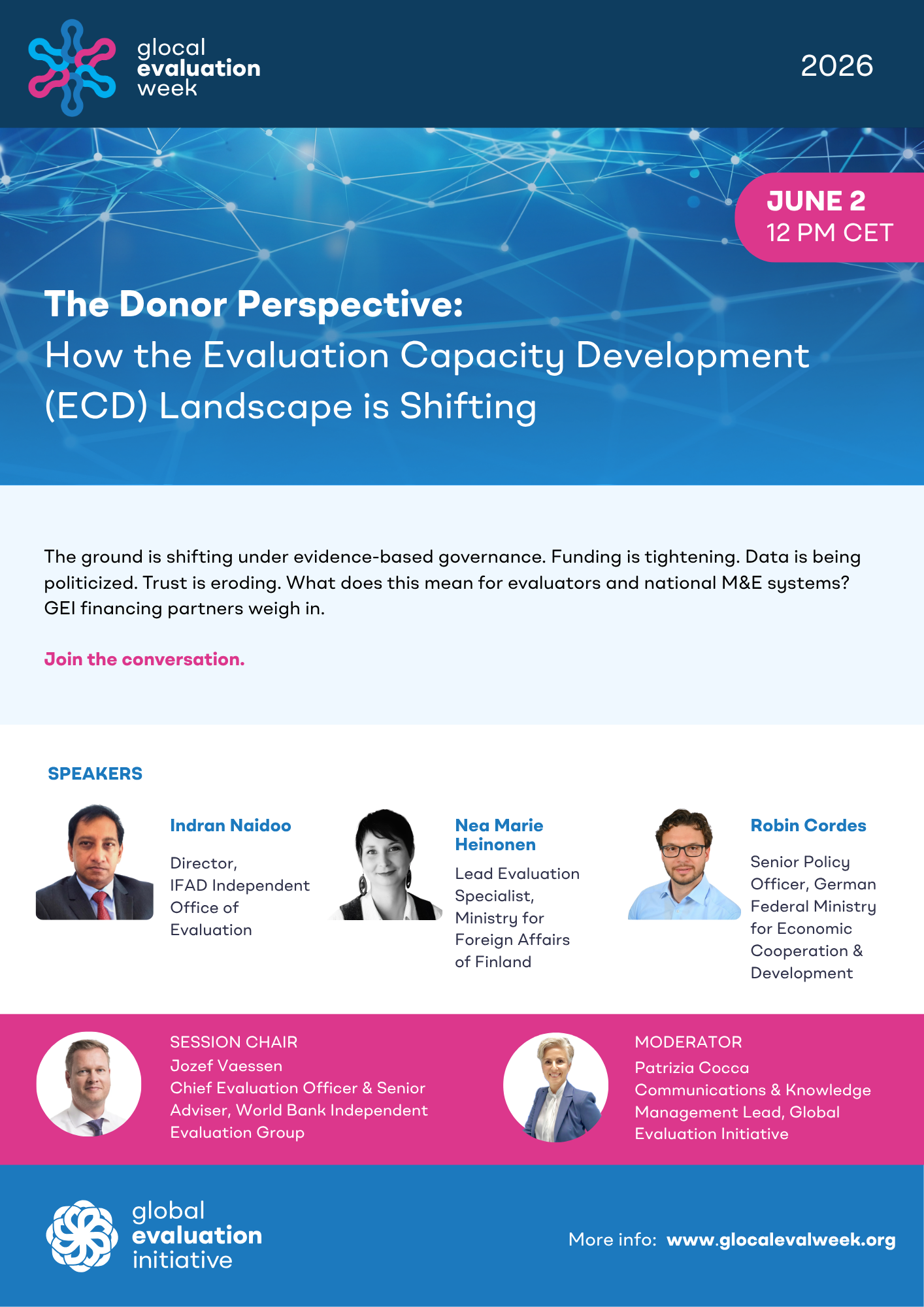
The evaluation capacity development (ECD) landscape is rapidly being reshaped. Across the globe, political volatility is testing the foundations of evidence-based governance. Funding for evaluation faces growing pressures. The politicization of data and science threatens the legitimacy of evidence itself. Public trust in institutions, and in the facts, they present, continues to erode.
Bilateral and multilateral partners who commission a significant share of evaluative work are navigating this period of transition. As their institutional priorities, funding approaches, and evidence needs evolve, so too do the expectations placed on evaluators and national monitoring and evaluation (M&E) systems.
This session convenes GEI financing partners for a forward-looking conversation on how they see the current state of the ECD field, how their institutional approaches are evolving, and what these shifts mean for evaluation practitioners and national M&E actors.
Bilateral and multilateral partners who commission a significant share of evaluative work are navigating this period of transition. As their institutional priorities, funding approaches, and evidence needs evolve, so too do the expectations placed on evaluators and national monitoring and evaluation (M&E) systems.
This session convenes GEI financing partners for a forward-looking conversation on how they see the current state of the ECD field, how their institutional approaches are evolving, and what these shifts mean for evaluation practitioners and national M&E actors.
Orador/a
| Nome | Título | Biography |
|---|---|---|
| Indran Naidoo | Director of the Independent Evaluation Office of IFAD. | Indran A. Naidoo is the Director of the Independent Office of Evaluation at IFAD. He brings vast global experience into the role having served as the Director of the Independent Evaluation (IEO) of the United Nations Development Program (UNDP), where he led the transformation and expansion of the office during his 8 year term. Indran has been active in evaluation networks of the United Nations, as a UNEG Vice-Chair, and former Board member of the International Development Evaluation Association (IDEAS), and South African Monitoring and Evaluation Association (SAMEA). He services as academic advisor and reviewer for evaluation courses and journals, and has published extensively. At the Public Service Commission (PSC) of South Africa, where he served for 12 years, he helped design and implement monitoring and evaluation systems to measure governance pinned on constitutional values and principles for good governance. In 1995, he entered the field and set up the first monitoring and evaluation Directorate to oversee the land reform program, in post-apartheid South Africa |
| Nea-Mari Heinonen | Lead Evaluation Specialist, Finland’s Ministry for Foreign Affairs | Nea-Mari Heinonen (MA, MSSc) is Lead Evaluation Specialist managing strategic evaluations for Finland’s Ministry for Foreign Affairs. With 20 years in international development, she specializes in planning, monitoring, evaluation, and learning. She has piloted AI and data science approaches and is currently pursuing a PhD in social data science. |
| Robin Cordes | Senior Policy Officer, Division G23 Development Research and Evaluation | Social scientist, graduate in Latin American Regional Studies with study stays in Cologne, Cádiz and São Paulo, and a postgraduate degree from the Centre for Rural Development (SLE) at Humboldt University in Berlin. Brings several years of practical experience in development cooperation, including work for the Deutsche Gesellschaft für Internationale Zusammenarbeit (GIZ) and Bread for the World. Currently serves as Senior Policy Officer in the evaluation unit (Division G23: Development Research and Evaluation) of the German Federal Ministry for Economic Cooperation and Development (BMZ), having previously worked as Senior Policy Officer for basic education in the education division, as Deputy Head of Cooperation at the German Embassy in Accra, and as Senior Policy Officer for Bangladesh in the regional division for South Asia at BMZ. |
Moderators
| Nome | Título | Biography |
|---|---|---|
| Patrizia Cocca | Communication Lead , Global Evaluation Initiative | Patrizia Cocca leads Communications and Knowledge Management at the Global Evaluation Initiative (GEI), where she helps developing countries strengthen the monitoring and evaluation systems that turn evidence into better decisions. She brings more than 25 years of experience steering communications, digital, and KM portfolios across major multilateral institutions, including the World Bank Group and the Global Environment Facility. Before development took over her career, she co-founded a web startup in Italy and worked in Italian public television. A Fulbright scholar, Patrizia holds master's degrees in Global Marketing Communications and in History |
Resumo
Brief Conclusions
Independence is Non-negotiable: Regardless of technological changes, the core principles of independence, credibility, and utility must remain the foundation of evaluation to ensure accountability
Human-in-the-Loop: AI should be integrated responsibly, but evaluation professionals are essential for providing contextual understanding and external judgment.
Systems Over Projects: To be sustainable, ECD must take a systemic approach—including legislation and a culture of accountability—rather than focusing solely on individual skill-building.
Usability and Timing: For evaluation to remain relevant to policymakers, it must provide methodologically robust evidence that is delivered in time for key decisions
The panelists and host identified several necessary actions for the evaluation community:
Enhance AI Literacy: Evaluation functions need capacity building and mutual learning to understand how to use new technologies responsibly and manage their risks.
Secure Demand for Evidence: Evaluators must proactively communicate the importance of evidence-based decisions to planners and the public to ensure demand does not erode.
Intensify Collective ECD Efforts: Donors should move away from isolated projects toward joint approaches via platforms like the GEI to reduce fragmentation and lower transaction costs for partner countries.
Prioritize Usability: There is a call for evaluators to put usability and timing at the center of their work, ensuring evidence is digestible for the public and policymakers.
Advocate for the Public Good: Evaluators are encouraged to be confident and unapologetic in their role as advocates for transparency and the public good, despite potential political pushback.