


Keeping Students in School: Behavioral and Tech Solutions from Pakistan
Webinar (em inglês) | Online
-
Organizado por:
Tabadlab
Sobre o evento
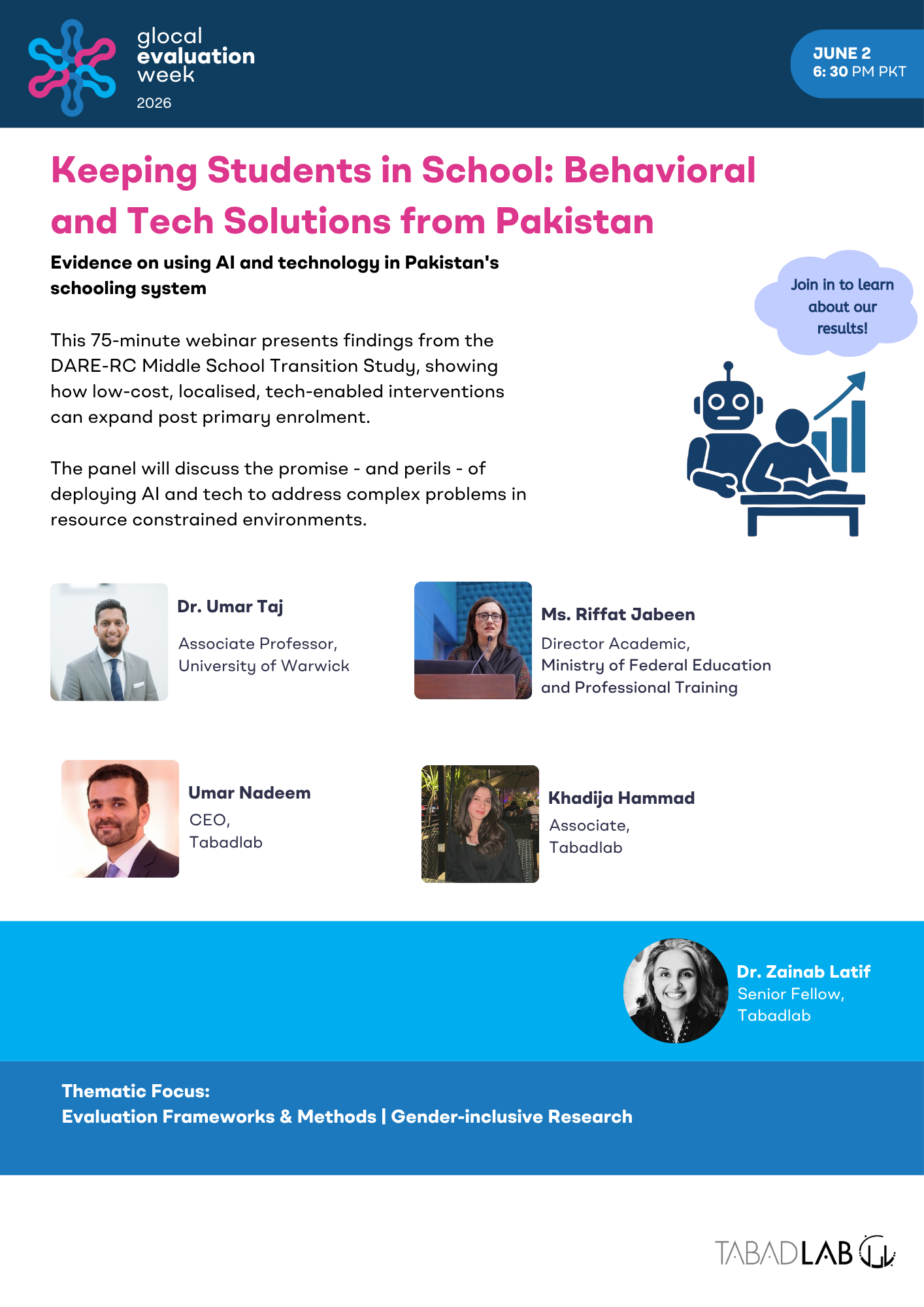
This 75-minute webinar presents results from the Middle School Transition (MST) Study, and offers insight into the importance of using local insights to inform large-scale, tech-driven interventions to maximise their efficacy. The study evaluates the effectiveness of a low-cost, digital intervention to improve post-primary school enrolment. Focusing on the transition from primary to middle school, the session highlights how non-academic barriers—such as lack of information, low confidence, and procedural complexity—shape parental decision-making, particularly for girls in rural contexts. The webinar walks participants through integrated results from administrative data analysis, behavioural diagnostics (COM-B), and results from a mixed-methods, field-based, randomized controlled trial.
The webinar begins with a short framing of the problem and study context, followed by a presentation of key research findings, including national trends, behavioural insights, and intervention results. This is followed by a panel discussion bringing together researchers and government practitioners to reflect on implementation realities, scalability, and the role of evidence in decision-making. The session concludes with an interactive Q&A, allowing participants to engage directly with the speakers.
The session aligns closely with gLOCAL Evaluation Week’s focus on strengthening evaluation practice in a rapidly evolving, technology-driven landscape. It contributes a grounded, local perspective to global debates on the role of AI and innovation in evaluation, demonstrating the continued importance of context-specific, field-based evidence. By showcasing how low-cost behavioural interventions can be rigorously evaluated and applied in low-resource settings, the webinar speaks directly to questions of credibility, adaptability, and the future of evaluation in uncertain and resource-scarce environments.
Participants will gain practical insights into designing and evaluating behavioural interventions in low-resource settings, applying tools like COM-B to understand decision-making, and interpreting mixed-methods evidence to assess what works, for whom, and why. They will also develop a clearer understanding of the role of local context, the limits of technology-driven solutions, and how behavioural approaches can be integrated into routine monitoring and evaluation systems.
The webinar begins with a short framing of the problem and study context, followed by a presentation of key research findings, including national trends, behavioural insights, and intervention results. This is followed by a panel discussion bringing together researchers and government practitioners to reflect on implementation realities, scalability, and the role of evidence in decision-making. The session concludes with an interactive Q&A, allowing participants to engage directly with the speakers.
The session aligns closely with gLOCAL Evaluation Week’s focus on strengthening evaluation practice in a rapidly evolving, technology-driven landscape. It contributes a grounded, local perspective to global debates on the role of AI and innovation in evaluation, demonstrating the continued importance of context-specific, field-based evidence. By showcasing how low-cost behavioural interventions can be rigorously evaluated and applied in low-resource settings, the webinar speaks directly to questions of credibility, adaptability, and the future of evaluation in uncertain and resource-scarce environments.
Participants will gain practical insights into designing and evaluating behavioural interventions in low-resource settings, applying tools like COM-B to understand decision-making, and interpreting mixed-methods evidence to assess what works, for whom, and why. They will also develop a clearer understanding of the role of local context, the limits of technology-driven solutions, and how behavioural approaches can be integrated into routine monitoring and evaluation systems.
Orador/a
| Nome | Título | Biography |
|---|---|---|
| Khadija Hammad | Advisory Associate, Tabadlab | Khadija Hammad is a consultant for the DARE-RC Middle School Transition study, which tests a behavioral science intervention aimed at improving gendered transition between primary and secondary school in Pakistan. She graduated from the National University of Sciences and Technology (NUST) in 2024 with placement on the Dean’s Honor List. Her broader research background includes education, economic development, and public policy through various projects and internships during her undergraduate studies, including work with the Planning Commission of Pakistan and Acumen’s agriculture development. Her interests lie in improving education access and outcomes through rigorous, equity-focused research and policy engagement. |
| Dr. Umer Taj | Associate Professor, University of Warwick | Dr. Umar Taj is Associate Professor of Behavioural Science at LSE, Oxford & Warwick. Co-founder of CogCo, he applies behavioural science, design & data science to help organisations scale, with 20+ BI units and 200+ projects delivered. Recent work focuses on Behavioural AI. |
| Umar Nadeem | CEO, Tabadlab | Umar Nadeem is the Chief Executive Officer and a founding partner of Tabadlab, a Pakistan-based policy advisory firm and think tank. With over 20 years of cross-sector experience, he has worked across banking, consulting, telecom, and technology, leading large-scale transformation and policy initiatives in Pakistan as well as internationally across Asia, Europe, and Africa. Since joining Tabadlab’s leadership in 2018, he has played a central role in shaping the organisation’s work across education, digital transformation, investment, and public policy. Prior to becoming CEO, he held multiple senior roles within the organisation, including Head of Content & Insights, Head of Advisory, and Managing Director, contributing to the firm’s growth and strategic direction. |
| Ms. Riffat Jabeen | Ministry of Federal Education and Professional Training | Ms. Riffat Jabeen is Director Academics, EdTech & QA at FDE, overseeing 400+ institutions. She has led major reforms in teacher training, digital learning, and national initiatives like TeleSchool, Connected Classrooms, AI labs, and STEAM programs, focusing on tech-driven education reform. |
Moderators
| Nome | Título | Biography |
|---|---|---|
| Dr. Zainab Latif | Senior Fellow, Tabadlab | Dr Zainab Latif is a senior fellow at Tabadlab, along with the thematic lead for girl’s education under the DARE RC programme, based in Asia. Her research work focuses on equity in access to education, women's incarceration, at-risk youth and electoral participation. She has 28 years of experience leading, designing and evaluating programmes for the Vera Institute of Justice, DAI, FCDO, UNDP, UNICEF, the Asia Foundation, and the Government of Punjab. She has also served the United Nations as an evaluator for the Office of Internal Oversight. Zainab holds a PhD in criminal justice from CUNY and an MPhil in development studies from IDS. |
Resumo
The webinar highlighted the potential of low-cost, behaviorally informed and technology-enabled interventions for school continuity in low-literacy contexts in Pakistan. Personalized, local-language, messaging, delivered via mobile phones, helped significantly increase the proportion of students transitioning from class 5 to class 6, for girls and boys, when compared with a control group. The discussion underscored the growing role of AI in education policy, from enhancing parental engagement and teacher support to improving data and evidence generation for policymakers. However, speakers cautioned that AI must be deployed responsibly, with strong safeguards, human oversight, and rigorous evaluation to ensure ethical and effective use.
- Pilot and evaluate how AI can support evidence generation to understand the potential benefits, limitations and externalities of AI-enabled ventures.
- Strengthen collaboration between researchers, policymakers, and implementers to promote evidence-informed decision-making by jointly identifying what evidence is needed, how it should be generated, and how it can most effectively support policy design, implementation, and evaluation.
- Develop guidance on the responsible and ethical use of AI in education, including data protection and accountability considerations.