Use and Process of Qualitative Assessment in Evaluating Life Skills among Adolescents and AI
Webinar (em inglês) | Online
-
Organizado por:
Magic Bus India Foundation
Sobre o evento
Title:
Integrating Qualitative Assessment and AI to Evaluate Life Skills Development among Adolescents
Abstract
Background and Rationale
Life skills education seeks to foster gradual, context-specific behavioural and socio-emotional changes among adolescents, which are often not fully captured through quantitative methods alone. While quantitative approaches measure outcomes and trends, they frequently overlook the processes and lived experiences underlying behavioural transformation. This study emphasizes the importance of qualitative assessment in capturing these nuanced dimensions, enabling a more comprehensive understanding of how life skills evolve in real-world contexts.
Objectives
The study aims to examine the role of qualitative assessment in understanding adolescents’ life skills development and to demonstrate how Artificial Intelligence (AI) can enhance the efficiency and rigor of qualitative research processes. Specifically, it assesses short-term behavioural outcomes, evaluates benefits such as resilience and self-efficacy, analyses stakeholder participation, and aligns findings with broader educational and developmental objectives.
Methodology
The research adopts a mixed qualitative design using stratified purposive sampling to ensure depth and contextual relevance. Data collection methods include in-depth interviews (IDIs) with adolescents and focus group discussions (FGDs) with parents and teachers. These methods generate rich, narrative data on adolescents’ perceptions, aspirations, and application of life skills. The approach prioritizes contextual understanding over generalization, enabling meaningful comparisons across participant groups.
Integration of AI in the Research Process
A key innovation of the study is the integration of AI across multiple stages of qualitative research. AI tools are utilized for transcription, translation, and data organization, followed by thematic analysis using structured prompts. This is complemented by manual coding to ensure contextual accuracy and analytical validity. The combined approach enhances efficiency, reduces processing time, and improves the consistency of qualitative analysis while preserving interpretive depth.
Key Insights and Implications
The findings highlight that qualitative assessment, when systematically implemented and supported by AI, provides deeper insights into adolescents’ behavioural and social transformations. It strengthens evidence-based programme design, informs policy decisions, and amplifies adolescents’ voices in shaping interventions. The study demonstrates that integrating qualitative methods with technological innovations offers a robust, scalable, and context-sensitive approach for evaluating life skills programmes across diverse settings.
Integrating Qualitative Assessment and AI to Evaluate Life Skills Development among Adolescents
Abstract
Background and Rationale
Life skills education seeks to foster gradual, context-specific behavioural and socio-emotional changes among adolescents, which are often not fully captured through quantitative methods alone. While quantitative approaches measure outcomes and trends, they frequently overlook the processes and lived experiences underlying behavioural transformation. This study emphasizes the importance of qualitative assessment in capturing these nuanced dimensions, enabling a more comprehensive understanding of how life skills evolve in real-world contexts.
Objectives
The study aims to examine the role of qualitative assessment in understanding adolescents’ life skills development and to demonstrate how Artificial Intelligence (AI) can enhance the efficiency and rigor of qualitative research processes. Specifically, it assesses short-term behavioural outcomes, evaluates benefits such as resilience and self-efficacy, analyses stakeholder participation, and aligns findings with broader educational and developmental objectives.
Methodology
The research adopts a mixed qualitative design using stratified purposive sampling to ensure depth and contextual relevance. Data collection methods include in-depth interviews (IDIs) with adolescents and focus group discussions (FGDs) with parents and teachers. These methods generate rich, narrative data on adolescents’ perceptions, aspirations, and application of life skills. The approach prioritizes contextual understanding over generalization, enabling meaningful comparisons across participant groups.
Integration of AI in the Research Process
A key innovation of the study is the integration of AI across multiple stages of qualitative research. AI tools are utilized for transcription, translation, and data organization, followed by thematic analysis using structured prompts. This is complemented by manual coding to ensure contextual accuracy and analytical validity. The combined approach enhances efficiency, reduces processing time, and improves the consistency of qualitative analysis while preserving interpretive depth.
Key Insights and Implications
The findings highlight that qualitative assessment, when systematically implemented and supported by AI, provides deeper insights into adolescents’ behavioural and social transformations. It strengthens evidence-based programme design, informs policy decisions, and amplifies adolescents’ voices in shaping interventions. The study demonstrates that integrating qualitative methods with technological innovations offers a robust, scalable, and context-sensitive approach for evaluating life skills programmes across diverse settings.
Orador/a
| Nome | Título | Biography |
|---|---|---|
| Dr. Somenath Ghosh | Sr. Manager Impact | Dr. Somenath Ghosh is an established practitioner in monitoring, evaluation, and learning (MEL), data analytics, and artificial intelligence, with over 10 years of professional experience across research and development sectors in India. He currently serves as Regional M&E Manager (East) at Magic Bus India Foundation, where he leads evaluation and assessment studies across six states, designs and operationalizes MEL frameworks, and oversees the integration of technology-driven systems for data collection, analysis, and dashboarding. His work involves synthesizing insights from mixed-method evaluations—including MIS data, qualitative research, and field observations—to inform program strategy and donor reporting, while also contributing to knowledge products and institutional learning. Previously, as Assistant Manager – Monitoring and Evaluation at Lutheran World Services India, he led MEL systems across three states, developing methodologies, tools, and accountability frameworks for international donor-funded projects supported by NORAD, Church of Sweden, and ACT Alliance, ensuring data quality, consistency, and evidence-based decision-making. Earlier in his career, he worked as a Research Officer at MANT and as a Researcher at the Agro-economic Research Centre, Visva-Bharati, contributing to large-scale studies including the Government of India–supported evaluation of the National Food Security Mission. Academically, Somenath holds a Ph.D. in Economics from Visva-Bharati (2025), with prior M.Phil. and strong grounding in quantitative and applied research methods. His core expertise spans evaluation design, data systems strengthening, AI-enabled analytics, MIS development, and knowledge management. Aligned with the goals of the Global Evaluation Initiative’s gLOCAL platform, his work focuses on leveraging technology to enhance the credibility, efficiency, and usability of evidence systems, while promoting adaptive learning and data-driven decision-making in development programs. |
| Sukanya Bose | Assistant Manager- Impact | Sukanya Bose is an early-career practitioner in monitoring, evaluation, and learning (MEL), with a strong interdisciplinary background in population studies and geography, and growing experience in evidence generation for development programmes. She currently serves as Assistant Manager – Impact at Magic Bus India Foundation, where she contributes to programme monitoring, data analysis, and evaluation of life skills interventions focused on improving adolescent outcomes. She holds a Master’s degree in Population Studies from the International Institute for Population Sciences (IIPS), Mumbai, and a Master’s degree in Geography from Jadavpur University, where she graduated with distinction, and is UGC-NET qualified in Geography (2023). Her professional journey includes progression from Management Trainee to a core impact role at Magic Bus, where she supports data-driven programme implementation, tracking, and evidence synthesis, along with prior experience as a Research Trainee at Jadavpur University under a DST-SERB funded project. She has also co-authored and presented research at national platforms, including the 46th Annual Conference of the Indian Association for the Study of Population (IASP), examining the role of play-based life skills education in shaping gender attitudes among adolescents in urban slums. Her interests lie in gender, adolescent development, and the application of mixed-method evaluation approaches, with a strong commitment to advancing evidence-based, inclusive, and context-responsive development practice. |
| Dr. Ajay K Singh | Head-Impact | Dr. Ajay Kumar Singh is the Head of Impact at Magic Bus India Foundation, where he leads strategic efforts to strengthen evidence-driven programming and maximize social impact for marginalized communities across India. With over 20 years of experience in monitoring, evaluation, and learning (MEL), spanning sectors such as public health, gender-based violence, engaging men, MNCH, family planning, migration, disaster risk reduction, renewable energy, and climate-smart agriculture, he brings deep expertise in designing and institutionalizing robust evaluation systems for large-scale development programmes. His work closely aligns with the objectives of the Global Evaluation Initiative’s gLOCAL platform, particularly in advancing the use of credible, transparent, and actionable evidence to inform policy and practice. Prior to joining Magic Bus, he served as Senior MEL Officer at PATH, leading MEL functions across South Asia and providing technical leadership on system design, evaluations, and capacity strengthening to enhance programme effectiveness and scalability. Dr. Singh has also worked with leading organizations including Population Council, International Center for Research on Women (ICRW), John Snow International (JSI), The Asia Foundation, and IPE Global, and has collaborated extensively with global donors such as USAID, CDC, the Bill & Melinda Gates Foundation (BMGF), NIH, and United Nations agencies. He holds an M.Phil and Ph.D. in Population Studies from the International Institute for Population Sciences, Mumbai, and has published widely in international peer-reviewed journals. His work emphasizes the integration of data, technology, and adaptive learning approaches to build resilient, future-ready evaluation systems that drive inclusive and sustainable development outcomes. |
Moderators
| Nome | Título | Biography |
|---|---|---|
| Santosh Kumar Sharma | Sr. Director Impact | Santosh Kumar Sharma is the Senior Director – Impact, with over 25 years of extensive experience in designing and managing research, evaluations, monitoring and evaluation (M&E) systems, and knowledge management initiatives across large-scale development programmes. He holds an MBA and a Post Graduate Diploma in Rural Development, along with a one-year programme in Strategic Management from IIM Calcutta. Over the past 12 years, he has led M&E and research verticals at the national level across multiple organizations, providing strategic leadership in strengthening evidence systems and institutional learning. His work aligns closely with the objectives of global evaluation platforms such as the Global Evaluation Initiative’s gLOCAL, with a strong emphasis on generating credible, actionable evidence to inform programme design, policy engagement, and large-scale impact. Santosh brings deep expertise in integrating evaluation frameworks with programme strategy, ensuring that data and learning continuously inform adaptive management and improve development outcomes. |
Resumo
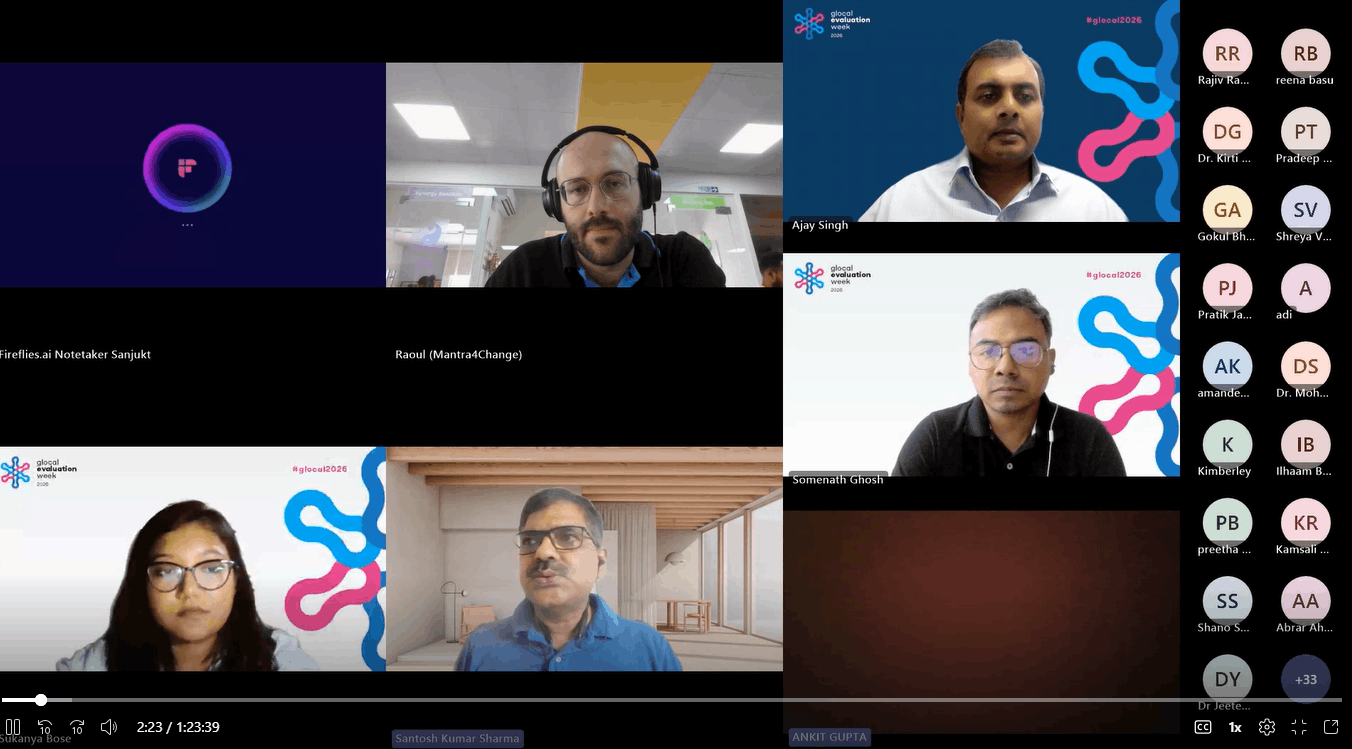
The GLocal Evaluation Week session successfully demonstrated how Artificial Intelligence can strengthen qualitative monitoring, evaluation, and learning systems within large-scale adolescent development programmes. By integrating AI into transcription, translation, coding, synthesis, and visualization processes, Magic Bus India Foundation has created a scalable and efficient model for qualitative evaluation while maintaining methodological rigor through human oversight.
The strong participation and active engagement from national and international stakeholders reflected the growing relevance of AI-enabled evaluation approaches across the development sector. The session contributed valuable practical insights for organizations seeking to responsibly leverage AI to generate deeper evidence, improve learning, and enhance programme effectiveness.
The research insights enabled us to streamline the process of quarterly qualitative study of Magic Bus India Foundation using various Artificial Intelligence tools and make proper time-management.
Image Gallery