


Evaluation Evidence on Environment, Fragility and Social Inclusion
Webinar (em inglês) | Online
-
Organizado por:
Independent Evaluation Office of the Global Environment Facility
Sobre o evento
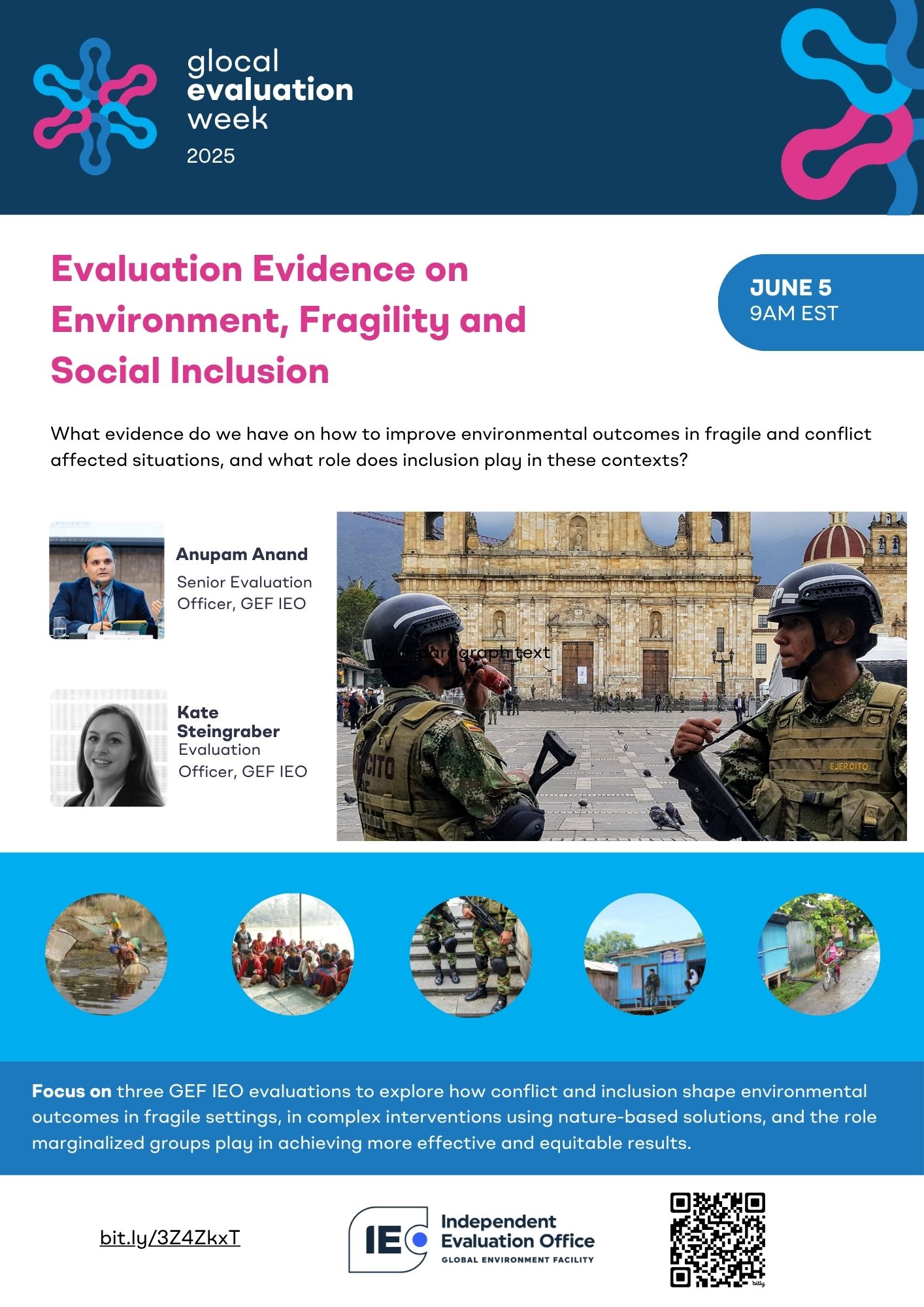
This presentation will address the question: “What evidence do we have on how to improve environmental outcomes in fragile and conflict affected situations, and what role does inclusion play in these contexts”
The presentation will focus on two recent GEF IEO evaluations:
1. GEF Support in Fragile and Conflict-Affected Situations. This evaluation assesses the impacts of conflict and fragility on the design, implementation, and monitoring and evaluation (M&E) of GEF interven- tions at the global scale, the country/economy and regional levels, and the individual project level.
This report analyzes how conflict and fragility affect GEF project outcomes at these three scales, determines the extent to which GEF-supported projects consider the broader conflict context in their design and implementation, and assesses
whether consideration of these factors affects project outcomes. Based on these findings, it offers recommendations for improving conflict sensitivity in GEF-sponsored projects
2. Assessing Inclusion of Marginalized Groups in GEF-Supported Projects, with Attention to Fragile and Conflict-Affected Situations (Forthcoming) This evaluation will examine whether, how, and to what extent projects supported by the Global Environment Facility (GEF) are inclusive of historically marginalized groups, and the effects of inclusion (or lack thereof). It will focus on inclusion of people marginalized on the basis of gender (with a primary focus on women, but also girls and sexual and gender minorities), Indigenous Peoples and local communities (IPLCs), and other groups such as youth and persons with disabilities. The evaluation will assess the approaches to and relative prevalence of inclusion of marginalized populations in GEF projects generally, with special consideration of GEF support in fragile and conflict-affected situations (FCS). Such situations are characterized by problems of marginalization and exclusion that are distinct from stable situations, and this evaluation of inclusion will build on a recent overall evaluation of GEF support in FCS. It will consider the effects of inclusion of marginalized populations on project outcomes as well as socioeconomic co-benefits. The evaluation will approach the issue of inclusion from a combined perspective of capitalizing on opportunities (e.g., inclusion as improving project outcomes) and managing risks (e.g., risks to projects and to stakeholders).
The presentation will focus on two recent GEF IEO evaluations:
1. GEF Support in Fragile and Conflict-Affected Situations. This evaluation assesses the impacts of conflict and fragility on the design, implementation, and monitoring and evaluation (M&E) of GEF interven- tions at the global scale, the country/economy and regional levels, and the individual project level.
This report analyzes how conflict and fragility affect GEF project outcomes at these three scales, determines the extent to which GEF-supported projects consider the broader conflict context in their design and implementation, and assesses
whether consideration of these factors affects project outcomes. Based on these findings, it offers recommendations for improving conflict sensitivity in GEF-sponsored projects
2. Assessing Inclusion of Marginalized Groups in GEF-Supported Projects, with Attention to Fragile and Conflict-Affected Situations (Forthcoming) This evaluation will examine whether, how, and to what extent projects supported by the Global Environment Facility (GEF) are inclusive of historically marginalized groups, and the effects of inclusion (or lack thereof). It will focus on inclusion of people marginalized on the basis of gender (with a primary focus on women, but also girls and sexual and gender minorities), Indigenous Peoples and local communities (IPLCs), and other groups such as youth and persons with disabilities. The evaluation will assess the approaches to and relative prevalence of inclusion of marginalized populations in GEF projects generally, with special consideration of GEF support in fragile and conflict-affected situations (FCS). Such situations are characterized by problems of marginalization and exclusion that are distinct from stable situations, and this evaluation of inclusion will build on a recent overall evaluation of GEF support in FCS. It will consider the effects of inclusion of marginalized populations on project outcomes as well as socioeconomic co-benefits. The evaluation will approach the issue of inclusion from a combined perspective of capitalizing on opportunities (e.g., inclusion as improving project outcomes) and managing risks (e.g., risks to projects and to stakeholders).
Orador/a
| Nome | Título | Biography |
|---|---|---|
| Kate Steingraber | Evaluation Officer | Kathryn comes to the IEO from the Development Impact Evaluation unit in the Development Economics Research group of the World Bank. Previously, she worked for the World Bank's Independent Evaluation Group where she focused on project, country, and thematic evaluations with an emphasis on including beneficiary voice in evaluations. Kate also worked with the Independent Evaluation Department at the Asian Development Bank and as a Lead Researcher for the Climate and Land Use Alliance. Her sector background includes natural resource management and she has a special interest in participatory development approaches. She holds a Master's in International Development Policy from the McCourt School of Public Policy at Georgetown University. |
| Anupam Anand | Senior Evaluation Officer | Anupam Anand, Senior Evaluation Officer at the GEF IEO, has more than 15 years of combined experience in evaluation, international development, and academia. He uses a blend of innovative mixed-method approaches and tools such as satellite data, GIS, machine learning, computational social science, UAVs, and field-based methods to enhance evaluative evidence and knowledge products. Anupam has led evaluations on biodiversity, SFM and REDD+, land degradation, fragility and conflict, and illegal wildlife trade. Previously, as a Remote Sensing Scientist at the University of Maryland, he worked on multiple NASA-funded projects, including field campaigns for future satellite missions. He also consulted for the Climate Investment Funds, World Bank. |