


From Student Work to Actionable Feedback: AI Applications for Strengthening Monitoring and Evaluation in Education
Manifestation | En ligne
-
Organisé par:
Peepul
À propos de l'événement
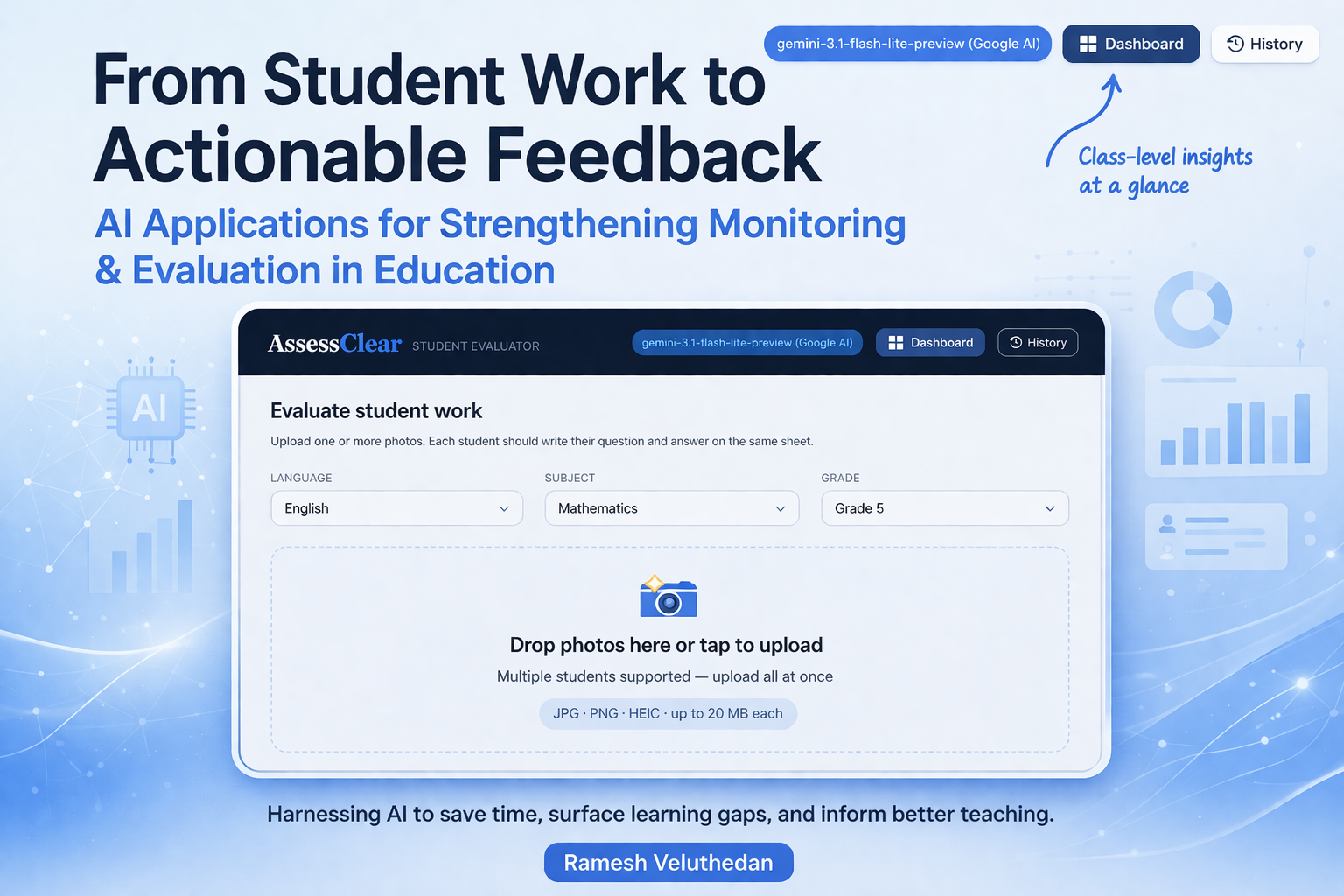
This session presents AssessClear, a web-based AI prototype that strengthens classroom-level monitoring and evaluation by converting student work into actionable evidence. The system generates structured feedback, identifies misconceptions, and builds a longitudinal database of student responses-drawing on classroom and formative assessments typically unavailable in MEL systems. This enables tracking of learning progress, identification of gaps, and targeted instructional support. The session combines a live demo with reflections on responsible AI use and evidence-informed decision-making while preserving teacher judgment.
Conférenciers
| Nom | Titre | Biography |
|---|---|---|
| Ramesh Veluthedan | Project Manager, MEL | Ramesh Veluthedan is an AI for Education practitioner with experience in monitoring, evaluation, and learning (MEL) systems. He builds exploratory AI applications to support teachers and improve classroom practice, focusing on actionable insights and multilingual contexts. |
| Kanishka Bhattacharya | Head of Strategy and Impact | Kanishka Bhattacharya is an experienced strategy and impact advisor with over 15 years of experience across international development, philanthropy, and public systems transformation. He has led over 50 engagements across 15+ countries and advised governments, foundations, multilaterals, NGOs, and corporations on strategy, monitoring and evaluation, policy, and scaling social impact. Currently, he serves as Head of Strategy and Impact at Peepul, where he leads organizational strategy, impact measurement, performance management, and system strengthening efforts. He has played a key role in shaping Peepul’s multi-year strategy and scaling partnerships across states including Delhi and Madhya Pradesh. Previously, Kanishka was an Associate Partner at Dalberg Advisors, where he contributed to several landmark global initiatives, including work with the World Bank and large-scale development programs. He holds a Master of Public Policy from Georgetown University and a BA in Economics and Conflict Studies from DePauw University. |
| Yachita Nanda | Network Coordinator | Yachita Nanda is an education professional with experience in school leadership and instructional improvement within government school systems. As a Network Coordinator at Peepul, she currently manages a cluster of three schools under the Exemplar Schools program in New Delhi. Her work focuses on strengthening teaching and learning processes through teacher coaching, professional development design, and fostering collaborative instructional leadership among school leaders. She is committed to improving student learning outcomes by supporting teachers and school teams to implement effective classroom practices. |
Résumé
The session on AssessClear at Global Evaluation Week 2026 presented a compelling case for transforming how formative assessment is conceptualized, delivered, and integrated within Monitoring, Evaluation, and Learning (MEL) systems in primary education. At its core, the presentation highlighted a critical systemic gap: while large-scale assessments and summative evaluations are widely used, real-time, classroom-level formative evidence remains largely absent, limiting the ability of teachers and systems to respond dynamically to learning needs.
The session began by framing this “MEL blind spot,” emphasizing that students often receive minimal actionable feedback, assessments are delayed, and teaching practices remain insufficiently informed by ground-level evidence.
AssessClear was introduced as a practical, scalable solution designed to address this challenge. The tool leverages AI to enable instant formative assessment using a simple workflow—capturing a student’s handwritten response via smartphone and generating diagnostic feedback in under 30 seconds. This simplicity is central to its innovation: it reduces dependency on infrastructure while maintaining analytical depth.
A key point emphasized throughout the session was that AssessClear goes beyond traditional right/wrong evaluation. Instead, it generates structured outputs for both teachers and students. For teachers, this includes correctness levels, summaries of student thinking, identification of misconceptions, and validation of methods. For students, it provides strengths-based feedback, identifies areas for improvement, and suggests actionable next steps—all in their home language. This dual-output design ensures that assessment is not merely evaluative but developmental.
The presentation also highlighted AssessClear’s strong alignment with foundational learning principles.
Another important discussion point was the theory of change, which identified three key pathways to improved outcomes: teacher action, field-level coaching, and MEL system integration. The session made it clear that technology alone does not improve learning—impact depends on whether teachers interpret and act on the insights generated. This emphasis on teacher uptake as a “critical assumption” positioned AssessClear as an enabling tool rather than a replacement for professional judgment.
The session also foregrounded responsible AI practices and system design considerations. Planned improvements such as anonymization of student data, curriculum alignment through NCERT-based knowledge systems, bias monitoring, and explainability layers demonstrated a commitment to ethical and contextually appropriate AI deployment. These safeguards are particularly important in education systems where trust and accountability are paramount.
Participants were also introduced to the current pilot status, which includes early deployment across 3 schools, 10 teachers, and over 450 evaluations. Initial findings suggest that teachers are able to identify misconceptions more effectively within weeks of use, pointing to the tool’s potential for rapid capacity enhancement.
A significant takeaway was AssessClear’s cost-effectiveness and scalability. With an approximate cost of $0.01 per evaluation, support for 13 Indian languages, and compatibility with basic smartphones, it is positioned as an inclusive innovation that can reach large-scale public education systems. This directly addresses the common trade-off between quality and affordability in EdTech solutions.
Finally, the session reinforced that AssessClear represents not just a product, but a shift in evaluation thinking. It repositions assessment as a continuous, embedded process that directly informs teaching, strengthens coaching conversations, and feeds into MEL systems for program-level decision-making. By enabling real-time, actionable evidence at the classroom level, it bridges the longstanding gap between data collection and instructional improvement.
In conclusion, the presentation demonstrated that AssessClear offers a viable pathway to strengthen formative assessment ecosystems. Its value lies in combining technological efficiency, pedagogical relevance, and system-level integration, making it a promising solution for improving foundational learning outcomes at scale.
The follow-up actions emerging from the AssessClear session are clearly articulated through two critical dimensions presented in slides 13 and 14: cost-effective scaling of the solution and a phased pathway toward large-scale adoption. Together, these define the strategic roadmap for transitioning AssessClear from a promising pilot to a system-level intervention.
The first key insight from slide 13 is the emphasis on cost efficiency and operational scalability as foundational enablers of adoption. AssessClear has demonstrated the ability to deliver high-quality formative feedback at approximately $0.01 per evaluation, with turnaround times of under 30 seconds. Moving forward, a core action will be to validate and maintain this cost-performance ratio as the system scales. This will involve optimizing AI usage, managing infrastructure costs, and ensuring that efficiency gains are not offset by increased complexity.
Another important next step is strengthening the product’s capability to operate consistently across contexts. While current features already support 13 Indian languages and Grades 3–8 learning levels, scaling will require rigorous testing across diverse linguistic, curricular, and classroom environments. This includes ensuring consistent accuracy of AI-generated feedback, particularly in regional languages, and refining models based on real-world usage.
Slide 14 outlines a clear multi-year pathway to scale, which forms the backbone of follow-up actions. The immediate next step is moving from the current pilot (10 teachers, 3 schools, 450+ evaluations) to a 30-school structured pilot in 2026, incorporating full MEL instrumentation and AI quality audits. This phase is critical as it will generate systematic evidence on effectiveness, usability, and learning outcomes.
Accordingly, one of the primary follow-up actions is to design and implement this structured pilot rigorously. This includes embedding monitoring systems to track teacher usage, feedback quality, student learning progress, and system-level patterns. The inclusion of MEL instrumentation ensures that the pilot does not merely demonstrate functionality but produces credible evidence for decision-making.
Simultaneously, there is a need to operationalize AI quality assurance mechanisms, including regular audits, expert validation, and bias monitoring. These processes, already outlined in earlier slides, must now be activated at scale to ensure reliability and trustworthiness as usage expands.
The next stage, planned for 2027, involves generating state-level evidence through more rigorous evaluation designs, including randomized controlled trials (RCTs) and structured government engagements. Preparatory actions for this phase include building partnerships with state education departments, aligning AssessClear with government priorities (such as foundational literacy and numeracy), and developing policy-ready documentation.
Thus, a key follow-up priority is strategic stakeholder engagement. This involves early and continuous engagement with government actors, funders, and system-level partners to ensure that the tool is aligned with policy frameworks and scalable within public systems.
Looking ahead to 2028 and beyond, the roadmap envisions government adoption at scale, potentially reaching over 500,000 students through state financing. Achieving this requires several preparatory steps, including demonstrating cost-effectiveness, ensuring interoperability with existing systems, and establishing sustainable implementation and support models.
Another critical follow-up action is strengthening the enabling ecosystem around AssessClear. This includes teacher training, integration with existing classroom practices, and development of support systems such as coaching and helpdesks. Given that teacher uptake is identified as the key driver of impact, sustained investment in capacity building remains essential.
Additionally, continuous product refinement based on pilot learning is a central next step. Insights from the structured pilot—such as usability challenges, error patterns, and contextual adaptations—must feed directly into iterative improvements of the tool.
Finally, a cross-cutting follow-up priority is evidence generation and dissemination. As AssessClear progresses through each phase of scale, systematically documenting outcomes, lessons, and impact will be essential. This evidence will not only support scaling efforts but also contribute to the broader field of AI in evaluation.
In summary, the follow-up actions focus on a disciplined and evidence-driven scaling strategy. By combining cost efficiency, rigorous piloting, stakeholder engagement, and continuous improvement, AssessClear aims to transition from a functional innovation to a transformational solution embedded within education systems.