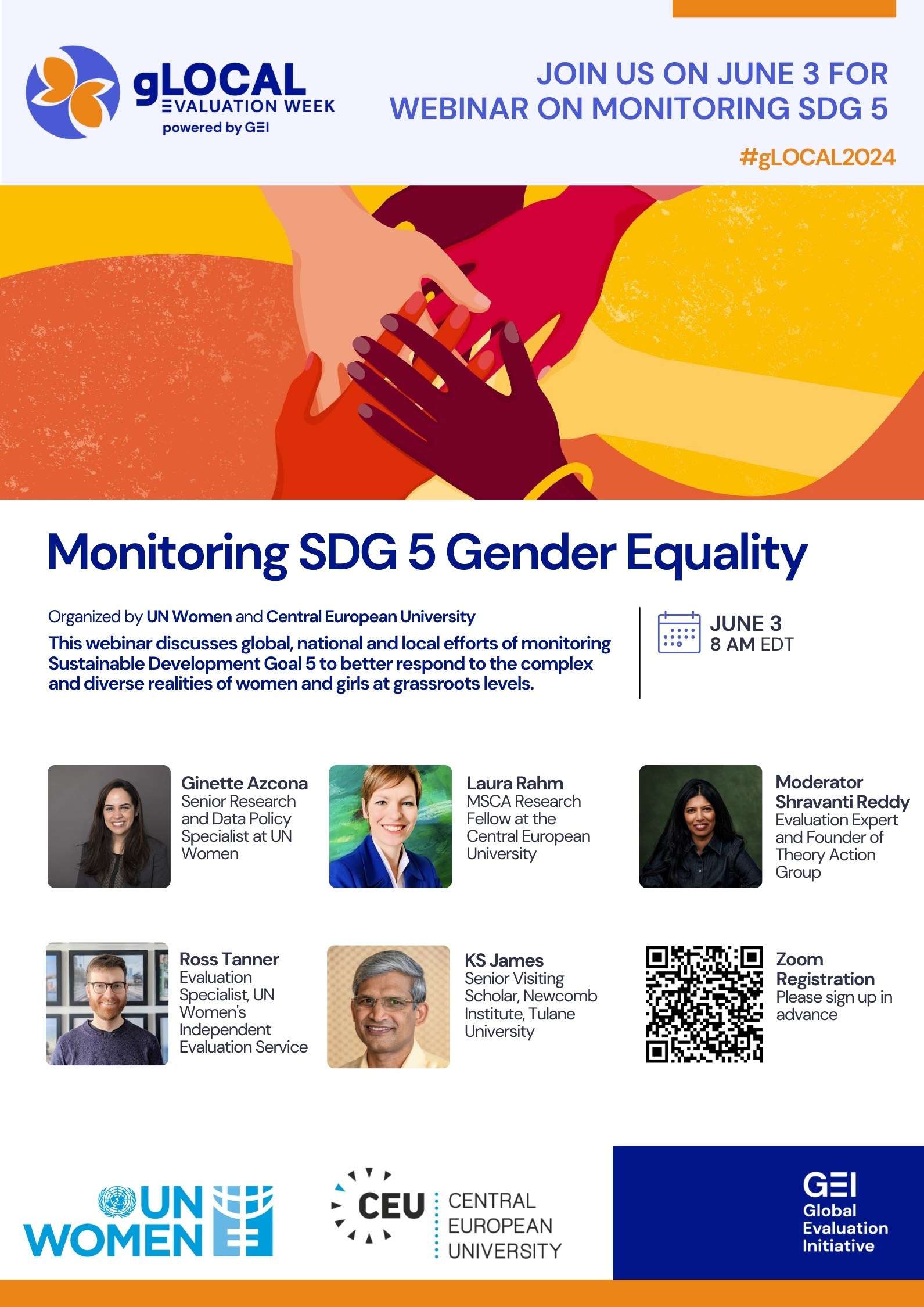
Monitoring SDG 5 (Gender Equality)
Webinaire | En ligne
-
Organisé par:
UN Women and Central European University
À propos de l'événement
The latest SDG 5 data indicate that the world is not on track to achieve gender equality and the empowerment of women and girls by 2030. The data for monitoring SDG 5 provide a wealth of information on the trajectory of progress on gender equality and the empowerment of women and girls, but many gaps remain. Only 55.6 per cent of data required to track progress on SDG 5 is available. Timeliness and frequency of data is also a concern. Important initiatives are ongoing to increase the collection of sex-disaggregated data at the country level, but more efforts are needed.
This event reviews the progress and setbacks towards achieving SDG 5 drawing from the latest Progress on the Sustainable Development Goals: The Gender Snapshot. It presents current evidence and data gaps on gender equality across all 17 goals from a gender perspective. It assesses the debates around what types of data are needed to identify and address gender inequalities. It showcases national and local efforts of monitoring SDG 5 to better respond to the complex and diverse realities of women and girls at grassroots levels. Lastly, it offers implications for research and practice on how to strengthen multi-stakeholder partnerships and data, monitoring, and accountability (SDG 17) to advance SDG 5 and the 2030 Agenda for Sustainable Development.
This event reviews the progress and setbacks towards achieving SDG 5 drawing from the latest Progress on the Sustainable Development Goals: The Gender Snapshot. It presents current evidence and data gaps on gender equality across all 17 goals from a gender perspective. It assesses the debates around what types of data are needed to identify and address gender inequalities. It showcases national and local efforts of monitoring SDG 5 to better respond to the complex and diverse realities of women and girls at grassroots levels. Lastly, it offers implications for research and practice on how to strengthen multi-stakeholder partnerships and data, monitoring, and accountability (SDG 17) to advance SDG 5 and the 2030 Agenda for Sustainable Development.
Conférenciers
| Nom | Titre | Biography |
|---|---|---|
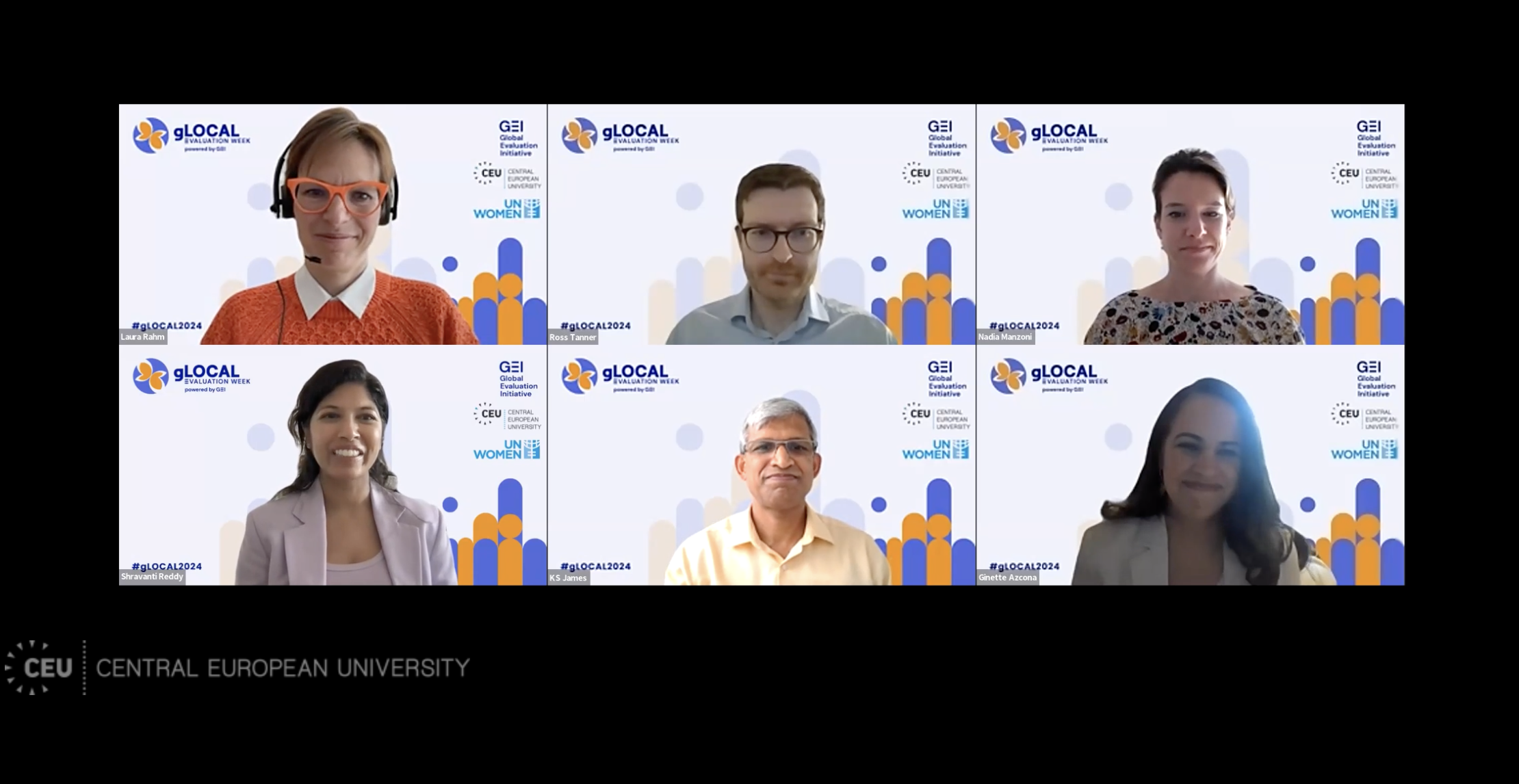
| Ginette Azcona | Senior Research and Data Policy Specialist at UN Women | Ginette Azcona is UN Women’s leading focal point on gender, data and the SDGs. She manages the data and statistics for UN Women’s flagship reports and has authored numerous publications, including the annual Progress on the Sustainable Development Goals: The Gender Snapshot. |
| Laura Rahm | MSCA Research Fellow, Department of Public Policy, Central European University. | Laura Rahm is a Political Demographer and Sociologist. She focuses her research on global governance, gender, monitoring, and evaluation. She has worked with UNFPA, UN Women, World Bank, and the German International Development Cooperation, among others. |
| KS James | Senior Visiting Scholar, Newcomb Institute, Tulane University | KS James is a leading demographer from India. Before joining Tulane University, KS James served as Director and Senior Professor of the International Institute for Population Sciences (IIPS), which produces the world's largest population survey: the National Family and Health Survey (NHFS). |
| Ross Tanner | Evaluation Specialist, UN Women's Independent Evaluation Service | Ross Tanner is an Evaluation Specialist with UN Women’s Independent Evaluation Service. He has worked on various evaluations, including an evaluation of UN Women’s policy advocacy work, a formative evaluation of UN Women’s work in climate change, and a recent UN Evaluation Synthesis on SDG 5. |
Moderators
| Nom | Titre | Biography |
|---|---|---|
| Shravanti Reddy | Evaluation Expert and Founder of Theory Action Group | Shravanti Reddy is a senior evaluation expert with over 20 years of experience working on complex evaluations and studies, mainly in the UN system. She is a systems thinker who specializes in the integration and intersection of gender equality, human rights and environmental issues within evaluation functions and processes. She is currently the Principal and Founder of Theory Action Group, a consulting firm, where she focuses on developing and testing innovative evaluation methods and approaches. |
Résumé
SDG 5 and the gender-specific measures across the other SDGs have strengthened the commitment to women's empowerment and gender equality. Yet, despite investments in data collection, processing, and dissemination, adequate and timely gender data remains insufficient. Data on marginalized groups of women and girls is even more limited. Greater efforts and multistakeholder partnerships are needed to promote gender data production and use, including from complementary sources reflecting women's lives. Evaluators play a crucial role in identifying solutions towards transformational change. Achieving SDG 5 is a collective effort requiring the application, testing, and scaling of effective strategies.
Engage diverse stakeholders to support the financing, collection, and dissemination of reliable, timely and disaggregated gender data.
Strengthen multi-stakeholder partnerships, joint programmes and coordination for advancing SDG 5 (Gender Equality) and all other SDGs from a gender perspective.
Enhance monitoring, research on partnership effectiveness, and localizing SDG 5 to advance gender equality and the 2030 Agenda.
Strengthen the measurement of outcomes and impact using a range of evaluation methodologies.
Advocate for more consistent use of theories of change in programme design to improve evaluability and learning from programmes.
Support national evaluation capacity development and strengthening of national information systems.
Image Gallery