Unpacking Use: What does it mean to use and utilize evaluations?
Table ronde | Hybride
-
Organisé par:
UNICEF
À propos de l'événement
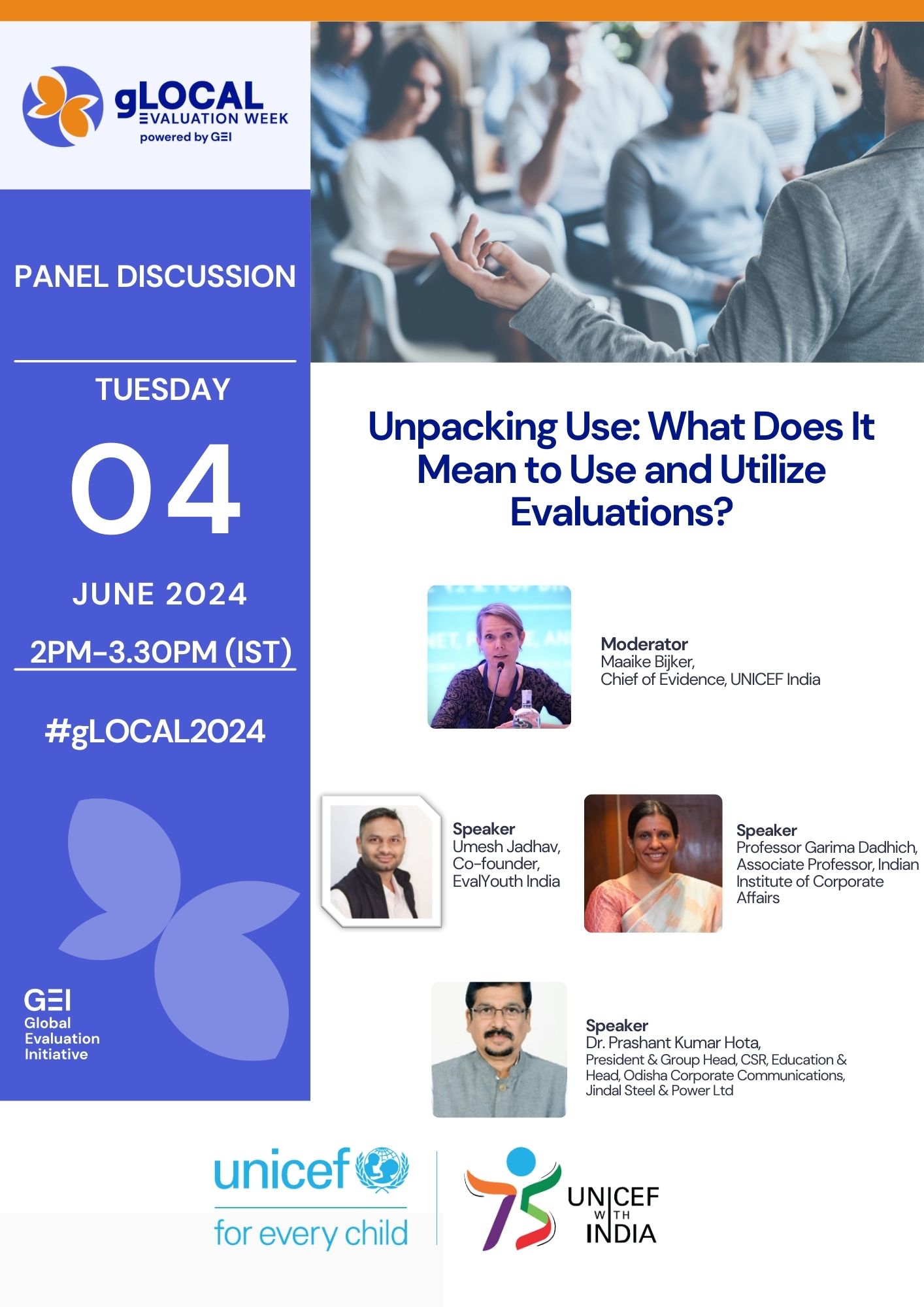
About the Session: Unpacking Use: What Does It Mean to Use and Utilize Evaluations?
There has always been a focus on generating new and high-quality evidence by conducting evaluations, improving the quality of evaluations, and deploying robust methodologies. However, there has been limited emphasis on the actual utilization of evaluation findings. This panel discussion takes a leap ahead by exploring the utilization of evaluations by a diverse set of stakeholders. Evaluations are conducted by various entities including governments, the private sector, academic institutions, civil society organizations, universities, and international multilateral organizations, each with distinct objectives. Yet, when considering the utilization of evaluation findings, the landscape becomes much more diverse. The utilization of evaluation findings encompasses a wide range of purposes, from enhancing program designs by program focal points, to informing policymaking and improving budget allocations by governments, to supporting research and publication endeavors by academic institutions, and more.
This session brings together UNICEF, private sector, government, as well as young evaluators for a discussion on unpacking what does meaningful use of evaluations and how it can be tracked. UNICEF India's research and evaluation specialist will make a presentation on UNICEF's lessons of examining use of its own evidence.
This 1.5-hour session aims to get perspectives of different stakeholders within the overall Monitoring and Evaluation ecosystem, on the various uses of evaluations. The session will draw focus on some of the best practices that aid the use and utilization of evaluations. The panelists will also speak about some key barriers or challenges around evaluation use. This will be followed by the panel's reflections and recommendations.
Some Themes which will be covered during the discussion:
Examples of good use of evidence, specifically evaluation findings. How can one track the use and utilization of the findings?
Challenges faced while using evaluation findings. Were there any unintended uses/results following an evaluation?
Some best practices deployed by organizations to circumvent some of the barriers that limit the use of evaluations.
Examination of contextual factors that affect the use of evaluations.
There has always been a focus on generating new and high-quality evidence by conducting evaluations, improving the quality of evaluations, and deploying robust methodologies. However, there has been limited emphasis on the actual utilization of evaluation findings. This panel discussion takes a leap ahead by exploring the utilization of evaluations by a diverse set of stakeholders. Evaluations are conducted by various entities including governments, the private sector, academic institutions, civil society organizations, universities, and international multilateral organizations, each with distinct objectives. Yet, when considering the utilization of evaluation findings, the landscape becomes much more diverse. The utilization of evaluation findings encompasses a wide range of purposes, from enhancing program designs by program focal points, to informing policymaking and improving budget allocations by governments, to supporting research and publication endeavors by academic institutions, and more.
This session brings together UNICEF, private sector, government, as well as young evaluators for a discussion on unpacking what does meaningful use of evaluations and how it can be tracked. UNICEF India's research and evaluation specialist will make a presentation on UNICEF's lessons of examining use of its own evidence.
This 1.5-hour session aims to get perspectives of different stakeholders within the overall Monitoring and Evaluation ecosystem, on the various uses of evaluations. The session will draw focus on some of the best practices that aid the use and utilization of evaluations. The panelists will also speak about some key barriers or challenges around evaluation use. This will be followed by the panel's reflections and recommendations.
Some Themes which will be covered during the discussion:
Examples of good use of evidence, specifically evaluation findings. How can one track the use and utilization of the findings?
Challenges faced while using evaluation findings. Were there any unintended uses/results following an evaluation?
Some best practices deployed by organizations to circumvent some of the barriers that limit the use of evaluations.
Examination of contextual factors that affect the use of evaluations.
Conférenciers
| Nom | Titre | Biography |
|---|---|---|
| Professor Garima Dadhich | Associate Professor, Indian Institute of Corporate Affairs | Prof. Garima Dadhich is an Associate Professor with the Indian Institute of Corporate Affairs (IICA), an autonomous institution under the Ministry of Corporate Affairs, Govt. of India. She is heading the School of Business Environment, Centre for Business and Human Rights and Centre for Responsible Business Advisory at IICA. |
| Dr. Prashant Kumar Hota | President & Group Head, CSR, Education & Head, Odisha Corporate Communications, Jindal Steel & Power Ltd | Dr. Prashant Hota made his transition into the private sector when he joined Vedanta Resources in Odisha in 2007 and subsequently in Jindal Steel & Power. During his present stint in Jindal Steel & Power in Odisha and Chhattisgarh Business has been acknowledged by Global Certifying agencies as a sustainable do-gooder for the Community for which several national and international awards have been conferred upon JSPL. Besides heading the CSR & Education of JSPL at the group level, Dr. Hota was heading the Group’s Sustainability for the last 5 years. |
| Umesh Jadhav | Co-founder, EvalYouth India | Umesh is an impact professional with 9+ years of diverse experience working with Govt and NPOs. He is a co-founder of the EvalYouth India. Umesh also works with the University of Chicago Trust India as an Engagement Manager and governance and mentors’ young policy professionals. |
Moderators
| Nom | Titre | Biography |
|---|---|---|
| Maaike Bijker | Chief of Evidence, UNICEF India | Maaike Bijker is the Chief of Evidence (Data, Research and Evaluation) at UNICEF India, with 10+ years of experience in research and evaluation internationally. She leads the Evidence for Children unit at UNICEF India, which is responsible for strategically prioritizing and technically supporting UNICEF-led evaluations, research, studies and monitoring activities commissioned by UNICEF. In addition, Maaike leads UNICEF’s external capacity building efforts in M&E, supporting partnerships for evidence across all UNICEF programmatic domains. Before joining UNICEF 5 years ago, Maaike worked as a Senior Research Manager at J-PAL South Asia in Delhi, leading a number of randomized-controlled trials in the areas of immunization, adolescent empowerment, education and environmental sustainability. She previously worked with Dalberg in London, SNEHA in Mumbai and the University of Cambridge, UK on research and evaluations. Maaike holds a Masters from LSE, UK, and a Masters from the University of Cambridge, UK. |
Résumé
Key Conclusions
• Evaluations are conducted by various entities including governments, the private sector, academic institutions, civil society organizations, universities, and international multilateral organizations, each with distinct objectives. Yet, when considering the utilization of evaluation findings, the landscape becomes much more diverse. The utilization of evaluation findings encompasses a wide range of purposes, from enhancing program designs by program focal points, to informing policymaking and improving budget allocations by governments, to supporting research and publication endeavors by academic institutions, and more.
• The panel attempted to bring together a diverse range of stakeholders (private sector, young evaluators, governments) to get their perspectives on the utility of evaluations within their ecosystems.
• Some of the key strategies, according to the panel, that can be deployed to support good use of evaluations includes – better planning of evidence and evaluations and use over a longer term; having a multi stakeholder engagement at the beginning of the conceptualization and incorporating different perspectives; generating evidence relevant to the needs of end users; ensuring good quality of the data and build ownership; design a communication plan at the conceptualization stage; and engage with government stakeholders and evidence users at different levels. The panel recognized the need to partner effectively amongst different types of stakeholders, think tanks, academia, research institutions, civil society organizations, and ultimately young people and children themselves to make sure that findings from evaluations are collectively taken up.
Value of Evaluations
• Evaluation becomes a very important tool for young professionals in the development sector since evidence generated from previous evaluation reports are referred for conducting research and even as a policy inputs for policy design. From the corporate point of view, to improve, evaluation is critical and there is economic, legal, but also ethical responsibility for evaluation. When evaluation findings demonstrate the positive impact of Corporate Social Responsibility (CSR) programs, businesses can pivot toward purpose driven actions. Thus, evaluations prove that there is value in social investment.
• Evaluations are inbuilt within Environmental, Social, and Governance (ESG) work since there is a requirement to develop baselines for ESG programs, policies and the metrics available in the company, to understand what peer companies are doing and then set ESG goals of the company. The goals have to be measurable (qualitative and quantitative targets) and the way to measure is through evaluation.
• It is mandatory for top listed companies to disclose their non-financial reporting which is known as business responsibility and sustainability reporting where they get a chance to utilize their evaluation techniques and disclose the company's performance.
• For the private sector, evaluations are very relevant for social work, but it is much beyond it. From the ESG perspective, evaluations have a critical role at various stages and as per the Companies Act, there is a mandatory evaluation requirement. Thus, it is important to understand the purpose of evaluation which essentially is real time monitoring, to assess the success, areas for improvement of a project, etc.
• • All the stakeholders- governments, private sector, academic institutions, CSOs, universities, and international multilateral organizations are working in one ecosystem, essentially towards the welfare of people and the communities.
• It is extremely important to ensure common evaluation agenda and all evaluations remain participatory – involving communities, the most marginalized, and the most vulnerable.
• As the demand for evaluative evidence is growing in funding/donor organizations, there is a need to develop a cadre of evaluators by investing in the training of the young people – a priority for institutions like EvalYouth India.
• To improve utilization, it is critical to liberate evaluations by making the evaluations reports more accessible through various channels. The utilization will also improve by producing and translating the evaluation reports in the local languages of India. More accessible evaluations will result in making the evaluations more participatory by sharing the knowledge with the communities, and communities contributing about the local dynamics, thus enriching the value and improving the quality of evaluations.
• There is a need to create general awareness and build capacities to translate the practice of monitoring and evaluation at all levels with all groups of stakeholders.
• There is a need to standardize the evaluation methods and principles since there are different thematic areas and community needs, and the projects cannot be evaluated using the common standards, or parameters.
• In terms of platforms, the Ministry of Corporate Affairs (MCA), Government of India has mandated to disclose impact assessment reports on their website, which includes details regarding the evaluation methods, and other aspects of the evaluation, making them more credible. This portal will also enable collaborations between private organizations. MCA is also undertaking other initiatives like publishing compendium best practices books, advocating exhibitions, etc.
Image Gallery