


Evaluating Development Programs
Table ronde
À propos de l'événement
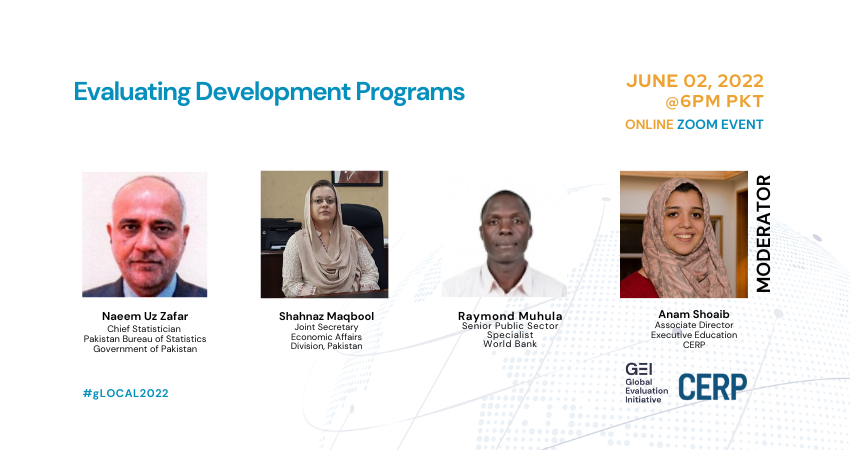
Panelists will be invited to discuss how the government in Pakistan can strengthen its existing mechanisms and processes for Evaluating Development Programs, specifically those tailored for infrastructure development and improvement in governance practices.
The experts will shed light on ways in which existing gaps within the M&E system can be improved to help evaluate the effectiveness of these programs along social, economic and environmental dimensions. They will highlight how and why it is critical to move away from simple Monitoring Outcomes towards data driven Impact Evaluation results to help the government assess how to dynamically improve programs in the future. The discussion will focus on ways in which such improvements can be made over time within the country.
The experts will shed light on ways in which existing gaps within the M&E system can be improved to help evaluate the effectiveness of these programs along social, economic and environmental dimensions. They will highlight how and why it is critical to move away from simple Monitoring Outcomes towards data driven Impact Evaluation results to help the government assess how to dynamically improve programs in the future. The discussion will focus on ways in which such improvements can be made over time within the country.
Conférenciers
| Nom | Titre | Biography |
|---|---|---|
| Shahnaz Maqbool | Economic Affairs Division, Pakistan | Shahnaz heads the Public Relations wing of the Federal Board of Revenue (FBR), the apex policymaking entity of the Revenue Division, under the Ministry of Finance, and is also a Member on its board. She holds a Master's in Public Administration from Harvard University. |
| Naeem Uz Zafar | Pakistan Bureau of Statistics, Government of Pakistan | Dr. Naeem completed his PhD in economics from Northern Illinois University, USA in 2010. Prior to that, he did his MBA from Institute of Business Administration, Karachi and undergraduate in Mechanical Engineering from NED University, Karachi. |
| Anam Shoaib | Associate Director, Executive Education | Anam is the Associate Director for the Executive Education vertical at CERP. Her niche area of her expertise is curriculum and case study design. She holds a Master’s Degree in Public Policy with an International Development specialization from Duke University. |
| Raymond Muhula | Senior Public Sector Specialist | Raymond coordinates the World Bank’s Governance Program in Pakistan where he leads various projects at the federal and provincial levels. His work has covered areas tax administration, public financial management, and civil service reforms. |
Résumé
It is needed to implement on international best practices for M&E in developing countries, like Pakistan itself, to evolve in terms of ensuring accountability and transparency in government projects. As there is a lack of resources in Pakistan’s Planning Commission to monitor and evaluate, there are no training and career development programs for M&E or appointed specialists to give recommendations for final approval of development projects. In addition, project directors that are heading a project from executing agencies are not appointed from day one of initiation of the project; therefore, they are not fully aware about the whole process and design of a project. There is also no system in place for beneficiaries’ feedback because most resources and investment go into infrastructure or social services projects. Moreover, background experience is also lacking and other than National Highway Authority, no other ministry has specialists for M&E who have a prior training related to tasks. Moreover, there is no knowledge available for data collection due to which data is not available in user friendly form for policy making. Other than that, there is no institutional memory that is to preserve and store knowledge. Regarding good governance indicators, there are no specific indicators designed for a particular country that would measure excellent outcomes in one region as outcome for a development project in one country could be different from another country. Lastly, after the completion of project, there is no mechanism to share findings of achievement or mistakes in implementation of a project.
There is a need to strengthen M&E system in developing countries, like Pakistan, which generates evidence for better policy and decision making in future. Government departments like Pakistan’s Planning Commission should also come up with customized indicators that reflect on projects to see whether development is happening properly. Moreover, for capacity building, workshops need to be arranged that show significance of investing more on evaluation than continuous expansion of a particular project, and on appointment of specialized M&E experts.