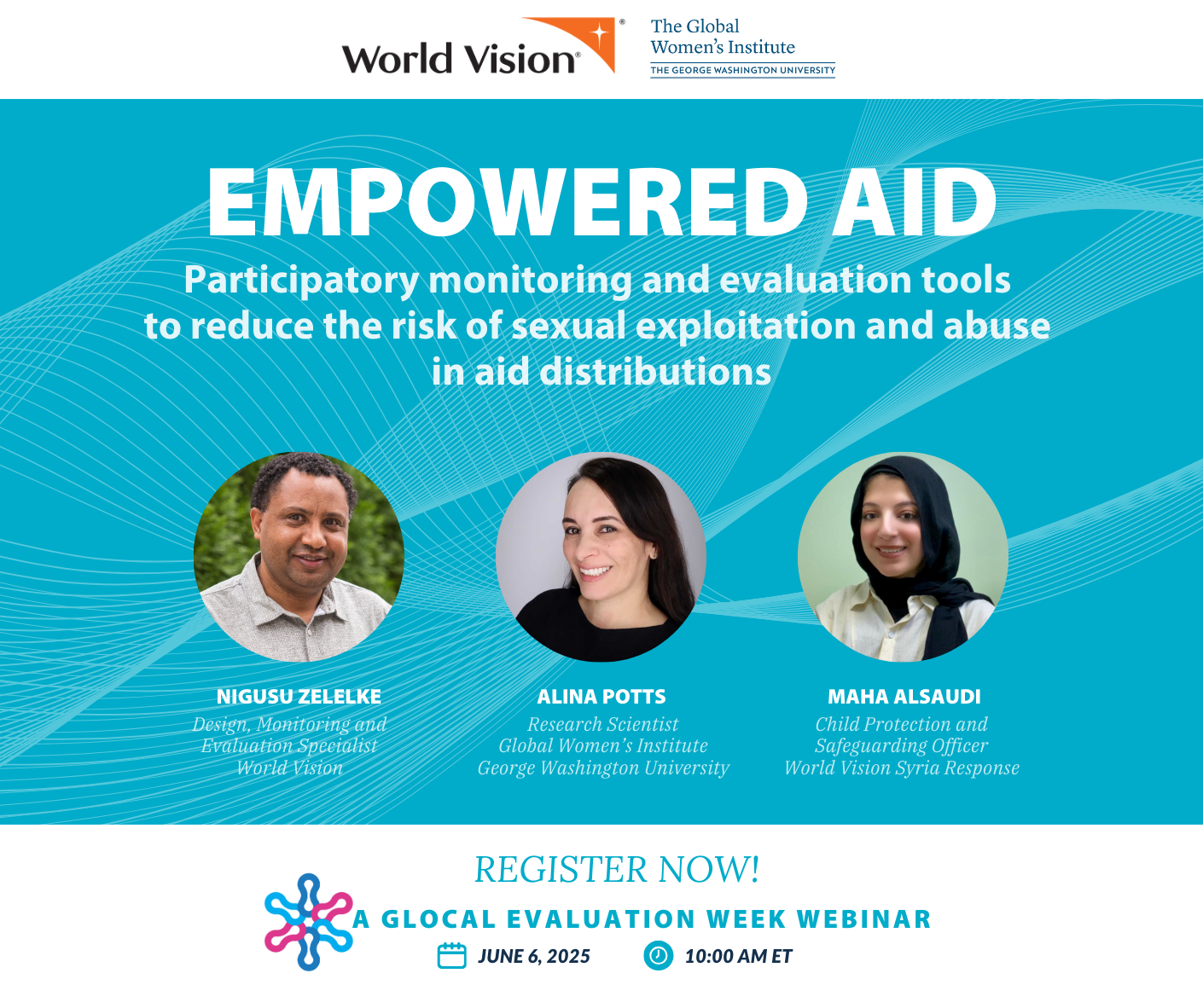
Empowered Aid: Participatory Monitoring and Evaluation tools to reduce the risk of sexual exploitation and abuse in aid distributions
Webinar | Online
-
Organized by:
WVUS
About the Event
The Empowered Aid initiative, led by the Global Women's Institute (GWI) in collaboration with global implementing partners, pioneers participatory approaches to combat sexual exploitation and abuse (SEA) in aid distribution. Recognizing the unique vulnerabilities and knowledge of refugee women and girls, Empowered Aid engaged them as co-researchers in Lebanon and Uganda, documenting the SEA risks they face when accessing humanitarian aid. The findings of this participatory action research were then used to develop effective, context-specific ways to mitigate the risk of SEA in aid distributions by adapting distribution modalities and monitoring tools. All tools and resources developed are freely shared, including in a free online course taught by the refugee women and girl co-researchers. This demonstration session led by GWI and one of its key partners, World Vision, offers attendees an orientation into the Empowered Aid model, showcasing its dual focus on participatory action research and implementation science. Participants will gain insights into the project's methodologies, from its initial phases of participatory data collection to how solutions identified through participatory approaches are tested for effectiveness and scaled up through implementation science approaches. Key results and highlights will be shared to illustrate what how these approaches supported aid programs with the development and implementation of strategies aimed at enhancing the safety and satisfaction of aid recipients—such as increasing the presence of female aid workers and transitioning to household-level aid distribution. Beyond the presentation of the process, tools, and outcomes, this session will explore the Empowered Aid's locally led approach. By integrating the lived experiences and expertise of refugee women and girls into the fabric of humanitarian aid delivery, Empowered Aid has not only improved safety perceptions and recipient satisfaction but has also charted a path for scaling these participatory methodologies to other contexts. The project's case studies from Lebanon, Uganda, Bangladesh, Jordan, Kenya, and Türkiye underscore the scalability and effectiveness of empowering those most affected by crisis to lead in the creation of safer, more equitable aid distribution systems. Designed for both domestic and international humanitarian practitioners, this session encourages a robust discussion on the practicalities of embedding participatory methods and monitoring within aid distributions. It invites a rethinking of traditional power dynamics within humanitarian aid, advocating for a shift towards greater accountability, inclusivity, and equity. Through a combination of presentations by GWI researchers and World Vision practitioners, and interactive discussions, attendees will leave equipped with the knowledge and inspiration to integrate these pioneering approaches into their own work, transforming the way aid is delivered to some of the world's most vulnerable populations.
Speakers
| Name | Title | Biography |
|---|---|---|
| NIGUSU ABOSET ZELELKE | Design Monitoring and Evaluation Specialist | Nigusu Zelelke has 16 years of experience in program design, monitoring, evaluation, and accountability systems. He is currently the Design Monitoring and Evaluation Specialist for the Evidence and Learning, Program Quality, and Impact Division at WVUS and supports the HEA grant portfolio across three regions. He passionate about indicators, impact methodology, program quality, and capacity building. Nigusu holds a Master’s Degree in Public Health, an MA in Sociology and Social Anthropology, and a Master’s in International Cooperation and Humanitarian Aid. |
| Alina Potts | Research Scientist | Alina Potts is a Research Scientist at the Global Women’s Institute at the George Washington University and former aid worker. Her work addressing gender-based violence in humanitarian settings uses participatory methods to center the expertise of crisis-affected women and girls, with a focus on preventing sexual exploitation and abuse (Empowered Aid), and providing mental health and psychosocial support services to survivors. For over a decade, she worked with UNICEF and IRC in a number of humanitarian emergencies. She holds a BA in Anthropology and International Development from Boston University and a MPH from Columbia University, and enjoys teaching and mentoring. |
| Maha AlSaudi | Child Protection and Safeguarding Officer | Maha is the Child Protection and Safeguarding Officer at World Vision Syria Response in Jordan. She holds an MSc in Clinical Psychology from the University of Edinburgh, specialising in the mental health of children and young people. With six years of experience in international non-governmental organisations, Maha is committed to enhancing child protection and safeguarding practices while advocating for gender issues, leveraging her expertise to create a positive impact in the lives of vulnerable children and communities. |
Summary
This session highlighted the use of participatory monitoring and evaluation (M&E) tools to identify, mitigate, and prevent risks of sexual exploitation and abuse (SEA) in the delivery of humanitarian aid. Drawing on findings from Lebanon, Uganda, and Jordan, the presenters discussed how participatory action research, grounded in feminist and anthropological methods, can be used to develop safer, more inclusive aid delivery models. We’ve explored how participatory approaches—especially centering the voices of women and girls—can transform how aid is delivered, making it safer and more accountable.
The session was attended by a diverse group of humanitarian and development professionals, including M&E specialists, gender and protection advisors, donor agency representatives, and program managers from international NGOs, UN agencies, and local organizations. Participants engaged in robust dialogue around practical strategies for SEA prevention, challenges in field implementation, and opportunities to scale evidence-based models. Key Takeaways
1. Center Women and Girls in Aid Design
2. Elevate Women and Girls as Experts
3. Use M&E as a Preventive Tool
Image Gallery