When SEL Travels: Translation, Visibility, and Power in the Global South
Mesa redonda | En línea
-
Organizado por:
Dream a Dream, India
Sobre el evento
Social and Emotional Learning (SEL) is increasingly embedded within education systems as a response to concerns around wellbeing, engagement, and social cohesion. Yet, as SEL enters systems through frameworks of evaluation and measurement, a critical question emerges: what becomes visible, valued, or rendered invisible when SEL is evaluated?
The panel’s primary exploration is: How does evaluation shape what counts as Social and Emotional Learning in education systems, and what becomes visible, valued, or invisible when SEL is measured in Global South contexts?
This panel is explicitly positioned from a Global South lens, centering contexts where education systems are shaped by historical inequalities, cultural plurality, and layered socio-political realities. It brings together practitioner-researchers to examine how SEL is understood, documented, and governed within public education systems. Rather than assuming a universal form of SEL, the panel interrogates how evaluation frameworks shape what counts as valid knowledge, often privileging standardized, comparable indicators while overlooking relational, contextual, and culturally embedded practices.
In Global South contexts, pedagogies of care, relational teaching, and community-based ways of engaging with emotions already exist but remain largely unrecognized within formal systems of evaluation. As a result, they are difficult to sustain and often rest disproportionately on teachers. The issue, therefore, is not whether SEL should be evaluated, but how systems decide what is worth measuring. Education systems tend to measure what they value but also come to value only what can be measured.
As data systems and artificial intelligence increasingly shape evaluation, these tensions intensify, risking forms of evidence that appear objective yet remain distanced from lived realities.
By centering practitioner-researchers, this panel positions the Global South not as a site of implementation but as a site of critique and knowledge production, calling for evaluation approaches that are contextual, relational, and grounded in practice.
The panel’s primary exploration is: How does evaluation shape what counts as Social and Emotional Learning in education systems, and what becomes visible, valued, or invisible when SEL is measured in Global South contexts?
This panel is explicitly positioned from a Global South lens, centering contexts where education systems are shaped by historical inequalities, cultural plurality, and layered socio-political realities. It brings together practitioner-researchers to examine how SEL is understood, documented, and governed within public education systems. Rather than assuming a universal form of SEL, the panel interrogates how evaluation frameworks shape what counts as valid knowledge, often privileging standardized, comparable indicators while overlooking relational, contextual, and culturally embedded practices.
In Global South contexts, pedagogies of care, relational teaching, and community-based ways of engaging with emotions already exist but remain largely unrecognized within formal systems of evaluation. As a result, they are difficult to sustain and often rest disproportionately on teachers. The issue, therefore, is not whether SEL should be evaluated, but how systems decide what is worth measuring. Education systems tend to measure what they value but also come to value only what can be measured.
As data systems and artificial intelligence increasingly shape evaluation, these tensions intensify, risking forms of evidence that appear objective yet remain distanced from lived realities.
By centering practitioner-researchers, this panel positions the Global South not as a site of implementation but as a site of critique and knowledge production, calling for evaluation approaches that are contextual, relational, and grounded in practice.
Presentador/a
| Nombre | Título | Biografía |
|---|---|---|
| Ms. Sarah Khan | Founder & Principal, Sarah Khan Associates (Pvt) Ltd, Pakistan | Sarah Khan is the Founder and Principal of Sarah Khan Associates, a Karachi-based behavioral systems and research translation firm. She has been working extensively in the field of social and emotional learning (SEL), with a focus on bridging research, practice, and policy in culturally diverse contexts. Her work sits at the intersection of research rigour, cultural relevance, and systems change, using SEL as a lever for human capital development. She currently serves as the Anchor Organisation Lead for the PSS-SEL Toolbox, an initiative of Harvard University’s EASEL Lab and INEE, where she leads the contextualisation of global SEL frameworks for South Asian settings. Grounded in the belief that frameworks developed in one context require systematic cultural adaptation before they can be meaningfully applied elsewhere, Sarah led the development of a behavioral assessment rubric over two and a half years. This work underpins a digital tool now used by over 13,000 users across five countries, and recognised as the Best Digital Product at GESS Dubai 2025. She also hosts The Translation Gap: When SEL Travels, a podcast that fosters cross-regional dialogue between Global South and Global North practitioners, exploring how SEL knowledge evolves across contexts, cultures, and power dynamics |
| Dr. Bhawana Shrestha | Co-founder, My Emotions Matter, Nepal | Dr. Bhawana Shrestha is an educator, researcher, and social-emotional learning (SEL) practitioner specialising in emotionally inclusive, compassionate, and equity-centred education across transnational contexts. She brings extensive experience in advancing SEL, student wellbeing, and research-led pedagogies through both practice and research. She currently serves as a Research Fellow at Xi’an-Jiaotong-Liverpool University, China, where she leads initiatives in SEL, student wellbeing, and educational innovation. As Co-Founder of My Emotions Matter, a social enterprise based in Nepal, she has designed and facilitated emotional literacy and wellbeing programmes for teachers and adolescents, while collaborating with global organisations including UNICEF, WHO, and Teach For All. Her work draws on frameworks such as emotional intelligence, Nonviolent Communication (NVC), and SEL to advocate for education systems grounded in empathy, dignity, emotional safety, and social justice. A TED-Ed trained educator and award-winning literacy advocate, she is a recipient of the Nepal Vidhyabhushan ‘Ka’ award from the Government of Nepal and has been recognised as an International Literacy Association 30 Under 30 Literacy Leader and an Echidna Global Scholar at The Brookings Institution. |
| Manjula Dissanayake | Founding Executive Director, Educate Lanka Foundation, Sri Lanka | Manjula Dissanayake is an investment banker turned social entrepreneur and the Founder of Educate Lanka Foundation, a nonprofit organisation dedicated to unleashing the potential of young people by expanding equitable and inclusive learning opportunities. He brings extensive experience working at the intersection of education, workforce development, and social innovation across global contexts. He currently leads initiatives that democratise access to learning and enable pathways for young people to learn, lead, and thrive. A passionate advocate for equity and inclusion, he actively contributes to global conversations on education and workforce transformation. His TEDx talk, “Talent is universal. Opportunity is not.”, reflects his commitment to ensuring that all young people have access to opportunities. His work spans leadership roles across global networks. He serves on the Board of the Learning Economy Foundation and on the Executive Committee of Karanga: The Global Alliance for Social Emotional Learning and Life Skills. He is also a Salzburg Global Fellow and a World in 2050 Senior Fellow. He holds a Bachelor’s degree in Finance from the University of Maryland and a Master’s degree in International Development and Social Innovation from The Fletcher School at Tufts University. Based in Washington, DC, he divides his time between the United States and Sri Lanka. |
| Dr. Tabassum Amina | Associate Professor, BRAC Institute of Educational Development, Bangladesh | Dr. Tabassum Amina is an educator and academic leader specialising in social-emotional learning (SEL), mental health, and wellbeing-centred education. She brings extensive experience in integrating SEL and psychosocial support into education systems, with a focus on early childhood development, adolescent wellbeing, and community resilience. She currently serves as Associate Professor and Head of Academics at BRAC Institute of Educational Development, BRAC University, Bangladesh. She also leads mental health initiatives aimed at building community-based psychosocial support systems and embedding SEL and mental health awareness across programmes addressing education, climate change, and youth empowerment. Her work is centred on advancing mental health as an integral component of holistic development and positioning education systems as critical spaces for early awareness, prevention, and care. She teaches graduate courses and works to integrate SEL into learning environments to strengthen individual capacities to address mental health challenges across the lifespan. She holds a PhD from the University of Illinois at Urbana-Champaign and a Master’s degree from Columbia University. |
| Dr. Sreehari Ravindranath | Director, Research and Impact, Dream a Dream, India | Dr. Ravindranath is a researcher and educator specialising in social and emotional learning, wellbeing-centred pedagogies, and enabling children and young people to thrive in adversity. He brings over 15 years of experience working across education systems in the Global South, leading large-scale initiatives on social and emotional learning, teacher mindsets, and evidence-informed policy reform. He currently leads research and education system transformation initiatives that bridge practice, policy, and evidence across Indian states and global networks. His work is centred on cultivating equitable, human-centred education systems that support holistic development, strengthen systemic resilience, and expand what education systems value, measure, and prioritise. He holds a PhD and an MA in Life Skills Education from Rajiv Gandhi National Institute of Youth Development (RGNIYD), and a BA in Psychology from Mahatma Gandhi University |
Moderador/a
| Nombre | Título | Biografía |
|---|---|---|
| Anagha C | Associate Manager, Research and Impact Assessment, Dream a Dream, India | Anagha is a researcher at Dream a Dream, working at the intersection of wellbeing, learner agency, and social-emotional learning. She holds a Master’s in Applied Psychology from TISS and has worked across education systems, community wellbeing, and public health. Her work focuses on reimagining learning and assessment to support holistic development and enable young people to thrive. |
Resumen
The discussion highlighted that SEL is not a new concept being introduced into different contexts, but one that has long existed through caregiving, community relationships, storytelling, and collective responsibility. As SEL becomes increasingly formalised, preserving context emerged as critical, recognising that wellbeing, agency, and flourishing are shaped by local histories and cultures. Participants also emphasised that evaluation is not neutral: what gets measured becomes visible, valued, and funded, often sidelining equally meaningful but less measurable aspects of learning. Finally, while AI presents opportunities to support educational practice, its use must remain grounded in human judgement and contextual understanding to avoid reinforcing existing blind spots and exclusions.
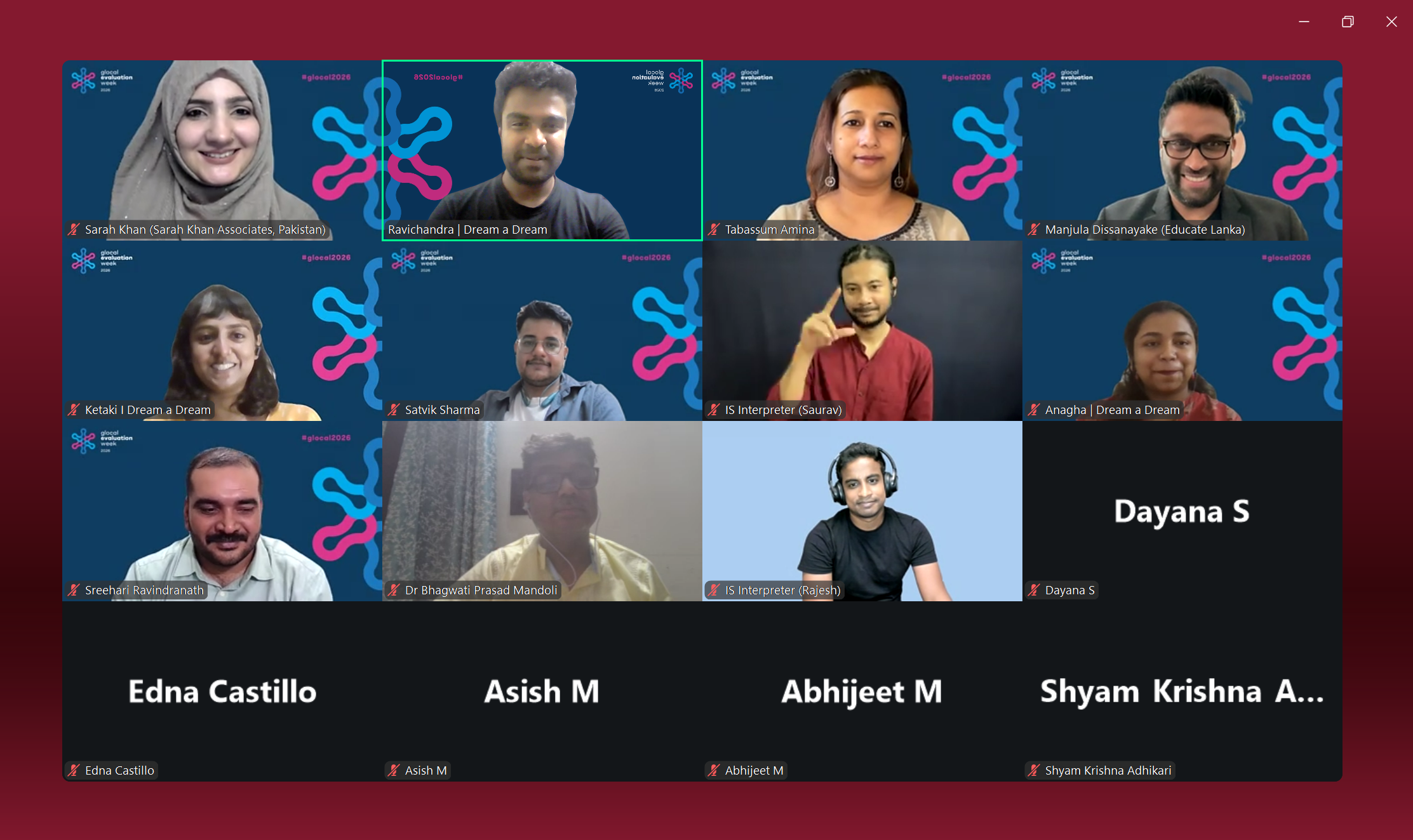
The session underscored the need to sustain spaces for dialogue and exchange across contexts, enabling practitioners, researchers, and policymakers to learn from one another's experiences. Participants called for greater recognition and documentation of locally grounded SEL practices and for evidence-building efforts that draw from lived realities rather than relying solely on standardised frameworks. Future evaluation approaches should incorporate diverse forms of evidence, including narratives, observations, and community perspectives. As AI becomes more prominent in education, its development and use should prioritise cultural responsiveness, complement human interpretation, and support more nuanced understandings of children's learning and wellbeing.
galería de imágenes