Ethics, Standards, and Human Judgement in Evaluation: Have We Arrived at the Age of AI?
Mesa | En línea
-
Organizado por:
I’M Every Woman (Durga India)
Sobre el evento
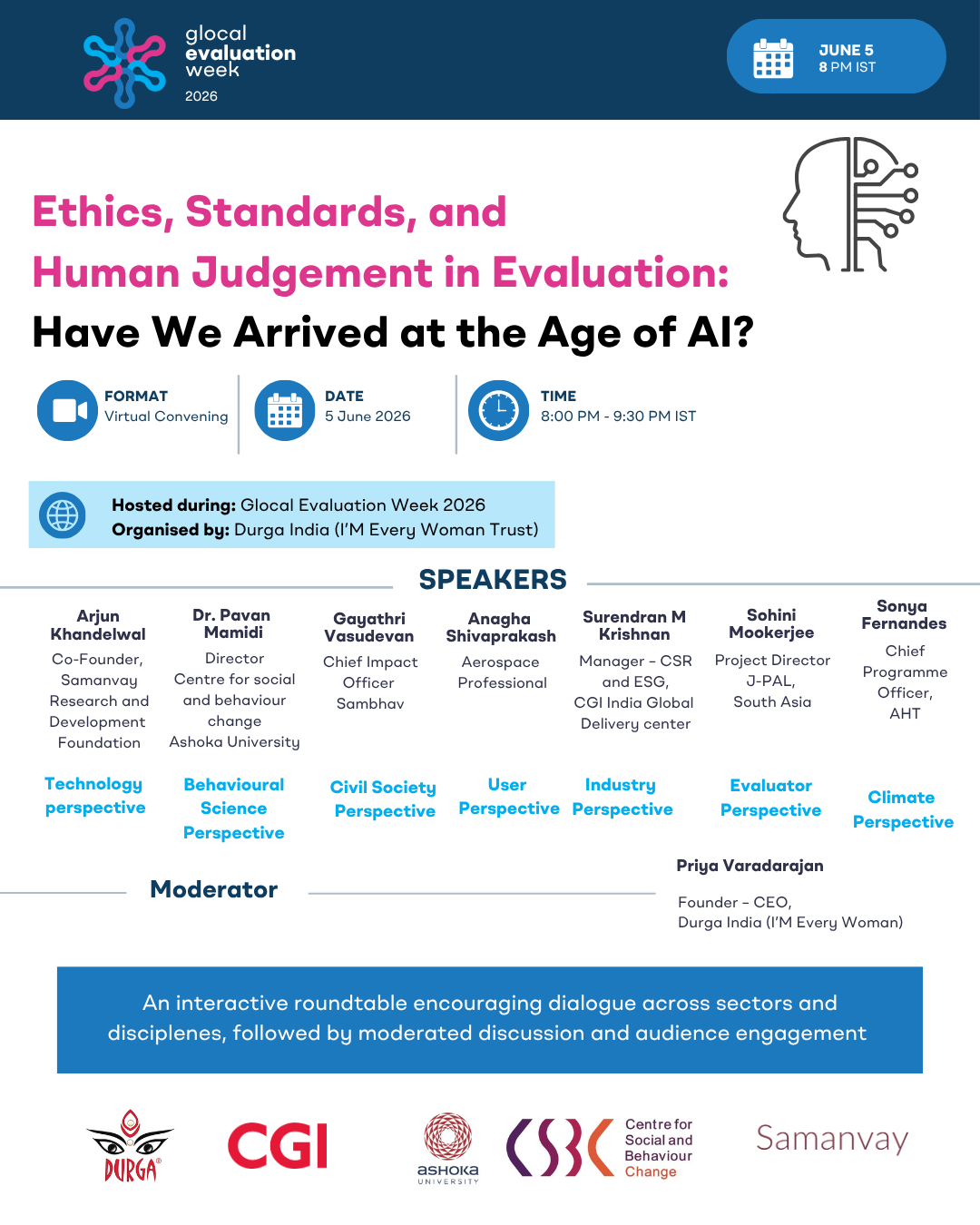
As artificial intelligence becomes embedded in research, monitoring, and evaluation, evaluators and development practitioners are confronted with new ethical questions. While AI promises efficiency, scale, and new analytical possibilities, it also raises concerns around bias, accountability, data governance, and the erosion of human judgement.
This roundtable brings together voices across the ecosystem—NGOs, researchers, technology partners, youth representatives, and donor agencies—to reflect on a central question:
Has AI enhanced ethical evaluation practice, or has it complicated it?
Objectives of the Roundtable
1. Interrogate the role of AI in evaluation practice and its implications for ethical standards.
2. Examine the continued importance of human judgement in interpreting data, context, and lived experiences.
3. Explore power dynamics and accountability when algorithms are introduced into decision-making.
4. Identify practical guardrails for responsible use of AI in evaluation.
This roundtable brings together voices across the ecosystem—NGOs, researchers, technology partners, youth representatives, and donor agencies—to reflect on a central question:
Has AI enhanced ethical evaluation practice, or has it complicated it?
Objectives of the Roundtable
1. Interrogate the role of AI in evaluation practice and its implications for ethical standards.
2. Examine the continued importance of human judgement in interpreting data, context, and lived experiences.
3. Explore power dynamics and accountability when algorithms are introduced into decision-making.
4. Identify practical guardrails for responsible use of AI in evaluation.
Presentador/a
| Nombre | Título | Biografía |
|---|---|---|
| Arjun | Co-Founder, Samanvay Research and Foundation | Arjun is the co-founder of Samanvay Research and Development Foundation, where he works with grassroots organisations to design and implement technology systems that strengthen field programmes and social impact. He also leads Avni, an open-source and highly adaptable fieldwork MIS platform used across sectors such as health, nutrition, education, and water. With over 20 years of experience in software product development and consulting, Arjun brings a technology perspective grounded in field realities and community-based work. His interests lie in building humane and equitable technology systems that remain accountable to the people and contexts they are meant to serve. |
| Sohini Mookherjee | Project Director at J-PAL South Asia | Sohini Mookherjee is a Project Director at J-PAL South Asia, where she leads the Capacity Accelerator Network (CAN), a Wellcome- and Mastercard Center for Inclusive Growth-supported initiative that strengthens data and AI capability in climate and health by building both talent pipelines and organizational capacity. She is a member of J-PAL South Asia’s Senior Management Team and contributes to the office’s strategic direction. With extensive experience working across governments, multilateral organizations, and civil society in South Asia, her work focuses on strengthening evidence use for decision-making and building institutional capability for sustained data-driven policymaking. She previously served as Interim Associate Director of Training and Director of CLEAR South Asia, leading large-scale capacity-building partnerships. Sohini is also a Principal Investigator on a J-PAL randomized controlled trial in Bengaluru examining interventions to improve bystander response to sexual harassment in public transport |
| Anagha Shivaprakash | Aerospace Engineer in a US-based aerospace organization | Anagha is an Aerospace Engineer with 5+ years of experience working with a US-based aerospace organization. In her current role, she works at the intersection of technology, strategy, and partnerships by collaborating with innovators, startups, and academia. She is passionate about increasing representation for underrepresented communities in STEM, and has led several STEM-focused initiatives that align with the cause. Apart from work, she loves volunteering, solo travelling, scuba diving, hiking, running, and experiencing different cultures. |
| Dr. Gayathri Vasudevan | Founder and Chairperson of Sambhav Foundation | Dr. Gayathri Vasudevan is the Founder and Chairperson of Sambhav Foundation, an organisation committed to enabling sustainable livelihoods and improving the quality of life of vulnerable communities through education, employability, and entrepreneurship. With a deep commitment to labour, livelihoods, and social inclusion, Dr. Gayathri has worked extensively at the intersection of policy, community mobilisation, skilling, employment, and enterprise development. Her work has focused on enabling youth, women, and marginalised workers to access dignified livelihoods, build economic resilience, and move towards micro-entrepreneurship. Prior to founding Sambhav Foundation, she worked with the International Labour Organization, a United Nations agency, between 1999 and 2007. She holds a Doctorate in Development Studies and has authored numerous publications on labour, employment, and gender. Dr. Gayathri’s contribution to the social development and livelihoods ecosystem has been widely recognised. She was named among the Top 50 Women in Business by Business Today in 2017, received the Forbes India Entrepreneur of the Year Award in the Social Business category in 2018, and was a recipient of the NITI Aayog Women Transforming India Award in 2021. She has also been a TED speaker on multiple occasions. Her work continues to be driven by a clear belief that livelihoods are central to dignity, mobility, and long-term social transformation. |
| Surendran M. Krishnan | CSR and ESG leader | Surendran M. Krishnan is a CSR and ESG leader with over 15 years of experience spanning technology, sustainability, volunteering, and social impact. He currently leads Corporate Social Responsibility and ESG initiatives for CGI India, where he drives programs across education, digital inclusion, skilling, environment, and community development in partnership with NGOs, government institutions, and civil society organizations. Having transitioned from a technology consulting career into the social impact sector, Surendran brings a unique perspective on the intersection of technology and human development. His work includes advancing STEM education, digital inclusion, green skilling, responsible use of emerging technologies, and large-scale employee volunteering. He is also the Co-Founder of V The Volunteers, a citizen-led movement that has mobilized thousands of volunteers for community action across India. For discussions on AI and evaluation, he brings a practitioner’s perspective on balancing technological innovation with ethics, inclusion, accountability, and human-centred decision-making in development programs. |
| Dr. Pavan Mamidi | Professor and Director of the Centre for Social and Behavior Change (CSBC) at Ashoka University. | Professor Pavan Mamidi is a Behavioural Economist and the Director of the Centre for Social and Behaviour Change (CSBC) at Ashoka University. His work spans two key areas: law and policy on emerging technologies (privacy, AI, and autonomy) and applied behavioral science. As Director of CSBC, he has played a pivotal role in establishing India's first Nudge Unit and state-level Behavioral Insights Units in Uttar Pradesh and Bihar. His research focuses on health and nutrition. He holds a Ph.D. from the University of Oxford, an LL.M. from Harvard Law School, and a Bachelor's in Mathematics from Osmania University |
| Sonya Fernandes | Chief Program Officer at AHT | Sonya brings extensive expertise across South Asia’s non-profit, research, and philanthropy sectors, with a focus on decentralized clean energy, renewable energy investments, and the food-water-energy nexus. Her career includes roles at TERI (The Energy and Resources Institute), REEEP (Renewable Energy and Energy Efficiency Partnership), and REN21, where she led the REEEP South Asia Secretariat and co-founded PFAN (Private Finance Advisory Network). She has collaborated with over 200 NGOs and social enterprises, evaluating program models, leadership, and funding strategies. Her work has helped secure over $11 million in grant funding, and she has established strategic plans, grant-making initiatives, and operational frameworks for impactful philanthropy. |
Moderador/a
| Nombre | Título | Biografía |
|---|---|---|
| Priya Varadarajan | Founder & CEO of Durga India – I’m Every Woman | Priya Varadarajan is the founder of Durga – I’m Every Woman, a nationally recognized gender justice initiative that reimagines how women and girls occupy public spaces in India. Born from her own lived experience and a refusal to accept normalized misogyny, Durga was established as a bold, intersectional response to the question: “How can women and girls truly belong in public spaces?” Under Priya’s leadership, Durga has evolved into a systems-change organization that blends behavioral science, grassroots mobilization, and institutional partnerships. The initiative has introduced pioneering interventions—including India’s first panic alarm system in public transport—trained over 5,000 active bystanders, and collaborated with 75+ colleges to co-create safe, inclusive campuses. Its programs for gender-just informal workspaces, bystander intervention, and public safety campaigns have shifted both norms and policy conversations. But Priya’s influence extends well beyond Durga. She previously led the Gender Justice, Disabilities, and Mental Health portfolio at the Azim Premji Foundation, overseeing a pan-India grantmaking program supporting over 400 partners with an annual portfolio of INR 100 crore. Her leadership helped shape the foundation’s anti-trafficking strategy and build inclusive grantmaking frameworks rooted in dignity and justice. As Program Manager at Co-Impact, a global collaborative for systems change, Priya led strategy and partnerships across Asia, supporting civil society organizations in India, Sri Lanka, and Malaysia. Her work included advancing women’s leadership in law and policy, care economy frameworks, and stigma-free access to sexual and reproductive health rights. Priya is also a state representative on multiple government committees addressing child marriage, inheritance law reform, and workplace gender justice. She is a visiting faculty member on gender studies, a Theatre of the Oppressed facilitator, and a passionate public speaker and writer whose early life experiences continue to fuel her pursuit of equity. With two decades of experience across philanthropy, policy, and grassroots action, Priya is now focused on deepening and scaling Durga’s mission. Her next decade of work is guided by a clear vision: to embed gender equity across public systems, create intentional and inclusive interventions, and empower communities to challenge and reset the norms that allow discrimination and violence to persist. For Priya, Durga is more than an organization—it is a life’s purpose to ensure that women and girls don’t just survive, but thrive in every space they claim. |
Resumen
We believe technology should strengthen human agency, not replace it. If AI can help reduce administrative burdens, identify patterns, democratise knowledge, and make evidence more accessible, that is valuable. But the future we should aim for is not one where machines make all the decisions—it is one where technology enables people and communities to make better decisions.
Ultimately, safety, justice, dignity, and social change have always depended on human beings choosing to act. The question we must keep returning to is: How do we ensure that AI serves people, communities, and the planet—not just efficiency, scale, or profit? The discussion was hopeful and reinforced our shared responsibility to shape AI with care and accountability.
One of the strongest calls to action emerging from the discussion was the need to be more conscious and reflective about our use of generative AI. We cannot assess AI solely by what it makes easier or faster; we must also ask critical questions: Who profits from these technologies? Whose labour, knowledge, and resources make them possible? Who bears the social and environmental costs of their development and use? As individuals and organisations working for social change, we need to build critical AI literacy and remain accountable to our values. If our work is ultimately for people and communities, then our choices around AI must prioritise dignity, equity, justice, and collective wellbeing over convenience, efficiency, or profit.
galería de imágenes