


Advancing the Tokyo Call for Action for Strong National Evaluation Systems
Mesa redonda | En línea
-
Organizado por:
Asia Pacific Evaluation Association (APEA)
- En alianza con: Asia Pacific Parliamentarians Forum For Evaluation (APPFE)
Sobre el evento
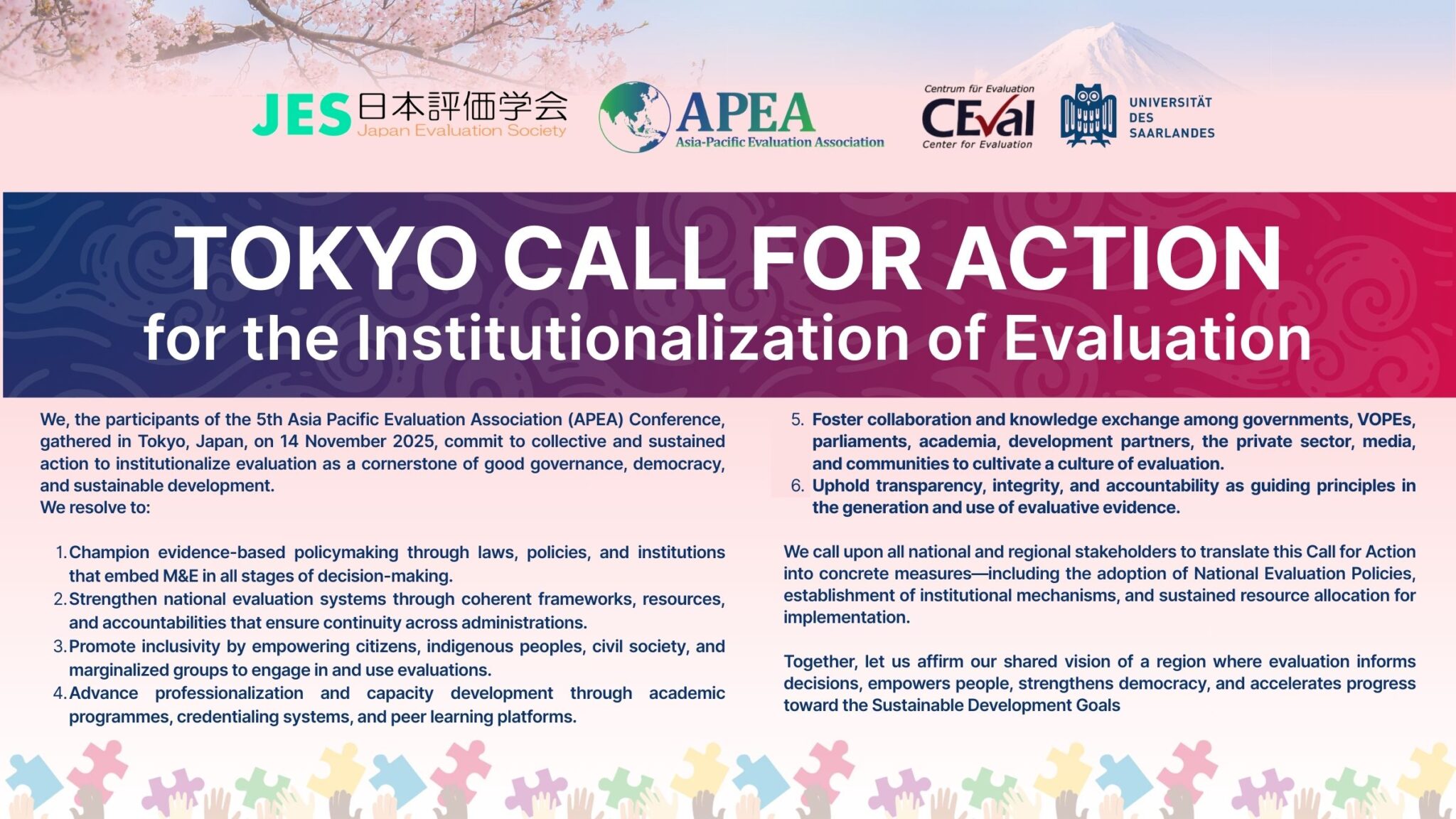
The Tokyo Call for Action, adopted at the 5th Asia Pacific Evaluation Association (APEA) Conference in Tokyo in November 2025, represents a renewed and urgent commitment to institutionalizing evaluation as a cornerstone of good governance, democracy, and sustainable development. Building on earlier global and regional commitments including the Colombo and Manila Declarations, it emphasizes the critical role of monitoring and evaluation (M&E) systems in strengthening evidence-based policymaking, transparency, and accountability in an increasingly complex and uncertain world. This webinar will bring together a diverse group of speakers to reflect on these commitments, share country experiences, and explore practical pathways for translating the Tokyo Call for Action into strengthened national evaluation systems and improved development outcomes.
Presentador/a
| Nombre | Título | Biografía |
|---|---|---|
| Dr Asela Kalugampitiya | National Evaluation Capacity Development Specialist, UNFPA | Asela Kalugampitiya has Masters and PhD in evaluation. He is a visiting lecturer at University of Saarland, Germany and at the University of Sri Jayewardenepura, Sri Lanka. He is the immediate past President of APEA. His main expertise area is national evaluation capacity development. |
| Dr. Romulo Emmanuel M. Miral Jr | Deputy Secretary General of the Congressional Policy and Budget Research Department, House of Representatives, Philippines | Dr Romulo has experience in public expenditure management, national budgeting, tax policy and administration, and intergovernmental fiscal relations. He holds a bachelor’s and PhD in economics. Miral is committed to evidence-based policymaking for inclusive and sustainable development. |
| Kazim Abbas Shah | Senior M&E Consultant, Planning Commission, Pakistan | Kazim Abbas Shah is a senior monitoring and evaluation (M&E) professional in Pakistan, focused on evidence-based decision-making and project management. He designs evaluation strategies for development programs, utilizing OECD-DAC criteria (relevance, effectiveness, efficiency, impact, sustainability). He works closely with government institutions, including the Planning Commission of Pakistan, on national development project evaluations |
| Jozef Leonardus Vaessen | Chief Evaluation Officer and Senior Adviser at the Independent Evaluation Group at the World Bank | |
| Ramesh Paudyal | Executive Committee Member, Asia Pacific Parliamentarians Forum for Evaluation |
Moderador/a
| Nombre | Título | Biografía |
|---|---|---|
| Emmanuel Jimenez | Director General, Independent Evaluation Department of Asian Development Bank | He was the Executive Director and CEO of 3ie. He led and conducted impact evaluations and evidence reviews and provided strategic direction to the organization as it championed the generation and use of evidence to guide decisions regarding policies and programs that improve lives in low and middle-income countries. He had worked for 30 years in the World Bank Group and held several senior management roles across several departments. He was a faculty member of the Economics Department of Western University in London, Canada. He has published extensively, including articles in peer-reviewed professional journals, books and reports on economic development and served as managing editor of several international development journals. |
Resumen
The Tokyo Call for Action demands evaluation be institutionalized for accountability and public trust
- Success requires political commitment, institutional capacity, and sustainable financing
- Pakistan's priorities include formalizing M&E policies and digital training
- while Nepal emphasizes parliamentary oversight
- Japan focuses on professionalization and empowering implementers through training and research
- Development partners note building an evaluation culture is a long-term, non-linear journey
requiring collaboration between international agencies and national systems
- Ultimately, M&E must be embedded in planning and budgeting to ensure evidence-based governance
APEA & Partners
TCA Roadmap: Define milestones, indicators, & reporting to track Tokyo Call for Action progress
Parliamentary Link: Work with APPFE to boost legislative demand for evaluation evidence
Peer Learning: Share lessons from Pakistan's reforms, Nepal's laws, and Japan's QA systems
Partner Synergy: Unify ADB, World Bank, UNFPA, VOPEs, and governments to maximize impact
National Governments
Enact/strengthen M&E laws and tie evaluation to budgeting and planning
Create mechanisms to ensure evaluation findings trigger action
Invest in quality assurance and professional capacity
Evaluation Community
Pivot focus from production to evaluation use and influence
Use participatory approaches; bridge evaluators, policymakers, and communities