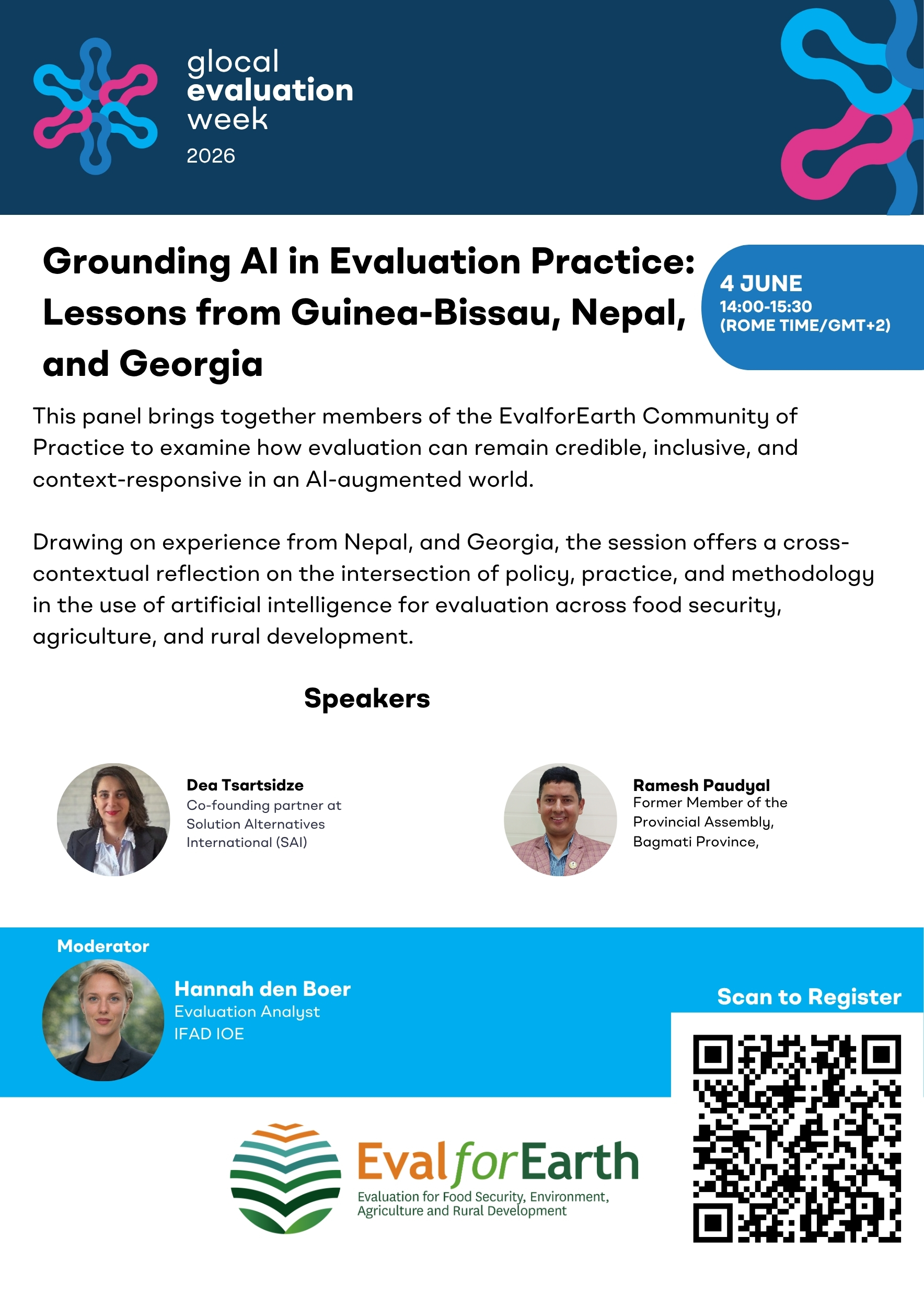
Grounding AI in Evaluation Practice: Lessons from Guinea-Bissau, Nepal, and Georgia
Mesa redonda | En línea
-
Organizado por:
EvalforEarth
Sobre el evento
In line with this year's theme Evaluation, Evidence, and Trust in the Age of AI, this panel brings together members of the EvalforEarth Community of Practice to examine how evaluation can remain credible, inclusive, and context-responsive in an AI-augmented world. Drawing on experience from Nepal, and Georgia, the session offers a cross-contextual reflection on the intersection of policy, practice, and methodology in the use of artificial intelligence for evaluation across food security, agriculture, and rural development.
The panel presents complementary perspectives. Ramesh (Nepal) explores the implications of Nepal's National AI Policy 2025, the country's first for development evaluation systems, governance, and public trust, drawing lessons for countries navigating responsible AI adoption under real infrastructure and data constraints. Dea (Georgia) uses Outcome Harvesting as a concrete methodological test case to examine where AI can responsibly support evaluation practice and where human judgement remains non-delegable, bridging field experience across multiple country contexts with reflections on evaluator training at the University of Tbilisi.
These voices make the case that maintaining trust in AI-supported evaluation depends not on technological innovation alone, but on human-centred approaches, ethical safeguards, and the capacity of evaluators to critically and deliberately navigate AI's role in diverse and rapidly evolving contexts. The session speaks directly to practitioners, policymakers, and emerging evaluators seeking to strengthen both the rigour and the integrity of evaluation in the age of AI.
The panel presents complementary perspectives. Ramesh (Nepal) explores the implications of Nepal's National AI Policy 2025, the country's first for development evaluation systems, governance, and public trust, drawing lessons for countries navigating responsible AI adoption under real infrastructure and data constraints. Dea (Georgia) uses Outcome Harvesting as a concrete methodological test case to examine where AI can responsibly support evaluation practice and where human judgement remains non-delegable, bridging field experience across multiple country contexts with reflections on evaluator training at the University of Tbilisi.
These voices make the case that maintaining trust in AI-supported evaluation depends not on technological innovation alone, but on human-centred approaches, ethical safeguards, and the capacity of evaluators to critically and deliberately navigate AI's role in diverse and rapidly evolving contexts. The session speaks directly to practitioners, policymakers, and emerging evaluators seeking to strengthen both the rigour and the integrity of evaluation in the age of AI.
Presentador/a
| Nombre | Título | Biografía |
|---|---|---|
| Ramesh Paudyal | Former Member of the Provincial Assembly, Bagmati Province, Nepal, and Central Committee Member of the Rastriya Swatantra Party (RSP). | Ramesh Paudyal is one of the founders of the Bibeksheel Nepali movement, which began in 2012 in Nepal to combat corruption and mismanagement through empathetic, transparent, and equitable citizen-led initiatives. His primary focus has been on fostering youth participation in leadership. He advocates for a human-centric, participatory, and inclusive polity and holds a centrist perspective. Mr. Paudyal holds an MA in Sociology and an MA in Political Science from Tribhuvan University, Nepal, as well as a Master of Management of Development (MSc) from Van Hall Larenstein University of Applied Sciences (part of Wageningen University & Research) in the Netherlands. With over 15 years of professional experience in the development sector, Mr. Paudyal specializes in inclusive and sustainable rural development. He currently runs a development consulting firm and is actively engaged in tourism-related entrepreneurship in Nepal. Mr. Paudyal served as a Member of the Provincial Assembly in Bagmati Province, Nepal (representing Bibeksheel Sajha Party). He is currently a Central Committee member of the Rastriya Swatantra Party (RSP). Mr. Paudyal is a member of the UNITE Network (Parliamentarians Network for Global Health), with its secretariat in Lisbon, Portugal. He also serves as a working committee member of the Asia Pacific Parliamentarians Forum on Evaluation, supported by the Asia Pacific Evaluation Association (APEA), with its secretariat in Manila, Philippines. Additionally, he is a member of the International Parliamentary Network for Education (IPNEd), based in London, United Kingdom |
| Dea Tsartsidze | HubEVAL, Department of Public Administration, University of Georgia; Co-founding partner at Solution Alternatives International (SAI) | MEL professional with 15+ years across development, governance, and humanitarian contexts worldwide. Co-founder, HubEVAL – the first university-based Evaluation Hub for Eastern Europe and the South Caucasus, at the University of Georgia. Co-founding Partner, Solution Alternatives International. |
Moderador/a
| Nombre | Título | Biografía |
|---|---|---|
| Hannah den Boer | Evaluation Analyst | Hannah is an Evaluation Analyst at the Independent Office of Evaluation (IOE), IFAD. She has contributed to project-level, country-level and corporate-level evaluations in her office. In her work, she is dedicated to crafting innovative solutions and leveraging emerging technologies to strengthen evaluation processes. She serves as an AI focal point in her office and has contributed to the development of the office-wide AI strategy. |
Resumen
This session examined how artificial intelligence is influencing evaluation practice, with discussions focusing on trust, ethics, transparency, governance, and methodological rigor in AI-supported evaluations across agriculture and rural development contexts. The discussion highlighted the importance of maintaining human oversight, protecting professional judgement, and ensuring that AI supports rather than replaces evaluators.
Participants reflected on the opportunities and risks associated with AI adoption in evaluation systems, including issues related to data quality, bias, unequal access to technology, transparency, and accountability. Discussions also explored practical experiences in integrating AI into evaluation methodologies such as Outcome Harvesting, as well as the implications of emerging national AI governance frameworks for evaluation systems and public trust.
The session emphasized that credible evaluation in AI-supported environments depends on ethical safeguards, context-responsive approaches, stakeholder engagement, and the ability of evaluators to critically interpret and validate AI-generated outputs. It also highlighted the need for continuous learning, institutional guidance, and stronger evaluator capacities to responsibly integrate AI into evaluation practice.
Continue knowledge sharing and peer learning on responsible AI use in evaluation through the EvalforEarth Community of Practice and related professional networks.
Strengthen evaluator capacities on the practical, ethical, and methodological use of AI tools in evaluation.
Promote transparency by documenting the use of AI tools, methods, and limitations in evaluation processes and reports.
Ensure human oversight, validation, and interpretation of AI-generated evidence throughout the evaluation cycle.
Encourage context-sensitive and inclusive approaches to AI adoption, particularly in settings with infrastructure, skills, and data constraints.
Develop and share practical guidance on data protection, bias mitigation, transparency, and ethical safeguards in AI-supported evaluations.
Continue discussions on the implications of AI governance frameworks and public trust for evaluation systems and evidence use.
Encourage collaboration between evaluators, policymakers, academic institutions, and practitioners to support responsible and context-appropriate AI integration in evaluation practice.
galería de imágenes