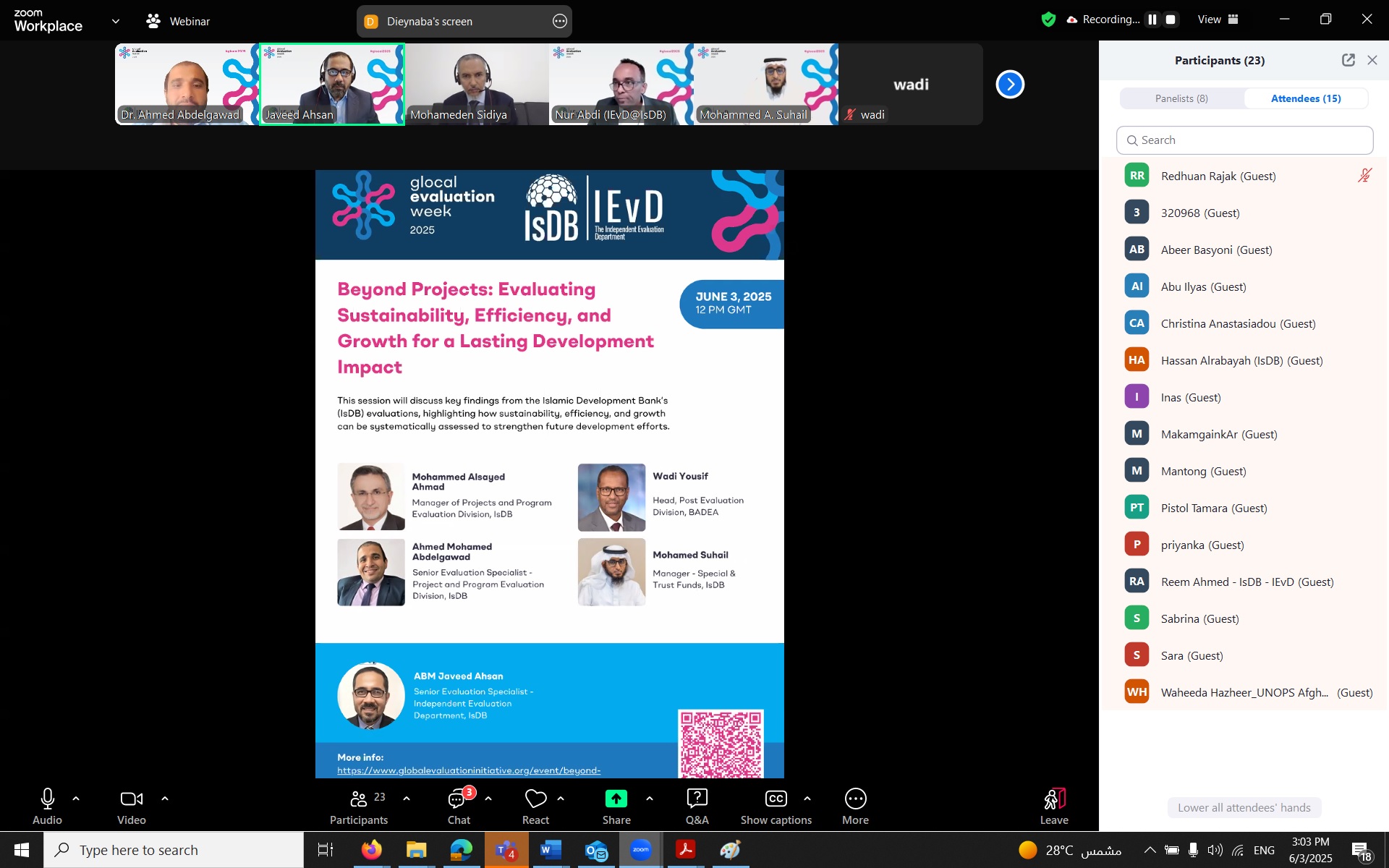
Beyond Projects: Evaluating Sustainability, Efficiency, and Growth for a Lasting Development Impact
Seminario | En línea
-
Organizado por:
Islamic Development Bank - Independent Evaluation Department
Sobre el evento
Project sustainability is paramount for development financing. Like other multilateral development banks, the Islamic Development Bank (IsDB), seeks to ensure long-term sustainability, efficiency, and inclusive growth of projects it supports. Independent Evaluation contributes to these goals by offering insights to enhance future interventions. While many development projects show short-to medium term success, how can we ensure their lasting impact, financial viability, and operational resilience? This session will discuss key findings from the Islamic Development Bank’s (IsDB) evaluations, highlighting how sustainability, efficiency, and growth can be systematically assessed to strengthen future development efforts.
Drawing from real-world evaluations of diverse health sector interventions – spanning hospital infrastructure, specialized medical centeres, mobile healthcare delivery and emergency responses initiatives -—this session will critically examine:
✅ Financial and institutional sustainability: How can projects transition from donor reliance to self-sufficiency? Some health interventions have successfully expanded access to vulnerable populations but continue to face long-term financing challenges. Others have demonstrated viable models of financial sustainability by attracting reginal demand and generating revenues, highlighting the importance of strategic positioning and institutional capacity.
✅ Operational efficiency and project delays: Why do so many large-scale projects experience significant cost overruns and delays? Cases show that ambitious infrastructure projects often exceed timelines due to procurement challenges, construction delays, and complex stakeholder coordination. These inefficiencies point to systemic planning and execution gaps that evaluations must uncover to improve future project planning and execution.
✅ Growth and scalability: What enables projects to expand their impact beyond their initial scope? Mobile healthcare initiatives serving underserved and fragile communities have shown potential but also face sustainability barriers such as limited government ownership and gaps in service continuity These experiences underline the need for early integration with national systems and financial planning to scale successful models.
✅ The role of evaluation in driving adaptive learning: Evaluations are not just tools for accountability—they are mechanisms for real-time learning and course correction. Evidence from results-based financing models demonstrated how adaptive evaluation approaches can ensure efficient resource use and align interventions with broader policy objectives, contributing to greater health-care system resilience.
This session will offer practical insights for evaluators, policymakers, and development practitioners, illustrating how rigorous evaluation frameworks can move beyond traditional performance assessments to actively shape smarter, more sustainable, and growth-oriented development outcomes. Participants will engage in discussions on best practices, emerging challenges, and innovative evaluation methodologies that contribute to sustainable development in low- and middle-income countries.
This session will showcase insights from the Islamic Development Bank’s (IsDB) and other development partners evaluations of key projects across health, education, and humanitarian sectors, revealing critical lessons on balancing financial sustainability, stakeholder engagement, and institutional resilience.
Through real-world cases—including emergency health services for refugees in Jordan, a national cardiology center in Mauritania, and mobile medical units in fragile settings—the discussion will highlight:
✅ How evaluations have informed adaptive strategies to enhance sustainability.
✅ Lessons on optimizing efficiency amid cost overruns and operational delays.
✅ The role of evaluation in guiding growth-oriented investments for long-term impact.
This session will provide evaluators, policymakers, and development practitioners with practical takeaways on how evaluation frameworks can move beyond accountability to drive smarter, more resilient development outcomes.
Drawing from real-world evaluations of diverse health sector interventions – spanning hospital infrastructure, specialized medical centeres, mobile healthcare delivery and emergency responses initiatives -—this session will critically examine:
✅ Financial and institutional sustainability: How can projects transition from donor reliance to self-sufficiency? Some health interventions have successfully expanded access to vulnerable populations but continue to face long-term financing challenges. Others have demonstrated viable models of financial sustainability by attracting reginal demand and generating revenues, highlighting the importance of strategic positioning and institutional capacity.
✅ Operational efficiency and project delays: Why do so many large-scale projects experience significant cost overruns and delays? Cases show that ambitious infrastructure projects often exceed timelines due to procurement challenges, construction delays, and complex stakeholder coordination. These inefficiencies point to systemic planning and execution gaps that evaluations must uncover to improve future project planning and execution.
✅ Growth and scalability: What enables projects to expand their impact beyond their initial scope? Mobile healthcare initiatives serving underserved and fragile communities have shown potential but also face sustainability barriers such as limited government ownership and gaps in service continuity These experiences underline the need for early integration with national systems and financial planning to scale successful models.
✅ The role of evaluation in driving adaptive learning: Evaluations are not just tools for accountability—they are mechanisms for real-time learning and course correction. Evidence from results-based financing models demonstrated how adaptive evaluation approaches can ensure efficient resource use and align interventions with broader policy objectives, contributing to greater health-care system resilience.
This session will offer practical insights for evaluators, policymakers, and development practitioners, illustrating how rigorous evaluation frameworks can move beyond traditional performance assessments to actively shape smarter, more sustainable, and growth-oriented development outcomes. Participants will engage in discussions on best practices, emerging challenges, and innovative evaluation methodologies that contribute to sustainable development in low- and middle-income countries.
This session will showcase insights from the Islamic Development Bank’s (IsDB) and other development partners evaluations of key projects across health, education, and humanitarian sectors, revealing critical lessons on balancing financial sustainability, stakeholder engagement, and institutional resilience.
Through real-world cases—including emergency health services for refugees in Jordan, a national cardiology center in Mauritania, and mobile medical units in fragile settings—the discussion will highlight:
✅ How evaluations have informed adaptive strategies to enhance sustainability.
✅ Lessons on optimizing efficiency amid cost overruns and operational delays.
✅ The role of evaluation in guiding growth-oriented investments for long-term impact.
This session will provide evaluators, policymakers, and development practitioners with practical takeaways on how evaluation frameworks can move beyond accountability to drive smarter, more resilient development outcomes.
Presentador/a
| Nombre | Título | Biografía |
|---|---|---|
| Ahmed Mohamed Tammam Abdelgawad | Senior Evaluation Specialist - Project and Program Evaluation Division, IsDB | |
| Mohammed Alsayed Ahmad | Manager of Projects and Program Evaluation Division, IsDB | |
| Wadi Yousif (TBC) | Manager - Independent Evaluation Division, BADEA | |
| Mohamed Suhail (TBC) | Manager - Special & Trust Funds, IsDB |
Moderador/a
| Nombre | Título | Biografía |
|---|---|---|
| ABM Javeed Ahsan | Senior Evaluation Specialist - Independent Evaluation Department, IsDB |
Resumen
The webinar successfully highlighted the importance of integrating sustainability and efficiency in development projects to ensure long-term impact. Key insights included addressing financing challenges in health projects, enhancing institutional capacity, tackling inefficiencies in project implementation, and comparing public versus private financing models. The rich discussion reinforced that evaluation is not just a tool for accountability but a critical driver for adaptive learning and improved development outcomes.
To build on this session, participants are encouraged to review forthcoming evaluation reports and engage in upcoming knowledge-sharing events. A recording of the webinar and key resources will be shared via email. We invite attendees to join the ongoing dialogue through the IsDB evaluation network and contribute to future sessions by suggesting topics or presenting case studies. For more information, please contact the Independent Evaluation Department.
galería de imágenes