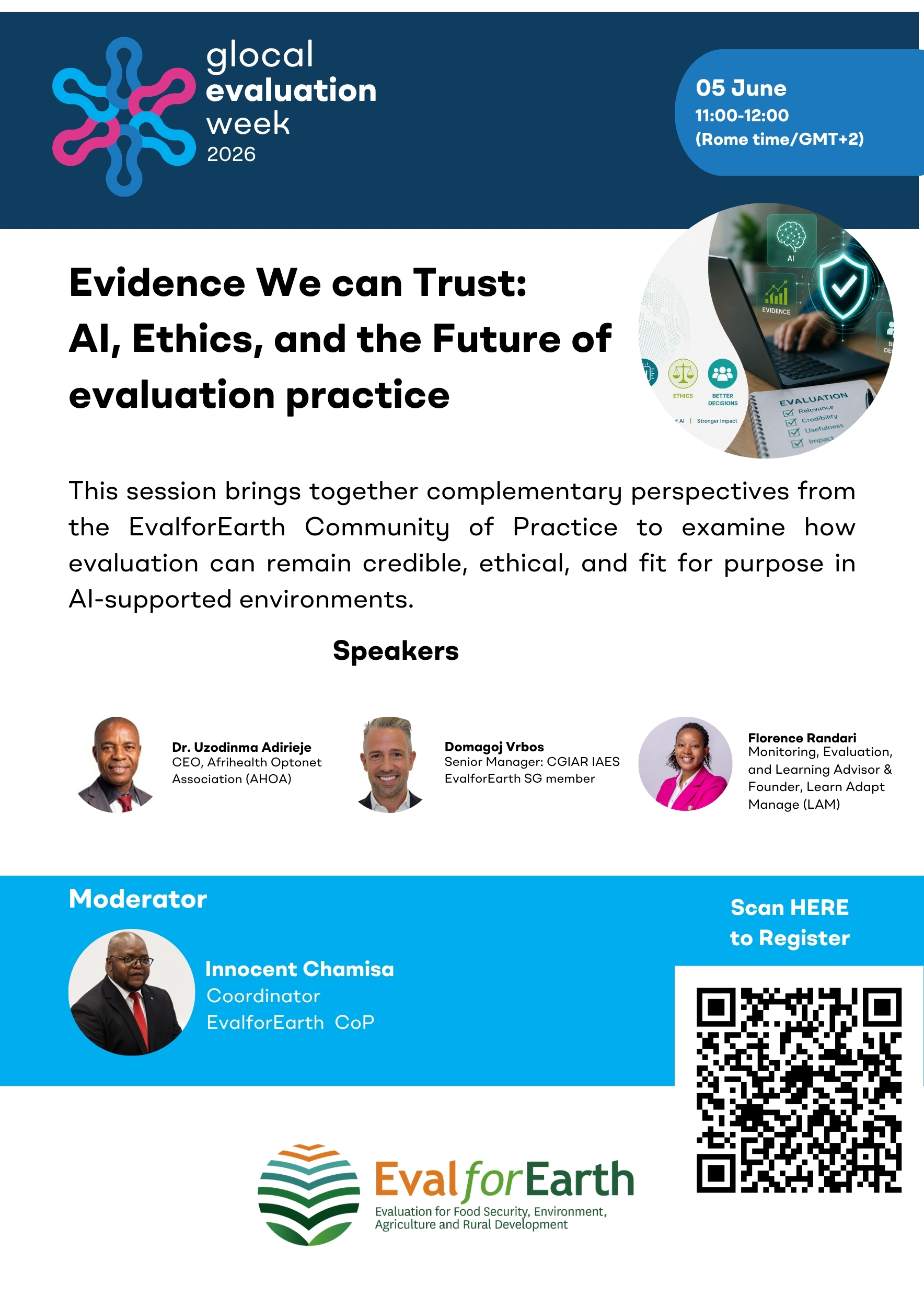
Evidence We can Trust: AI, Ethics, and the Future of evaluation practice
Panel Discussion | Online
-
Organized by:
EvalforEarth
About the Event
As artificial intelligence continues to reshape how evidence is generated, analysed, and used, the question of trust in evaluation is becoming increasingly central and more urgent in contexts where the consequences of weak or unreliable evidence are most significant. This session brings together complementary perspectives from the EvalforEarth Community of Practice to examine how evaluation can remain credible, ethical, and fit for purpose in AI-supported environments.
The discussion highlights two interrelated dimensions. The first focuses on the design of trustworthy evaluation systems, emphasizing that credibility cannot be retrofitted but must be embedded from the outset. This includes clearly defining decision needs, calibrating appropriate levels of rigor in increasingly data-rich contexts, and preserving the collective and interpretive dimensions of evidence use that remain essential to meaningful evaluation practice. The second dimension examines the expanding role of AI across the evaluation cycle, identifying ethical and methodological risks related to transparency, bias, data protection, and the potential erosion of professional judgement particularly in contexts where unequal access to technology and external control of digital systems may pose additional challenges.
The discussion highlights two interrelated dimensions. The first focuses on the design of trustworthy evaluation systems, emphasizing that credibility cannot be retrofitted but must be embedded from the outset. This includes clearly defining decision needs, calibrating appropriate levels of rigor in increasingly data-rich contexts, and preserving the collective and interpretive dimensions of evidence use that remain essential to meaningful evaluation practice. The second dimension examines the expanding role of AI across the evaluation cycle, identifying ethical and methodological risks related to transparency, bias, data protection, and the potential erosion of professional judgement particularly in contexts where unequal access to technology and external control of digital systems may pose additional challenges.
Speakers
| Name | Title | Biography |
|---|---|---|
| Dr. Uzodinma Adirieje | Programmes Director/CEO, Afrihealth Optonet Association (AHOA) | Dr. Uzodinma Adirieje is a development expert, climate-health economist, evaluator, and CEO, Afrihealth Optonet Association. With over two decades in evaluation, policy, and research, he works on ethics, credibility, and responsible use of AI-supported evidence in development and public policy.. |
| Florence Randari | Monitoring, Evaluation, and Learning Advisor & Founder, Learn Adapt Manage (LAM) | Florence Randari is a Monitoring, Evaluation, and Learning Advisor and founder of Learn Adapt Manage (LAM). She supports development programs to strengthen evidence use, program learning, and adaptive management, focusing on turning data into better decisions |
Moderators
| Name | Title | Biography |
|---|---|---|
| Innocent Chamisa | EvalforEarth CoP Coordinator | International development specialist with over 10 years of experience across food systems, land governance, digital innovation, and evaluation. FAO award recipient for policy coordination and sustainable agriculture. Currently serving as Global Coordinator of EvalforEarth, supporting evaluation for food security, environment, agriculture, and rural development. |
Summary
Discussions emphasized that AI should support rather than replace evaluators, and that human oversight remains essential throughout the evaluation cycle.
Key reflections highlighted the importance of designing evaluations around clear decision-making needs rather than excessive data collection, ensuring transparency in the use of AI tools, validating AI-generated evidence, and maintaining human interpretation and collective dialogue in evidence use. Participants also discussed risks related to bias, data protection, and the use of AI in contexts involving vulnerable groups.
The session underscored that trust remains central to evaluation practice and that technology alone cannot guarantee credible evidence. Participants were encouraged to strengthen due diligence in reviewing AI outputs, document the use of AI in evaluation reports, engage stakeholders throughout the process, and continue exchanges on responsible AI use in evaluation through the EvalforEarth Community of Practice platform.
### Proposed Next Steps
1. Continue peer learning and exchanges on responsible AI use in evaluation through the EvalforEarth Community of Practice platform.
2. Encourage evaluators and evidence producers to document and disclose the use of AI tools and methods in evaluation processes and reports.
3. Strengthen human oversight, validation, and quality assurance of AI-generated evidence throughout the evaluation cycle.
4. Promote practical guidance and knowledge sharing on ethical safeguards, data protection, transparency, and bias mitigation in AI-supported evaluations.
5. Support capacity development for evaluators on the responsible and context-appropriate use of AI tools.
6. Encourage greater stakeholder engagement and collective interpretation of evidence to maintain trust and credibility in evaluation processes.
7. Explore opportunities for follow-up discussions, blogs, webinars, or online forums focused on AI, ethics, and evaluation practice in agriculture and rural development contexts.
Image Gallery