


Rethinking Qualitative Evidence in the Age of AI: Decentralizing Decision-Making in MEL
Webinar | Online
-
Organized by:
Dots
About the Event
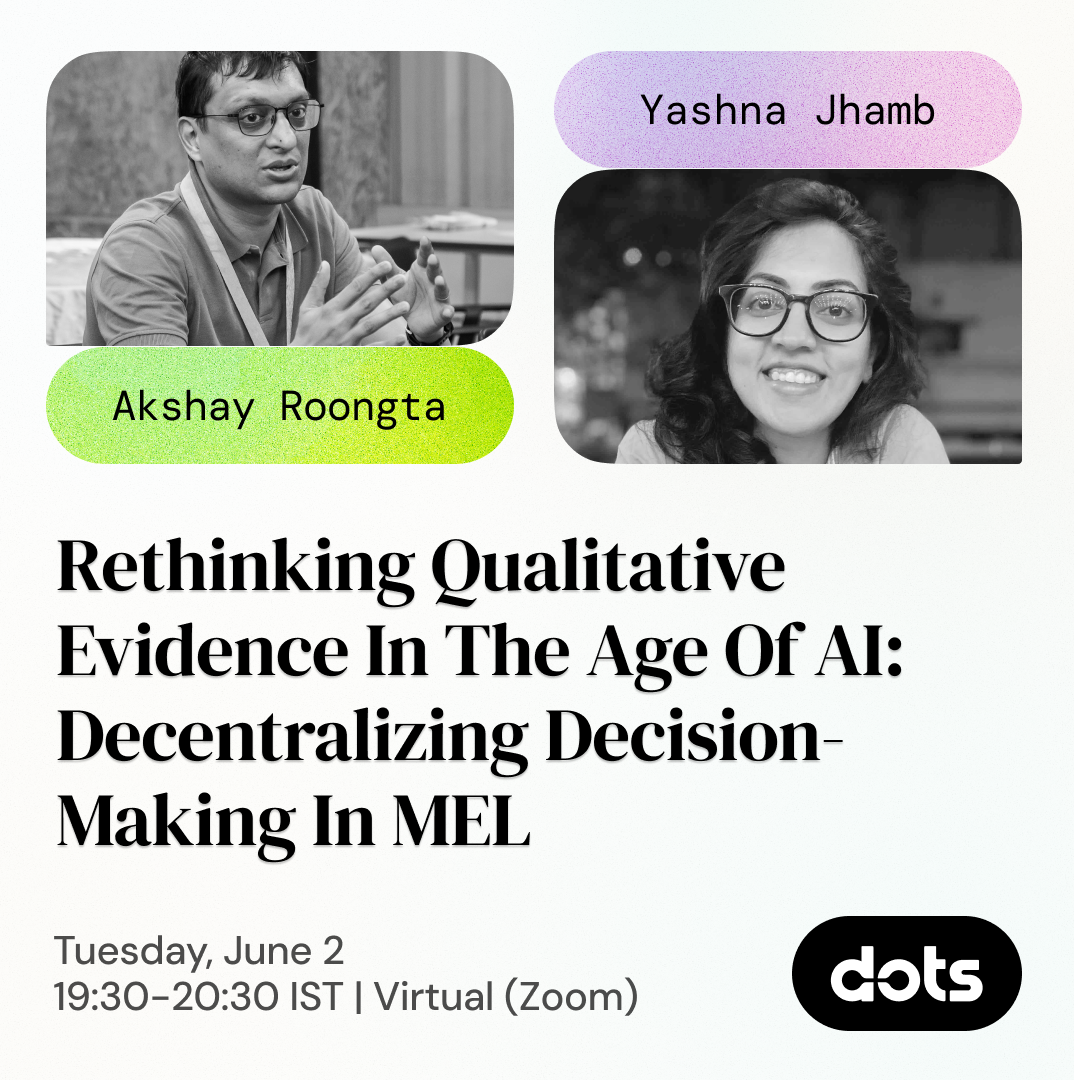
Organizations collect vast amounts of qualitative data from the field; yet much of it is used only for storytelling rather than decision making, often remaining limited to program officers and managers. As teams experiment with AI tools to analyze transcripts and field notes, unstructured data often produces weak or unreliable insights. Using a MEL case study, this session demonstrates how structuring qualitative evidence enables responsible AI-supported analysis while preserving context and rigor. It also explores when AI strengthens evaluation, when human judgement should take precedence, and how to make evidence visible across teams for decentralized learning and decision-making.
Speakers
| Name | Title | Biography |
|---|---|---|
| Akshay Roongta | Co-Founder, Dots | Co-founder of Dots, with 10+ years of experience across WASH, health & education; expert at blending systems thinking with participatory research to help teams make sense of lived experiences for lasting change. |
| Yashna Jhamb | Co-Founder, Dots | Co-founder of Dots, a SaaS platform helping organizations collect, organize, and analyze qualitative data at scale. Acumen fellow with a background in ethnographic research and systems thinking; advocate for ethical tech that amplifies overlooked voices and drives equity-centered change |
Summary
Organizations collect vast amounts of qualitative data from the field i.e. interviews, observations, reflections, FGDs. Yet, most MEL systems are designed to only sustain periodic upward reporting (to donors/stakeholders and leadership), or for storytelling as a communications add-on, rather than to support the daily decisions of field and program staff. As AI tools enter our workflows, this gap matters more than ever. Unstructured qualitative data fed into AI often produces weak synthesis or outputs that lose the very context that makes the evidence meaningful.
The solution is to decentralize decision-making by surfacing insights at every level of the organization, shaped to each role's specific needs, not just aggregated for the top.
Four principles to build distributed learning systems in MEL:
1. Start with intent: Data collection should follow decision needs. Define what decisions need to be made, and what you need to understand in order to make them.
2. Collect continuously and across methods: Mixed methods data such as surveys, feedback, field stories, interviews, and FGDs together build a richer, more reliable picture than any single source.
3. Structure for reuse: Metadata, tags, and shared codebooks make qualitative data searchable and comparable across teams, locations, and time.
4. Use AI as a tool, not a substitute: AI can speed up coding, generate first-pass summaries, and surface patterns, but human judgment remains critical to interpretation and meaning-making.