


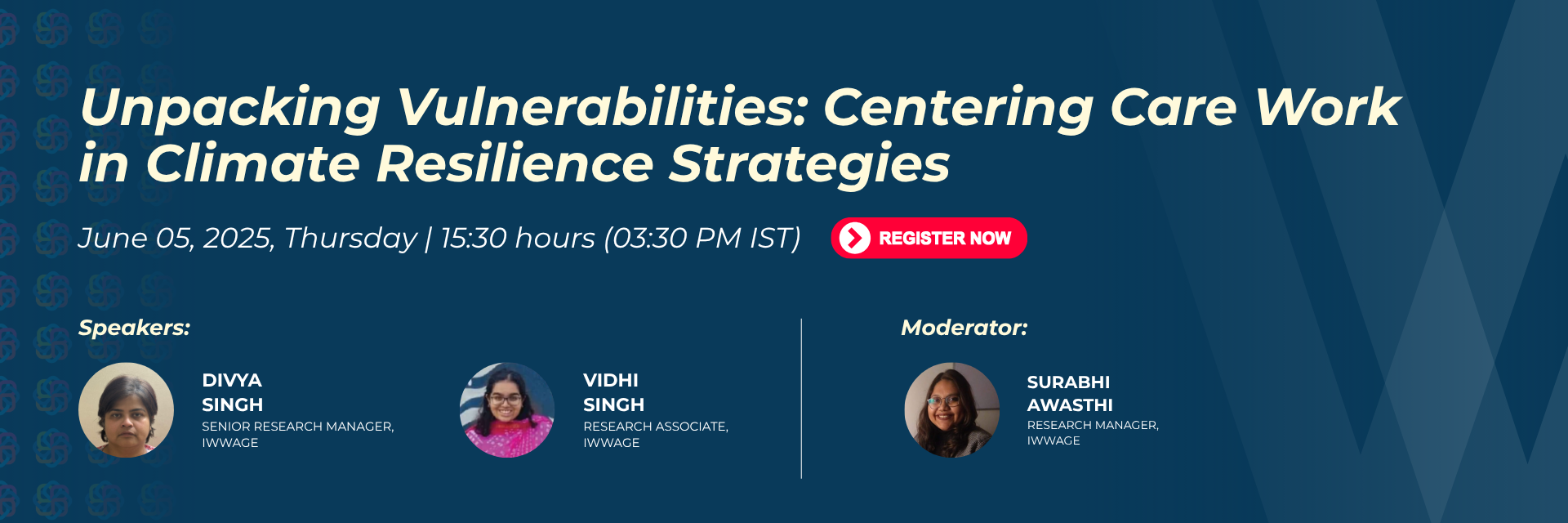
Unpacking Vulnerabilities: Centering Care Work in Climate Resilience Strategies
Webinar | Online
-
Organized by:
Institute For What Works to Advance Gender Equality
About the Event
Vulnerability is understood as exposure to uncertainty and risk, where external shocks—such as climate change, economic instability, and social crises—lead to persistent deprivation and exclusion. While conventional assessments focus on individual and group-level deprivation (e.g., those based on income, gender, caste, class, and other social inequities), contemporary approaches emphasise intersectional frameworks of vulnerability assessments. These frameworks highlight the significance of examining various interrelated and frequently overlapping factors that contribute to marginalisation. They emphasise that understanding the complexities of marginalisation requires a holistic approach, taking into account not only socio-economic status but also aspects such as race, gender, sexual orientation, and disability. By recognising how these variables interact and influence one another, we can gain a deeper insight into the multifaceted nature of marginalisation and work towards more effective solutions that address the root causes of vulnerability.
In India, climate change is a significant driver of vulnerability, with over 80% of the population residing in districts highly susceptible to extreme hydro-meteorological disasters. For instance, climate-induced displacement has already affected over three million people (2020–2021), with projections estimating 45 million migrants by 2050. Women are disproportionately impacted by these disruptions, which threaten their lives and livelihoods. Environmental degradation, resulting from climate change, further intensifies women’s care burdens as resources such as water, fuel, and food increasingly become scarce impelling them to spend more time on caregiving.
Despite these challenges, the impact of climate change on women is consistently overlooked in climate policy discussions. Climate adaptation policies and interventions continue to be predominantly gender-blind, neglecting to consider how climate shocks affect women, particularly in exacerbating their unpaid care responsibilities workload. Without intentional interventions and the integration of care analysis into the planning, implementation, and evaluation of climate action, there is a risk of reinforcing—rather than reducing—these disparities. Addressing climate-induced vulnerability necessitates gender-responsive strategies in adaptation, mainly through investments in care infrastructure. The need to integrate intersectional risks into vulnerability assessments by leveraging the 5Rs framework (recognise, reduce, redistribute, reward, represent) is highly crucial. This requires acknowledging unpaid care work in national statistics, reducing burdens through investments in climate-resilient care infrastructure, and redistributing responsibilities across genders.
The upcoming discussion will center around field evidence gathered from IWWAGE's initiatives on care, highlighting the critical role of care as a public good in facilitating a just transition toward a low-emission economy. The panel will underscore the necessity of implementing gender-responsive policies that effectively address the disproportionate unpaid care burdens faced by women, while simultaneously enhancing climate resilience in communities. It is essential to adopt multi-dimensional evaluation frameworks that assess the social, economic, and environmental impacts of infrastructure investments. By prioritising care in policy discussions, we can foster a more inclusive and sustainable future that recognises and supports the vital contributions of caregivers in the fight against climate change.
In India, climate change is a significant driver of vulnerability, with over 80% of the population residing in districts highly susceptible to extreme hydro-meteorological disasters. For instance, climate-induced displacement has already affected over three million people (2020–2021), with projections estimating 45 million migrants by 2050. Women are disproportionately impacted by these disruptions, which threaten their lives and livelihoods. Environmental degradation, resulting from climate change, further intensifies women’s care burdens as resources such as water, fuel, and food increasingly become scarce impelling them to spend more time on caregiving.
Despite these challenges, the impact of climate change on women is consistently overlooked in climate policy discussions. Climate adaptation policies and interventions continue to be predominantly gender-blind, neglecting to consider how climate shocks affect women, particularly in exacerbating their unpaid care responsibilities workload. Without intentional interventions and the integration of care analysis into the planning, implementation, and evaluation of climate action, there is a risk of reinforcing—rather than reducing—these disparities. Addressing climate-induced vulnerability necessitates gender-responsive strategies in adaptation, mainly through investments in care infrastructure. The need to integrate intersectional risks into vulnerability assessments by leveraging the 5Rs framework (recognise, reduce, redistribute, reward, represent) is highly crucial. This requires acknowledging unpaid care work in national statistics, reducing burdens through investments in climate-resilient care infrastructure, and redistributing responsibilities across genders.
The upcoming discussion will center around field evidence gathered from IWWAGE's initiatives on care, highlighting the critical role of care as a public good in facilitating a just transition toward a low-emission economy. The panel will underscore the necessity of implementing gender-responsive policies that effectively address the disproportionate unpaid care burdens faced by women, while simultaneously enhancing climate resilience in communities. It is essential to adopt multi-dimensional evaluation frameworks that assess the social, economic, and environmental impacts of infrastructure investments. By prioritising care in policy discussions, we can foster a more inclusive and sustainable future that recognises and supports the vital contributions of caregivers in the fight against climate change.
Speakers
| Name | Title | Biography |
|---|---|---|
| Divya Singh | Senior Research Manager | Divya Singh has worked extensively on issues of gender equity and environmental sustainability. She has around ten years of experience in the field, working for national and international development organizations. Her focus areas have been gender budgeting, child budgeting and climate finance. She has an MA and MPhil in Political Science from Jawaharlal Nehru University and an MSc in Environmental Assessment and Management from the University of East Anglia. |
| Vidhi Singh | Research Associate | Vidhi holds a Master’s degree in Public Policy and Governance from Azim Premji University, Bengaluru. She has previously interned with SEWA Bharat and PRS Legislative Research. Before joining IWWAGE as a Research Associate, she was working in the capacity of a Research Analyst in a private consulting firm based out of Lucknow. In this role, she was involved in monitoring and evaluation research studies at the intersection of gender and health. From her schooling years, she has been active in advocating for gender rights and wants to continue working in the domain. Her areas of interest primarily include intersections of gender and data. |
Moderators
| Name | Title | Biography |
|---|---|---|
| Surabhi Awasthi | Research Manager | Surabhi Awasthi is a Research Manager at IWWAGE, and is currently working with the Strengthening Women’s Institutions for Agency and Empowerment (SWAYAM) for the National Rural Livelihood Mission. She has previously worked with the National Human Rights Commission as a consultant providing research support in the policy and research division on the issues related to women and children. Before joining IWWAGE, she led the research team for the Geography of Philosophy Project based at IIT, Delhi, and headquartered at the University of Pittsburgh (USA). She is a trained qualitative researcher with experience in narrative inquiry and ethnography; her research interests include gender, labor, and changing family institutions. Surabhi holds an M.Phil. in Social Work from the University of Delhi, where she was awarded a Junior Research Fellowship from the University Grants Commission, India. Through her work, she aims to bridge the gap between academia and practical policy goals, particularly related to furthering women’s equality in India through education and welfare policy. |